


Abdul Mannan: BDUC – 4 Letters That Make Many Haematologists Uncomfortable
Abdul Mannan, Consultant Haematologist at Betsi Cadwaladr University Health Board, shared on LinkedIn:
”BDUC. Four letters that make many haematologists uncomfortable.
Bleeding Disorder of Unknown Cause. The patient bleeds. Your tests are normal.
Now what?
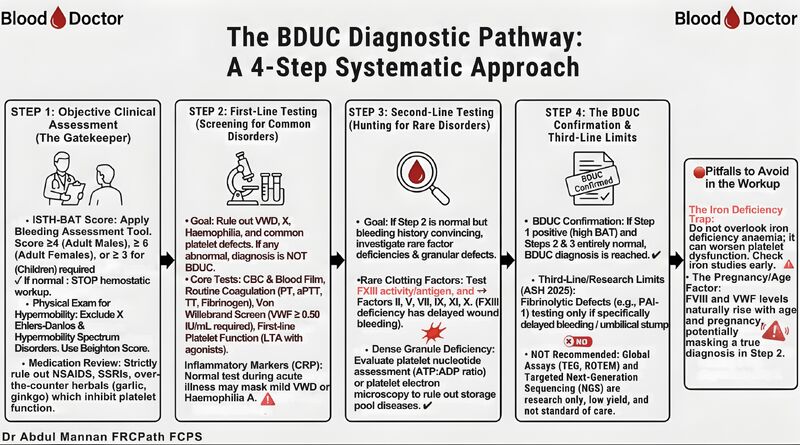
I’ve developed a 4-step systematic approach to navigate this clinical challenge:
Step 1: The Gatekeeper
Apply ISTH-BAT Score (≥4 men, ≥6 women, ≥3 children)
If normal, stop. No hemostatic workup needed.
Check for hypermobility syndromes and medication culprits (NSAIDs, SSRIs, garlic, ginkgo)
Step 2: Rule Out Common Disorders
CBC, blood film, routine coagulation, VWF screen (≥0.50 IU/mL required)
First-line platelet function (LTA with agonists)
Remember: Inflammation masks mild VWD and Haemophilia A
Step 3: Hunt for Rare Disorders
If Step 2 is normal but bleeding history is convincing, test FXIII (delayed wound healing!) and Factors II, V, VII, IX, XI, X
Consider dense granule deficiency with ATP:ADP ratio or electron microscopy
Step 4: Confirm BDUC
High BAT score + completely normal Steps 2 and 3 equals BDUC confirmed
Test fibrinolytic defects only if delayed bleeding or umbilical stump issues (ASH 2025)
TEG, ROTEM, NGS? Not standard of care. Low yield.
Two pitfalls I see repeatedly: Overlooking iron deficiency (worsens platelet function)
Testing FVIII/VWF during pregnancy or inflammation (falsely normal)
The visual flowchart is in the comments below.
What’s your approach when bleeding history is strong but labs are normal?”
Stay updated with Hemostasis Today.
-
Sep 30, 2026, 14:13Ashok Choudhury: Portal Vein Thrombosis and Outcomes in Cirrhosis
-
Sep 30, 2026, 13:57Leslye Conde Bazán: When Conventional Imaging Is Not Enough – The Role of IVUS
-
Sep 30, 2026, 13:41Huda Salah Eldin: The Challenge of Balancing Antithrombotic Therapy After PCI
-
Sep 30, 2026, 13:29Abdus Salam: What Can CT Venography Reveal About the Veins?
-
Sep 30, 2026, 13:03Amira Mohy: Diagnostic Flow Cytometry Panels for Hematological Malignancies
-
Sep 30, 2026, 12:52Paul Watton: Could Repetitive Head Impacts Leave a Molecular Memory?
-
Sep 30, 2026, 12:41The Journey to ISTH 2027 Starts in Vancouver
-
Sep 30, 2026, 11:36Basit Ali: A Closer Look at CT Venography
-
Sep 30, 2026, 11:16Christina Pohlman: Could aPL Levels Help Predict Stroke Recurrence?