


Alejandro González Veliz: No ST Elevation Does Not Guarantee an Open Coronary Artery
Alejandro González Veliz, Interventional Cardiologist at Institute of Cardiology and Cardiovascular Surgery, shared a post on LinkedIn about a recent article by Riyad Yazan Kherallah et al, publish in JACC Journals, adding:
“No ST elevation does not guarantee an open coronary artery.
Acute coronary occlusion can occur in patients presenting with NSTEMI, and the absence of diagnostic ST-segment elevation does not necessarily mean the absence of an acutely occluded culprit vessel.
In this large CathPCI Registry analysis of 1,198,544 patients undergoing PCI between 2018 and 2023, acute coronary occlusion was identified in 14.9 percent of NSTEMI patients using a 100 percent acute stenosis definition.
When the definition also included culprit lesions with TIMI flow 0–1, the proportion increased to 24.4 percent.
Among NSTEMI patients with acute coronary occlusion, the culprit vessels were:
- Left circumflex (LCx): 32.7 percent
- Right coronary artery (RCA): 30.1 percent
- Left anterior descending (LAD): 27.4 percent
The clinical significance is substantial. Compared with NSTEMI patients without acute coronary occlusion, those with occlusion had higher adjusted odds of:
- In hospital major adverse cardiovascular events: 2.26
- In hospital cardiovascular death: 2.81
What should we take into clinical practice?
The ECG remains essential, but it must be interpreted alongside the clinical presentation.
Persistent or refractory ischemic symptoms, subtle ECG abnormalities, hyperacute T waves, and patterns suggesting posterior myocardial infarction should prompt careful reassessment. Additional ECG leads may be appropriate when clinically indicated.
Importantly, this observational study demonstrates an association between acute coronary occlusion and worse in hospital outcomes; it does not establish that immediate reperfusion improves outcomes in every NSTEMI patient with an occluded artery. The optimal management strategy requires further investigation.
The key message: Do not let the absence of ST elevation end the diagnostic search.
The ECG phenotype does not always reflect the underlying coronary anatomy.”
Title: Acute Coronary Occlusions in NSTEMI Undergoing Percutaneous Coronary Intervention: Insights From the CathPCI Registry
Authors: Riyad Yazan Kherallah, Syed Zaid, Yazan Assaf, Angel Chen Marks, Glenn Levine, Neal S. Kleiman, Mirza Umair Khalid, Lorraine Mascarenhas, Jing Liu, Waleed Kayani, Yochai Birnbaum, Daniel Wojdyla, Rajesh V. Swaminathan, and Ali A. Denktas 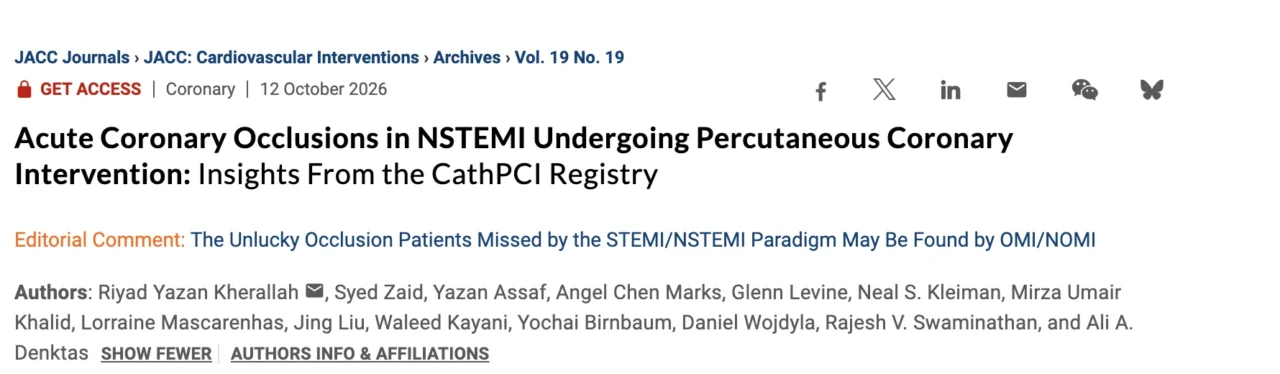
Stay updated on all scientific advances with Hemostasis Today.
-
Oct 19, 2026, 06:02Thomas Dayspring: Vascular Resilience – What Is It and How Can We Measure It?
-
Oct 19, 2026, 05:53Kevon Dindial: Collaboration for Better Childhood Cancer Outcomes
-
Oct 19, 2026, 05:44Mavis Agnes Kisakye: Raising Awareness about Haemophilia and Other Blood Disorders at Luweero General Hospital
-
Oct 19, 2026, 05:43Mohsen Asadi: Women and Blood Clots – Understanding Risk Across Every Life Stage
-
Oct 19, 2026, 05:39Shivir Moosai: Warm AIHA in a Young Woman
-
Oct 19, 2026, 03:54Jennifer Trowbridge: How Mutant Blood Stem Cells Use Inflammation to Drive Their Own Expansion
-
Oct 19, 2026, 03:39Wyenona Hicks: Catching Up With Old Friends and New Colleagues at AABB 2026
-
Oct 19, 2026, 03:33Developing a Non-Invasive Treatment for Life-Threatening PE – University of Michigan College of Engineering
-
Oct 19, 2026, 03:28Jim Hoffman: How NETs Contribute to Gallstone Formation and Growth