

Transplant-Associated Thrombotic Microangiopathy: New Consensus Criteria for Diagnosis and Risk Assessment After Transplant
After a stem cell or bone marrow transplant, some patients develop a rare but serious complication called transplantation-associated thrombotic microangiopathy, or TA-TMA. In this condition, tiny blood vessels become damaged and obstructed by microscopic clots, which can lead to kidney injury, high blood pressure, and, in severe cases, multi-organ failure.
A recent consensus report published in Transplantation and Cellular Therapy brings together international experts to answer an important question: how can clinicians diagnose TA-TMA more consistently and identify patients at highest risk earlier?
Why TA-TMA Matters
TA-TMA can occur after hematopoietic cell transplantation (HCT), a procedure used to treat certain blood cancers, immune disorders, and inherited conditions. Although it is not common, it can be life-threatening, particularly when it affects the kidneys or other vital organs.
For many years, different transplant centers used different definitions and diagnostic criteria for TA-TMA. This made it difficult to compare patients, interpret research results, and decide which patients needed the most urgent attention.
The new report was developed by experts from the European Society for Blood and Marrow Transplantation (EBMT), the Pediatric Transplantation and Cellular Therapy Consortium, and the Center for International Blood and Marrow Transplant Research.
A Common Language for Diagnosis
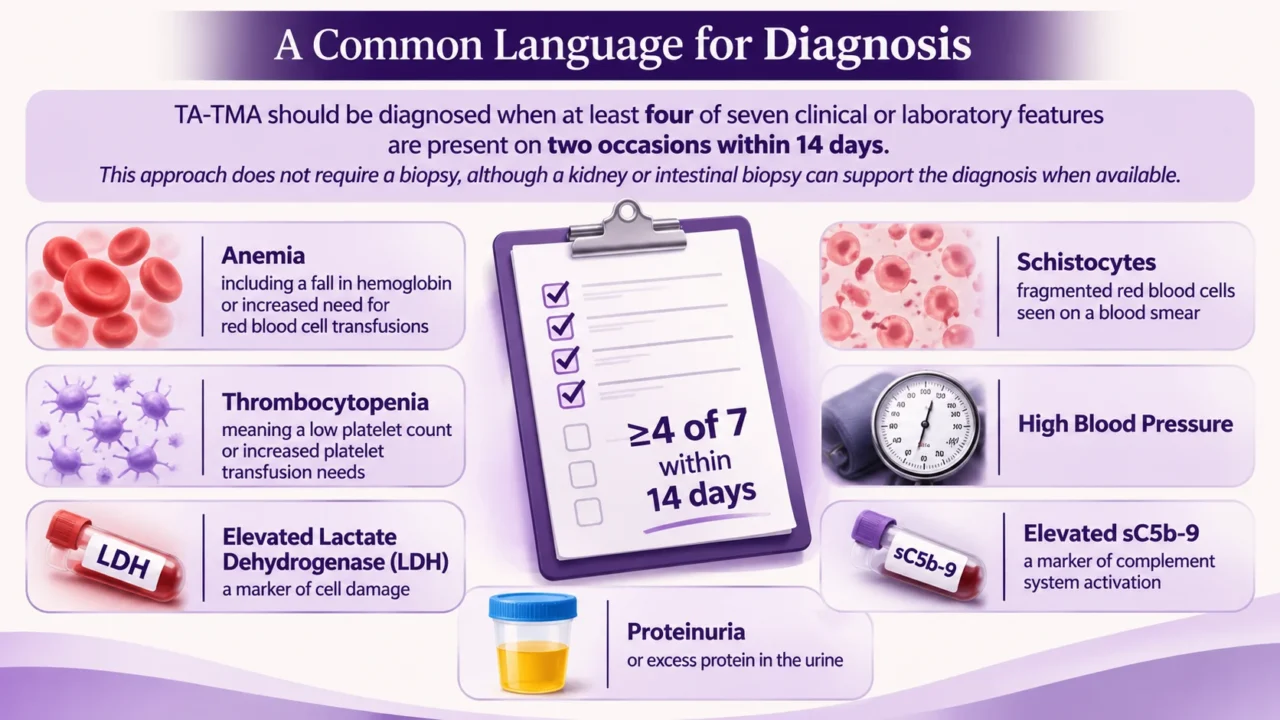
The authors propose that TA-TMA should be diagnosed when at least four of seven clinical or laboratory features are present on two occasions within 14 days. This approach does not require a biopsy, although a kidney or intestinal biopsy can support the diagnosis when available.
The seven features are:
- Anemia, including a fall in hemoglobin or increased need for red blood cell transfusions
- Thrombocytopenia, meaning a low platelet count or increased platelet transfusion needs
- Elevated lactate dehydrogenase (LDH), a marker of cell damage
- Schistocytes, fragmented red blood cells seen on a blood smear
- High blood pressure
- Elevated sC5b-9, a marker of complement system activation
- Proteinuria, or excess protein in the urine
Using several markers together is important because TA-TMA does not always show up through one single test. Instead, it is a syndrome that affects blood cells, blood vessels, the kidneys, and sometimes other organs.
What Is Different From Older Criteria?
The report builds on the widely used Jodele criteria but modifies some definitions to make them more practical and broadly applicable. In particular, the authors refine the definitions of anemia and thrombocytopenia, recognizing that patients after transplant may already have low blood counts because of the transplant procedure itself.
This is an important point: after HCT, anemia and low platelets can occur for many reasons. The new criteria try to distinguish TA-TMA-related changes from the expected effects of transplantation, chemotherapy, infections, and other complications.
Challenges in Clinical Practice
Diagnosing TA-TMA remains challenging because its clinical manifestations can overlap with other common post-transplant complications, including sepsis, graft-versus-host disease (GVHD), medication-related toxicity, and disseminated intravascular coagulation (DIC).
These conditions may produce similar laboratory abnormalities, making it difficult to identify the underlying cause of endothelial injury.
Therefore, clinicians should consider TA-TMA as part of the differential diagnosis when transplant recipients develop unexplained anemia, thrombocytopenia, rising LDH levels, hypertension, or new-onset proteinuria.
A systematic approach and repeated laboratory assessment are essential to avoid delayed recognition.
Identifying High-Risk Patients
Perhaps the most clinically useful part of the article is its proposal to divide patients into standard-risk and high-risk TA-TMA. High-risk disease is defined by the presence of at least one poor prognostic feature.
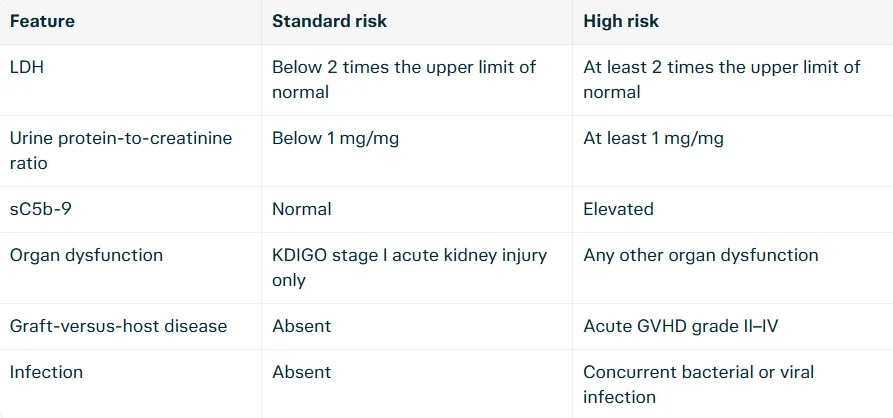
Patients in the high-risk group may need closer monitoring and earlier consideration of targeted treatment or enrollment in clinical trials. The authors suggest that standard-risk patients may be managed with careful observation, while high-risk patients require a more urgent and individualized approach.
Why Early Detection Is Critical
One of the strongest messages of the article is that TA-TMA should be recognized before severe organ damage develops. Once multi-organ dysfunction occurs, it can be difficult to reverse.
For this reason, the authors recommend screening all allogeneic transplant recipients, as well as children receiving autologous transplants for neuroblastoma, during the first 100 days after transplantation. This period is when TA-TMA most often develops.
Early screening may help clinicians detect subtle changes—such as rising LDH, new hypertension, proteinuria, or complement activation—before the disease becomes more advanced.
What This Means for Hemostasis
Although TA-TMA is not a classic bleeding or clotting disorder, it is deeply connected to hemostasis and vascular biology. The disease involves injury to the small blood vessels, activation of the complement system, and formation of microthrombi that can disrupt normal blood flow.
For hematologists, transplant specialists, and laboratory professionals, the article highlights the importance of interpreting blood counts, LDH, schistocytes, kidney function, and complement markers together. No single laboratory value can confirm TA-TMA on its own.
The Takeaway
This consensus report does not claim to have found a perfect test for TA-TMA. Instead, it offers something equally important: a shared framework for recognizing the disease earlier and more consistently.
By standardizing diagnostic criteria and identifying high-risk features, the authors hope to improve clinical care, support better clinical trials, and ultimately help more transplant patients avoid the most severe consequences of TA-TMA.
Key Prognostic Markers
Beyond establishing the diagnosis, the consensus report emphasizes the importance of identifying clinical and laboratory findings associated with poor outcomes.
These include elevated soluble C5b-9, significant proteinuria, elevated LDH, organ dysfunction, concurrent infections, and graft-versus-host disease (GVHD).
Recognizing these features can help clinicians identify patients who may be at greater risk of disease progression and transplant-related complications. Importantly, risk assessment should be dynamic, as a patient’s clinical condition and laboratory findings may change rapidly after transplantation.
FAQ
1. What is TA-TMA?
TA-TMA is a serious complication after stem cell transplant in which small blood vessels become damaged and blocked by tiny clots.
2. Why is it important?
It can cause kidney injury, high blood pressure, and multi-organ failure.
3. Why new criteria?
To make diagnosis and risk assessment more consistent across centers.
4. How is TA-TMA diagnosed?
When at least 4 of 7 features are present twice within 14 days.
5. What are the 7 features?
Anemia, low platelets, high LDH, schistocytes, hypertension, high sC5b-9, and proteinuria.
6. Is biopsy needed?
No, but it can support the diagnosis.
7. What is sC5b-9?
A marker of complement activation.
8. What is high-risk TA-TMA?
TA-TMA with at least one poor prognostic feature.
9. Who should be screened?
All allogeneic transplant recipients and children with neuroblastoma after autologous transplant, during the first 100 days.
10. Does the article give treatment advice?
No, it focuses on diagnosis and risk assessment.
Written by Anna Stepanyan, MD
Stay updated with Hemostasis Today.
-
Nov 27, 2026, 14:07Christina Pohlman: Improving Care for Pregnant Individuals With APS
-
Nov 27, 2026, 13:59Thirunavukkarasu Angappan: One Swollen Knee – Hemaphillia A Treatment Ladder
-
Nov 27, 2026, 13:52David McIntosh: A Call for More Blood Donations
-
Nov 27, 2026, 13:24Shivanand Kumatagi: Bombay Blood Group
-
Nov 27, 2026, 13:06Abdul Muqtadir Abbasi: Iron Deficiency in Men – Finding the Underlying Cause
-
Nov 27, 2026, 12:57Wolfgang Miesbach: Successful AAV Redosing in Severe Hemophilia B
-
Nov 27, 2026, 12:44Mehran Ghasemzadeh: The Hidden Dysfunction in Chronic ITP
-
Nov 27, 2026, 12:31Leonardo Roever: Platelet Activation in Myocardial Microvascular Obstruction
-
Nov 27, 2026, 09:29Katarina Glise Sandblad: DOACs and SSRIs in VTE Patients