


Carlos Andrés Vergara Sánchez: Insights From the POLY-ACS Trial on Post-ACS Medication Adherence
Carlos Andrés Vergara Sánchez, Chief Cardiovascular Disease Fellow at Mayo Clinic College of Medicine and Science, shared a post on LinkedIn about a recent article by Juan David Coellar et al, adding:
“Simplifying Post‑ACS Care: Insights from the POLY‑ACS Trial.
Medication adherence after ACS remains one of the biggest barriers to preventing recurrent events.
A new pilot study, POLY‑ACS, explored whether simplifying therapy into a single, once‑daily polypill could make a meaningful difference.
Study at a glance:
- 2‑center, open‑label pilot RCT
- 128 ACS patients; median age 58
- 63 percent Hispanic, 63 percent uninsured, 86 percent safety‑net hospitals
- Randomized 30 days post‑discharge
- Intervention: Polypill (ASA + Rosuvastatin 40 mg + clopidogral 75 mg or prasugrel 10 mg)
- Comparator: Usual care
30‑day outcomes assessed:
- LDL‑C
- Platelet reactivity
- Patient‑reported measures (adherence, satisfaction, QoL)
Key findings:
LDL‑C: Polypill led to a significant within‑group reduction; usual care showed no meaningful change (between‑group Non-significant change).
Platelet Reactivity: Maintained inhibition with polypill; worsened with usual care (between‑group Non-significant).
Patient‑Reported Outcomes:
- Higher adherence in the polypill arm
- QoL improved in both groups
- No change in treatment satisfaction
Between group difference were non-significant across all pt reported outcomes.
Most interesting insight:
Among patients with poor baseline adherence, the polypill produced a meaningful LDL‑C drop, with between‑group differences approaching significance.
Those who struggle most with complex regimens may benefit the most from simplification.
Strengths:
- Diverse, socioeconomically vulnerable cohort
- Real‑world antiplatelet regimen included
- Objective biomarker endpoints
Limitations:
- 30‑day follow‑up
- Randomization not at hospital discharge
- Already optimized baseline LDL (57 mg/dL)
Bottom line:
- Post‑ACS mortality is still unacceptably high. We have therapies that work — but adherence remains the Achilles’ heel.
- A polypill won’t solve everything, but it may simplify enough to matter, especially for vulnerable patients.
- Larger, longer‑term trials with clinical outcomes are needed, but this is a great start towards simplifying treatment and reducing pill burden.
See tweetorial by Nathalie Marrero from UM.
Congratulations to the authors on this important work!”
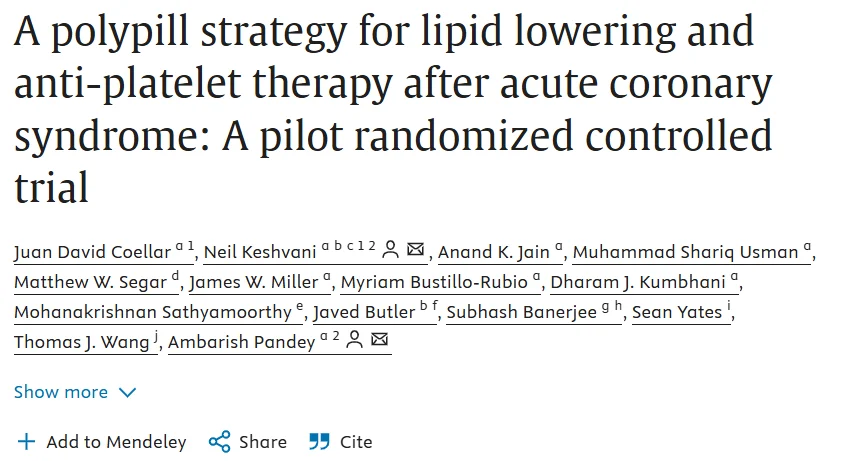
Title: A polypill strategy for lipid lowering and anti-platelet therapy after acute coronary syndrome: A pilot randomized controlled trial
Authors: Juan David Coellar, Neil Keshvani, Anand K. Jain, Muhammad Shariq Usman, Matthew W. Segar, James W. Miller, Myriam Bustillo-Rubio, Dharam J. Kumbhani, Mohanakrishnan Sathyamoorthy, Javed Butler, Subhash Banerjee, Sean Yates, Thomas J. Wang, Ambarish Pandey
Read the Full Article on American Journal of Preventive Cardiology
Read the Editorial.
Stay updated with Hemostasis Today.
-
Sep 30, 2026, 01:52Javed Anees: DADA2 – When a Young Stroke Is More Than a Stroke
-
Sep 30, 2026, 01:51How a Venous Thrombus Becomes Revascularized – ISTH
-
Sep 29, 2026, 22:45Victor Agunyego: Paracetamol – The Most Common Drug We Underestimate
-
Sep 29, 2026, 22:42Nova Sinclair: Advancing the Future of Hematology – Meet Our 2027 Organizing Committee
-
Sep 29, 2026, 22:41Lorenz Räber: Intracoronary Imaging in PCI – Why, When, How, and Which Modality?
-
Sep 29, 2026, 22:31Selma Turkovic: Pleased to Deliver the Opening Presentation at Kingston Hospital
-
Sep 29, 2026, 22:31Miguel Teran: Ultrasound and Simulation in Arterial Blood Sampling
-
Sep 29, 2026, 22:28Mohammad Refaei: Navigating Your Career in Hematology From Training to Practice
-
Sep 29, 2026, 22:27Matteo Foschi: 10 Clinical Pearls for Antithrombotic Therapy in Secondary Stroke Prevention