

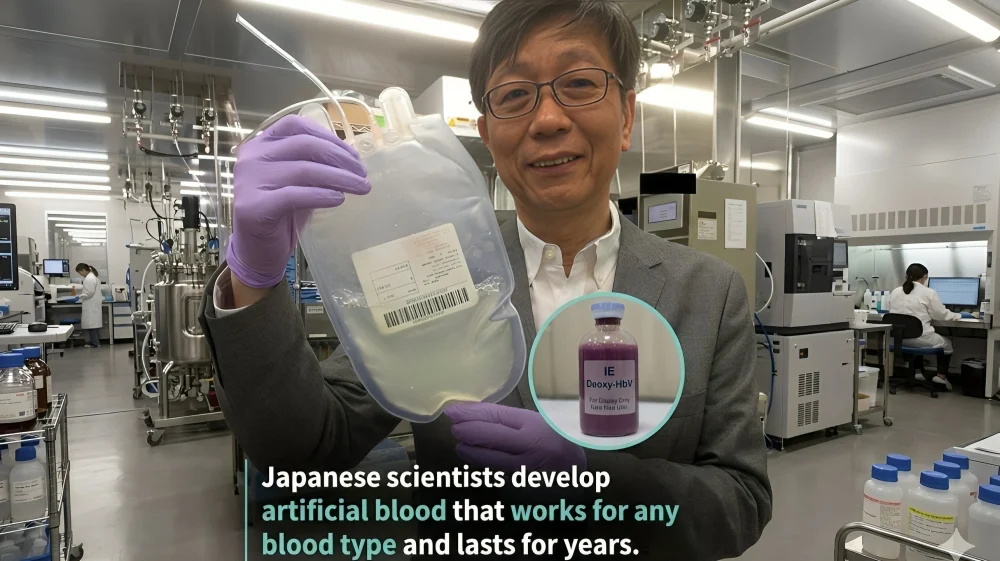
Hamid Yousaif Qureshi: Japanese Scientists Develop Artificial Blood
Hamid Yousaif Qureshi, Expert in Medication Management and Patient-Centric Care, shared a post on LinkedIn:
“Researchers at Nara Medical University in Japan have been developing an experimental artificial blood substitute known as hemoglobin vesicles (HbV).
These are microscopic particles designed to carry oxygen in a way similar to red blood cells.
Each vesicle contains purified hemoglobin enclosed inside a lipid layer that functions like a simplified cell membrane.
One of the key advantages is compatibility. Natural blood must be carefully matched between donor and patient due to surface markers.
These vesicles do not carry those markers, meaning they could potentially be used across different blood types without matching.
Another major benefit is storage.
Donated blood typically lasts around 42 days, while these artificial vesicles can remain stable for much longer under controlled conditions.
This could make them useful in emergencies, disaster response, and areas where blood supply is limited.
However, this technology is still under development.
Natural blood performs many roles beyond oxygen transport, including clotting, immune response, and nutrient delivery.
Current versions of artificial blood are mainly designed to support oxygen delivery in specific situations.
Further research and clinical studies are ongoing to determine safety, effectiveness, and how this technology could be used in real-world medical care.
Source: Nara Medical University – research on hemoglobin vesicles.
Disclaimer: This content is for informational purposes only.
Courtesy:
MedStories.”
Stay updated with Hemostasis Today.
-
Sep 24, 2026, 16:02Leonardo Roever: Understanding Peripheral Artery Disease in the Modern Era
-
Sep 24, 2026, 15:49Sthanu Subramanian: When HbA1c Does Not Reflect True Glycemia
-
Sep 24, 2026, 15:09Caroline Voltz-Girolt: Accelerating the Development of Innovative Therapies for Rare Blood Disorders
-
Sep 24, 2026, 15:00Gambo Ramatu: Anemia as a Preventable Pregnancy Challenge
-
Sep 24, 2026, 14:56Holly John: Sickle Cell Disease Beyond Pain and Clinical Outcomes
-
Sep 24, 2026, 14:45Bruce Holland: Ex Vivo Assessment of ActiGraft Clot Formation Under Anticoagulation
-
Sep 24, 2026, 14:33Mohamed El Belghiti Alaoui: Thrombin as a Therapeutic Target in Coagulation
-
Sep 24, 2026, 14:22Integrating Thrombosis Risk Into Menopause Care – World Thrombosis Day
-
Sep 24, 2026, 13:41Mahmoud Samir Bayomi: Raise ITP Awareness and Improve Patient Care