


Mirjavad Mammadov: Understanding the Thrombotic Paradox of Heparin Therapy
Mirjavad Mammadov, Cardiac Device Specialist at Besan MMC, shared a post on LinkedIn about a recent article by Theodore E. Warkentin et al. published in NEJM, adding:
“Heparin-Induced Thrombocytopenia (HIT): When an Anticoagulant Triggers a Prothrombotic Immune Response
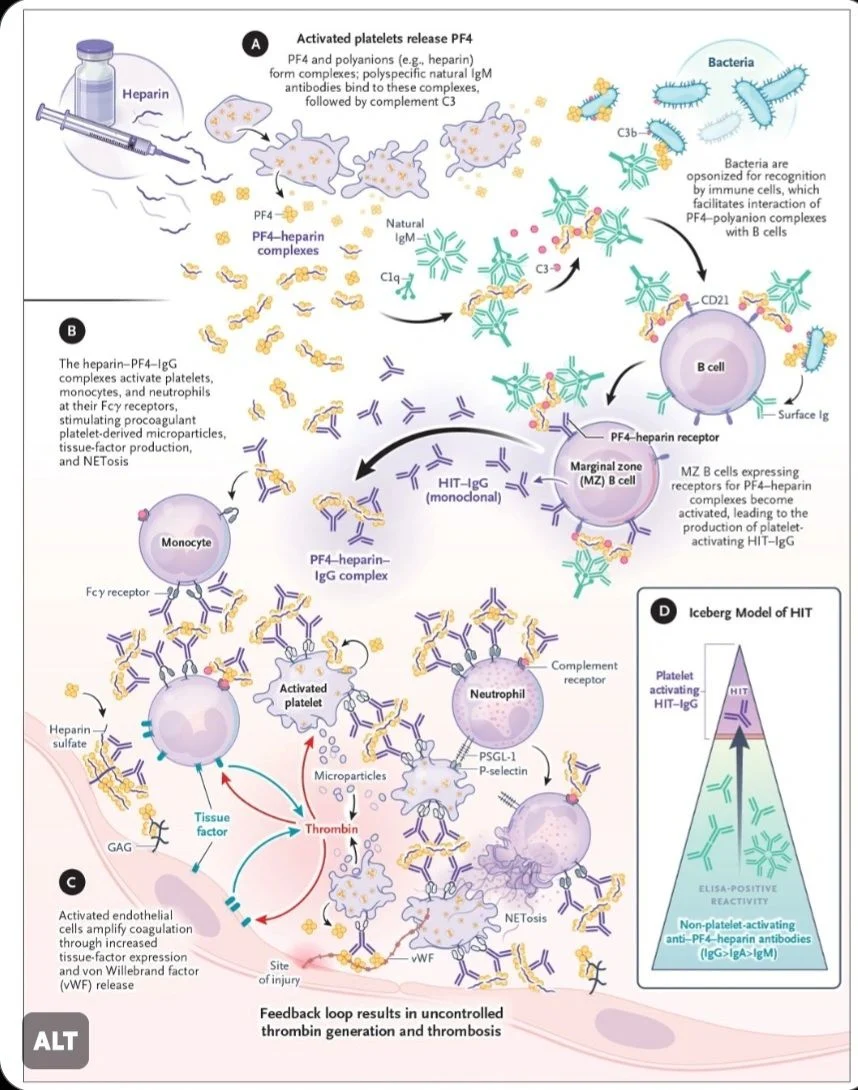
Despite being one of the most widely used anticoagulants, heparin can, in rare cases, trigger a serious immune-mediated complication known as Heparin-Induced Thrombocytopenia (HIT).
The underlying mechanism begins when platelet factor 4 (PF4) binds to heparin, forming complexes that may be recognized as foreign by the immune system.
This can stimulate the production of anti-PF4/heparin IgG antibodies, which bind to platelets through FcγIIa receptors, causing intense platelet activation.
Paradoxically, although platelet counts fall, the major clinical concern is thrombosis rather than bleeding. Activated platelets release additional PF4, amplify thrombin generation, and create a self-perpetuating cycle of platelet activation and clot formation.
Early recognition is critical. In patients with suspected HIT:
- Heparin should be discontinued immediately.
- Alternative non-heparin anticoagulation should be considered.
- Diagnosis combines clinical probability (such as the 4Ts score) with laboratory confirmation.
Understanding the immunopathogenesis of HIT remains essential for clinicians managing anticoagulated patients in both cardiovascular medicine and critical care.
Source:
Warkentin TE, Greinacher A. Platelet-Activating Anti-Platelet Factor 4 Disorders. New England Journal of Medicine (NEJM).
Disclaimer:
This post is intended for educational purposes only and should not be interpreted as medical advice or clinical guidance for individual patients.”
Title: Platelet-Activating Anti–Platelet Factor 4 Disorders
Authors: Theodore E. Warkentin, M.D., Andreas Greinacher, M.D.
Stay updated on all scientific advances with Hemostasis Today.
-
Sep 19, 2026, 14:17Abdul Mannan: What Exactly Is a Platelet?
-
Sep 19, 2026, 13:39Keisuke Goda: Decoding Platelet Phenotypes in COVID-19 With Optofluidic Imaging
-
Sep 19, 2026, 13:30Targeted Thrombolysis Beyond tPA
-
Sep 19, 2026, 13:21Paul Armstrong: From Summer Studentship to Young Researcher
-
Sep 19, 2026, 13:06Rabiya Masood: Breaking the Cycle of Thalassemia Through Screening
-
Sep 19, 2026, 10:52Consuela A. Albright: The Critical Role of Black Blood Donors in Sickle Cell Treatment
-
Sep 19, 2026, 10:47Amber Yates: Inside Agios’ Partnership with the Sickle Cell Community
-
Sep 19, 2026, 10:46Anton Farkas: Mechanical Thrombectomy for Acute PE in Early Pregnancy
-
Sep 19, 2026, 10:40Marjolein Smidt: ASH Raises Ferritin Thresholds for Iron Deficiency