


Zena Vexler: Targeting Neutrophil Elastase and NETosis to Mitigate Infection-Triggered Childhood Stroke
Zena Vexler, Professor, Dept of Neurology at University of California, San Francisco, shared a post on LinkedIn about a recent article he and his colleagues co-authored, published in Brain, adding:
“Delighted to share that our manuscript was published in Brain:
It has been known for a long time that common infections can trigger arterial ischemic stroke in children.
Unfortunately, there have been no murine models for investigating the underlying mechanisms of this phenomenon.
To examine the consequences of viral priming for childhood arterial ischemic stroke, we first developed a novel model that simulates virus-induced childhood cerebral arteriopathy by administering viral mimetic/TLR3-agonist Poly-IC in juvenile mice and subsequently combined Poly-IC priming with transient middle cerebral artery occlusion three days later.
We first showed that Poly-IC administration rapidly and transiently altered gene expression in brain microvascular cells, priming endothelial and inflammatory responses in juvenile mice before stroke.
This priming led to increased neutrophil accumulation in the brain, neutrophil elastase activation, and NETosis in injured regions after stroke, resulting in marked hemorrhagic transformation.
Poly-IC priming altered the neutrophil phenotypes and caused long-term changes of vascular networks after stroke in juvenile mice.
Inhibiting NE at the time of middle cerebral artery occlusion significantly reduced hemorrhagic transformation and overall injury by attenuating the initiation of the peripheral inflammatory response and limiting neutrophil elastase-mediated NETosis formation in the injured brain. Neutrophil elastase inhibition also altered neutrophil-monocyte interactions in injured juvenile brain.
Together, these findings identify neutrophil elastase/NETosis inhibition as a potential strategy to minimize injury induced by TLR3-mediated viral priming in childhood arterial ischemic stroke.”
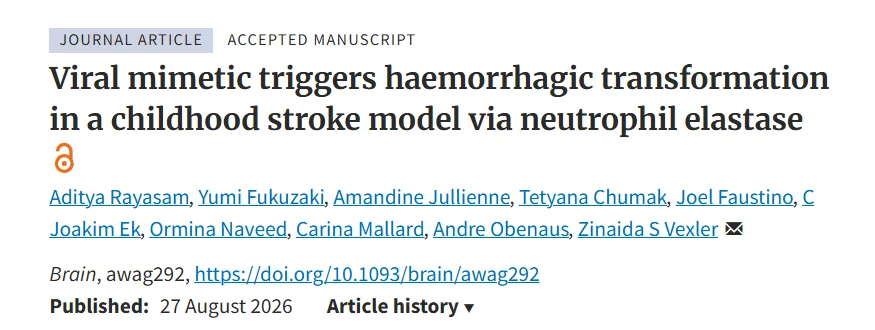
Title: Viral mimetic triggers haemorrhagic transformation in a childhood stroke model via neutrophil elastase
Authors: Aditya Rayasam, Yumi Fukuzaki, Amandine Jullienne, Tetyana Chumak, Joel Faustino, C Joakim Ek, Ormina Naveed, Carina Mallard, Andre Obenaus, Zinaida S Vexler
Stay updated on all scientific advances with Hemostasis Today.
-
Oct 20, 2026, 03:49Domenico Simone Castiello: Rethinking Prolonged DAPT in Multivessel PCI – Insights from the DAPT-MVD Trial
-
Oct 20, 2026, 03:37Rucha Patil: Scaling POC Diagnostics for Haemophilia A and VWD Across India
-
Oct 20, 2026, 03:24Chaza Alaji: Diagnosing Protein C and Protein S Deficiency
-
Oct 20, 2026, 03:24Mou Nandi: How Maternal Health During Pregnancy May Shape Infant Development
-
Oct 20, 2026, 03:13Sumyea Kabir: Pre-Analytical Quality in Phlebotomy – Preventing In Vitro Hemolysis
-
Oct 20, 2026, 02:37M. Sekip Altunkan: Can Anticoagulation Be Safely Stopped After AF Ablation?
-
Oct 20, 2026, 02:26Ahmed Ammar: Managing VT Recurrence Post-Ablation
-
Oct 20, 2026, 01:43Oliver Weingärtner: Deprescribing of Lipid Lowering Drug after MI is Associated with Cardiovascular Events
-
Oct 19, 2026, 19:44Where You Live Should not Determine Whether You Receive Care – World Federation of Hemophilia