

Cold Agglutinin Disease: Beyond Hemolysis Toward Complement-Directed Treatment
Cold agglutinin disease (CAD) is a rare autoimmune hemolytic anemia in which pathogenic IgM antibodies bind red blood cells at temperatures below 37°C and activate the classical complement pathway.
While hemolysis has traditionally defined the disease, modern management increasingly recognizes CAD as a disorder with both hematologic and cold-induced circulatory manifestations, requiring treatment tailored to the dominant clinical problem.
A recent review by Dae-Ho Choi, published in Blood Research (2026), provides a comprehensive, clinically oriented synthesis of cold agglutinin disease (CAD), emphasizing that the disease is far more than complement-mediated hemolysis.
The article frames CAD as a dual-process disorder—clonal B-cell lymphoproliferation plus classical complement activation—and argues that modern treatment must address both the anemia and the often disabling cold-induced circulatory symptoms.
Disease Definition and Burden
CAD is a rare form of autoimmune hemolytic anemia (AIHA), accounting for approximately 15%–25% of all AIHA cases.
It is defined by two interdependent features: a clonal bone marrow B-cell lymphoproliferative disorder producing monoclonal IgM-kappa autoantibodies, and complement-mediated hemolysis driven by the classical pathway.
The estimated prevalence is 5–20 per million, with an annual incidence of roughly 0.5–1.9 per million. The disease predominantly affects older adults, with a median age at diagnosis of 67–72 years and a female predominance.
Despite its chronicity, overall survival is relatively preserved, with a median survival of approximately 16 years from diagnosis—close to the age-matched general population’s life expectancy.
However, morbidity remains substantial, with transfusion-dependent anemia, profound fatigue, and a heightened thromboembolic risk dominating the clinical picture.
The Two-Hit Pathophysiology
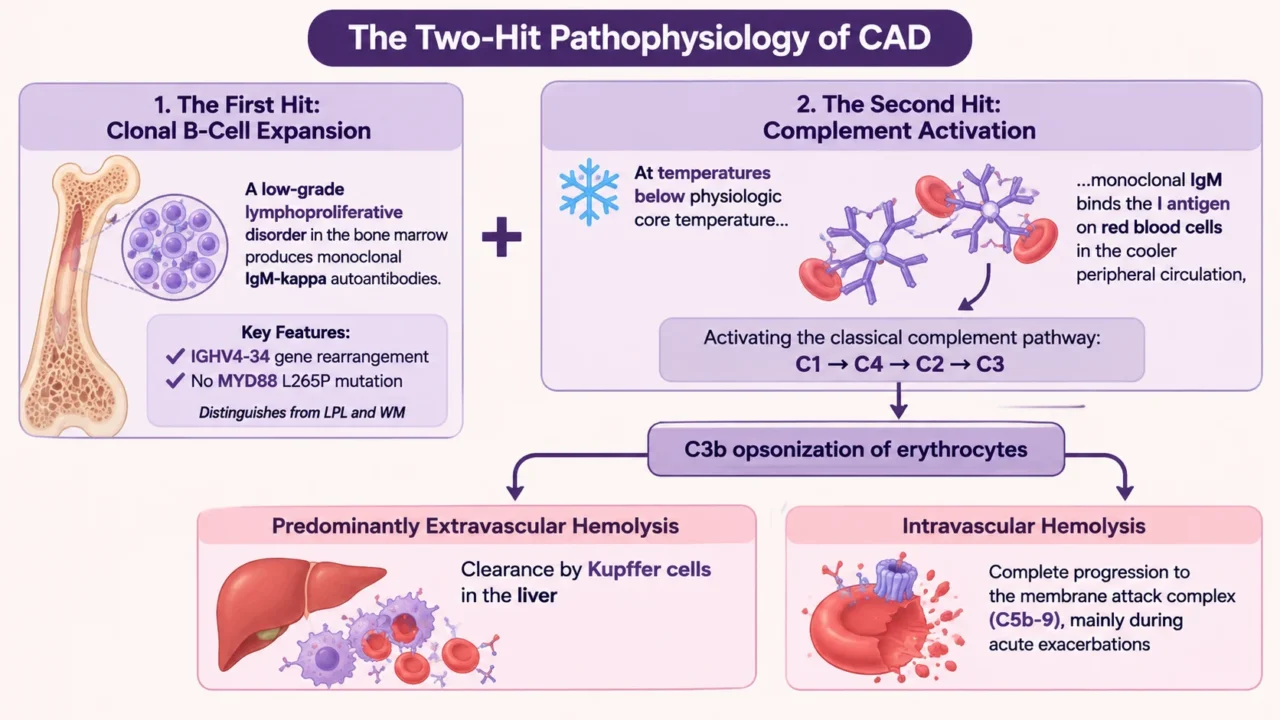
The review presents CAD pathophysiology as a “two-hit” model. The first hit is a clonal B-cell expansion in the bone marrow—a low-grade lymphoproliferative disorder that produces monoclonal IgM-kappa autoantibodies.
This clone characteristically exhibits IGHV4-34 gene rearrangement and lacks the MYD88 L265P mutation, distinguishing it from lymphoplasmacytic lymphoma (LPL) and Waldenström macroglobulinemia (WM).
The second hit is complement activation. At temperatures below physiologic core temperature, the monoclonal IgM binds the I antigen on red blood cells in the cooler peripheral circulation, activating the classical complement pathway in the sequence C1, followed by C4, C2, and C3..
C3b opsonization of erythrocytes leads to their clearance by Kupffer cells in the liver, producing predominantly extravascular hemolysis. Complete progression to the membrane attack complex (C5b-9) causes intravascular hemolysis, which occurs mainly during acute exacerbations.
CAD Versus Cold Agglutinin Syndrome
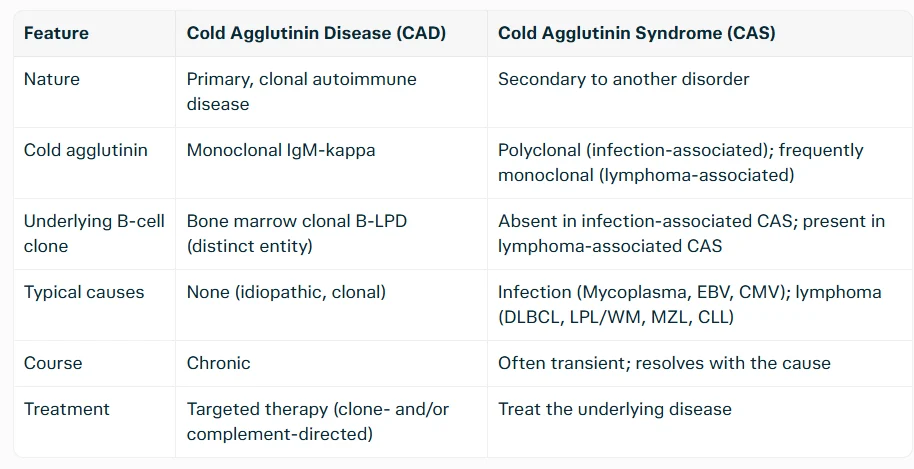
A critical distinction in the review is between primary CAD and secondary cold agglutinin syndrome (CAS). CAD is a primary clonal autoimmune disease requiring targeted therapy, whereas CAS is secondary to another disorder—such as infection (Mycoplasma pneumoniae, EBV, CMV) or lymphoma—and is managed by treating the underlying cause.
CAD-Associated Lymphoproliferative Disease: A Distinct Entity
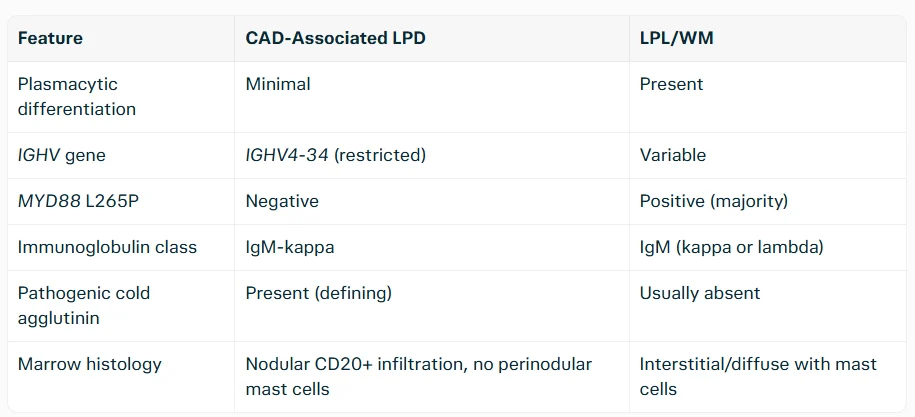
The 2022 World Health Organization classification formally recognized CAD-associated lymphoproliferative disease as a distinct entity from LPL and WM. The review highlights that CAD-associated LPD shows nodular CD20-positive B-cell infiltration with minimal plasmacytic differentiation and the absence of the perinodular mast cells typical of LPL/WM.
The combination of IGHV4-34 restriction and the absence of MYD88 L265P provides the key molecular distinction. These features were instrumental in the WHO’s recognition of CAD-associated LPD as its own entity.
Clinical Manifestations Beyond Anemia
The review emphasizes that CAD’s clinical burden has historically been underestimated. Beyond transfusion-requiring anemia, patients experience disabling cold-induced circulatory symptoms—acrocyanosis of the fingers, toes, ears, and nose, Raynaud-like phenomena, and livedo reticularis—reported by approximately 90% of patients.
Importantly, these circulatory symptoms are not complement-mediated and are therefore not addressed by complement inhibitors, a distinction with direct therapeutic relevance. Anemia is frequently transfusion-requiring, with more than half of patients receiving red blood cell transfusions over the course of their disease.
CAD is also associated with a clinically meaningful risk of thrombosis. Patients show an increased incidence of venous thromboembolism, with a reported hazard ratio of approximately 3.3 relative to the general population, and arterial thrombotic events are also more frequent.
Diagnostic Approach
The review outlines a logical, stepwise diagnostic workup. The first step is confirming hemolysis through elevated LDH and indirect bilirubin, reticulocytosis, and reduced haptoglobin, together with a peripheral blood smear review that may show erythrocyte agglutination.
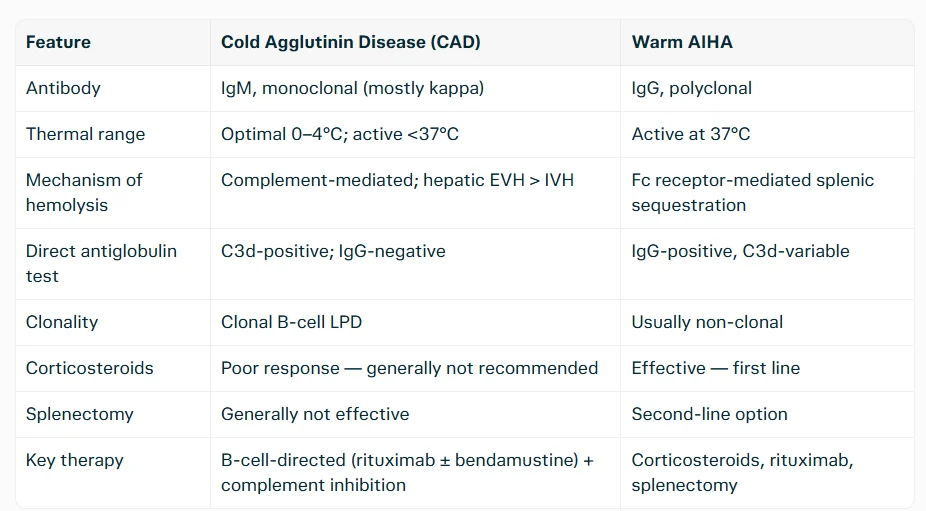
The second step is a monospecific direct antiglobulin test (DAT). CAD characteristically shows strong C3d positivity with a negative or only weakly positive IgG result.
The third step is subtyping and confirmation, with a cold agglutinin titer of at least 1:64 at 4°C. The final step distinguishes primary CAD from secondary CAS by evaluating for underlying infection, autoimmunity, or lymphoma, with bone marrow examination to confirm the clonal process.
Diagnostic Pearls
Several practical points improve diagnostic accuracy:
- Blood should be collected and transported at 37°C, as cooling causes in vitro agglutination that can spuriously elevate MCV and MCHC and lower the measured red blood cell count.
- A monospecific DAT is essential—C3d strongly positive with IgG negativity—because polyspecific DAT alone is insufficient to distinguish CAD from warm AIHA.
- Thermal amplitude is a better predictor of clinical severity than titer alone; a thermal amplitude of approximately 28–30°C or higher marks a pathogenic threshold.
- Secondary CAS must be actively excluded by evaluating for infection (Mycoplasma, EBV, CMV) and lymphoma (DLBCL, marginal zone lymphoma, LPL/WM).
Why Corticosteroids and Splenectomy Fail in CAD
A central practical message of the review is that corticosteroids and splenectomy—mainstays of warm AIHA management—are generally ineffective in CAD. This is because hemolysis in CAD is complement-mediated and predominantly hepatic, rather than Fc-mediated and splenic as in warm AIHA.
Current Treatment Landscape
General Measures and Indications
Not all patients with CAD require pharmacological therapy. Treatment is indicated for clinically significant or symptomatic anemia (hemoglobin <10 g/dL or significant decline), transfusion dependence, disabling circulatory symptoms, and anticipated cold exposure or surgery.
General measures apply to all patients and include thermal protection, avoidance of cold triggers, folic acid supplementation, consideration of thromboprophylaxis in high-risk settings, and mandatory use of a blood warmer during transfusion.
Plasmapheresis in Acute Crisis
Because pathogenic IgM is largely intravascular, therapeutic plasma exchange can rapidly reduce the cold agglutinin burden. A single session may remove a substantial fraction of circulating IgM, serving as effective emergency management for acute severe hemolytic crisis and as a bridge before hypothermic procedures such as cardiac surgery.
A critical procedural caveat is that the extracorporeal circuit can cool blood below the thermal amplitude and precipitate agglutination within the tubing; therefore, maintenance of strict normothermia with a fluid warmer at 37°C throughout the procedure is mandatory.
B-Cell-Directed Therapy
B-cell-directed therapy targets the underlying clone and offers the prospect of durable, treatment-free remission. Rituximab monotherapy (375 mg/m² weekly for four weeks) produces overall response rates of approximately 50%–60% with low complete response rates and a median response duration of about 11 months.
The combination of bendamustine and rituximab (BR) is a preferred first-line option for many patients without other illnesses, with overall response rates of 71%–78%, complete response rates of 40%–53%, and five-year sustained remission in approximately 77% in the Nordic prospective experience.
Complement Inhibition: Sutimlimab
Sutimlimab, a humanized monoclonal antibody against C1s, was the first complement inhibitor extensively studied in CAD and the first approved therapeutic agent for the disease.
In the phase 3 open-label CARDINAL trial of 24 transfusion-dependent patients, sutimlimab met its composite primary endpoint in 54% of patients, raised mean hemoglobin from 8.6 to 11.2 g/dL, rendered 71% transfusion-free, and improved fatigue, with responses evident within the first week.
The phase 3 randomized, double-blind, placebo-controlled CADENZA trial in 42 non-transfusion-dependent patients confirmed these findings, with the primary endpoint achieved in 72.7% versus 15% (p less 0.001) and hemoglobin of at least 12 g/dL in 50% versus 7%.
Two practical considerations emerge. First, sutimlimab controls complement-mediated hemolysis but does not target the underlying clone; disease activity recurs upon discontinuation, making a combination strategy with B-cell-directed treatment attractive when a fixed-duration approach is desired. Second, because the agent modulates the complement system, vaccination against encapsulated bacteria should be completed or updated at least two weeks before the first dose.
Relapsed/Refractory Disease and Emerging Therapies
Several clone- and complement-directed options have been investigated for relapsed or refractory CAD. Daratumumab, an anti-CD38 antibody targeting long-lived plasma cells, produced hemoglobin responses in a small retrospective series with improvement in circulatory symptoms.
BTK inhibitors such as ibrutinib offer dual inhibition of the B-cell and mast-cell pathways, with reports describing rapid improvement in hemolytic anemia and resolution of acrocyanosis. Bortezomib, through plasma-cell depletion, achieved an overall response rate of approximately 32%, with a median response duration of approximately 16 months, though limited by neuropathy.
Two complement-directed agents are particularly notable:
- Riliprubart, a next-generation antibody against active C1s, produced rapid and sustained hemoglobin improvement after a single dose, with responses maintained for around 15 weeks, raising the prospect of dosing as infrequently as every 12 weeks.
- Iptacopan, an oral factor B inhibitor, achieved the primary endpoint in 50% of a small phase 2 CAD cohort, with a mean hemoglobin increase of 2.2 g/dL at week 12, normalization of LDH in all patients, and improvement in fatigue.
Response Assessment and Sequential Strategy
Response criteria derived from Nordic prospective studies define complete response as normalization of hemoglobin, transfusion independence, resolution of hemolytic markers, and disappearance of the clonal disease on bone marrow biopsy. Partial response denotes a significant hemoglobin increase (mean, approximately plus 3.9 g/dL) with reduced transfusion needs and possible persistence of the clone.
These definitions emphasize that the most durable outcomes require clone eradication, not merely hemolysis control. This motivates a rational sequential strategy: a complement inhibitor first to achieve rapid hemolysis control (a bridge), then B-cell-directed therapy to target the clone (induction), followed by careful tapering of complement inhibition once clonal control is established.
Real-World Access and Cost Considerations
Access to these therapies varies considerably among regions, and the gap between the evidence base and routine availability is a practical reality. In some health systems, including Korea, sutimlimab has not yet been approved for CAD, and bendamustine-based therapy is not formally reimbursed under a CAD indication.
Formal cost-effectiveness analyses indicate that continuous sutimlimab therapy markedly exceeds conventional willingness-to-pay thresholds, whereas fixed-duration rituximab-based chemoimmunotherapy delivers durable responses at a substantially more favorable cost. This economic dimension is especially salient in settings where complement inhibitors are inaccessible.
Future Directions
Several investigational strategies may further reshape CAD management. Clone-directed therapy is being extended to next-generation agents, including the BTK inhibitor zanubrutinib (CaZa; NCT06067048), the APRIL/BAFF dual-antagonist povetacicept (RUBY-4; NCT05757570), and the BCMA-targeting agent OM336 (NCT07083960).
In the complement axis, classical-pathway inhibition with GL-0719 (NCT05318534) and oral factor B inhibition with iptacopan (NCT06847607) are under evaluation, potentially improving convenience and cost. CD19-directed CAR T-cell therapy (inaticabtagene autoleucel; NCT07091370) is also entering early-phase studies for refractory AIHA.
Key priorities remain the prospective validation of sequential and combination regimens, development of therapies for non-complement-mediated circulatory symptoms, and broader, more affordable access worldwide.
Conclusion
The review concludes that CAD is defined by the interplay of a clonal B-cell lymphoproliferative disorder and classical-pathway complement-mediated hemolysis, and must always be distinguished from secondary CAS. Diagnosis depends on a monospecific DAT that is C3d-positive and IgG-negative, a cold agglutinin titer of at least 1:64, and bone marrow evaluation, with thermal amplitude serving as a better predictor of severity than titer.
Corticosteroids and splenectomy have limited roles and are generally not recommended. For patients without other diseases, bendamustine plus rituximab is a commonly preferred first-line option, whereas rituximab monotherapy is favored for frail or elderly patients. Sutimlimab provides rapid, reliable control of complement-mediated hemolysis but requires continuous administration, favoring its combination with clone-directed therapy as a fixed-duration strategy—though this approach still requires prospective validation.
FAQs
1. What is cold agglutinin disease (CAD)?
A rare autoimmune hemolytic anemia caused by monoclonal IgM autoantibodies that bind red blood cells below 37°C and activate complement, leading to hemolysis.
2. How is CAD different from secondary cold agglutinin syndrome (CAS)?
CAD is a primary clonal disease requiring targeted therapy; CAS is secondary to infection or lymphoma and is managed by treating the underlying cause.
3. What are the two main mechanisms driving CAD?
A. A “two-hit” model: clonal B-cell lymphoproliferation producing IgM, plus classical complement activation causing hemolysis.
4. What symptoms occur beyond anemia?
Cold-induced acrocyanosis, Raynaud-like symptoms, and livedo reticularis affect approximately 90% of patients and are not complement-mediated.
5. How is CAD diagnosed?
Hemolysis markers, C3d-positive/IgG-negative DAT, cold agglutinin titer greater than 1:64 at 4°C, and bone marrow confirmation.
6. Why do corticosteroids and splenectomy fail in CAD?
Hemolysis is complement-mediated and hepatic, not Fc-mediated and splenic as in warm AIHA.
7. What is the role of sutimlimab?
It blocks C1s, rapidly controlling hemolysis and raising hemoglobin, but does not eliminate the underlying clone.
8. Does complement inhibition improve cold-induced circulatory symptoms?
No—cold-induced circulatory symptoms persist because they are driven by agglutination, not complement.
9. What are the preferred first-line treatment options?
Bendamustine plus rituximab for durable control; rituximab monotherapy for frail patients; sutimlimab for severe hemolysis.
10. What emerging therapies are in development?
Riliprubart, iptacopan, zanubrutinib, povetacicept, and CAR T-cell therapy are being studied for more precise, less burdensome treatment.
Written by Anna Stepanyan, MD
Stay updated with Hemostasis Today.
-
Nov 24, 2026, 15:19Essama Telli: Recognizing Retiform Purpura as a Sign of Vascular Injury and Thrombosis
-
Nov 24, 2026, 15:11Kerstin Piayda: University Hospital Giessen Performs Europe’s First PE Procedure With Lightning Flash 3.0
-
Nov 24, 2026, 14:55Cecilia Kretz: Evaluating Aspirin-Free Antithrombotic Strategies in HeartMate 3 Patients
-
Nov 24, 2026, 14:54The Future of Global Hemophilia Care and the Impact of the World Health Assembly Resolution
-
Nov 24, 2026, 14:39Andrija Velevski: Why Oxygen Availability Does Not Guarantee Tissue Oxygenation
-
Nov 24, 2026, 14:27Basyouni Omran: Clinical Guidance on Antiplatelet Use in Acute Ischemic Stroke
-
Nov 24, 2026, 14:07Mohamed Sherif Salem: AHA 2026 Recommendations for Antiplatelet Management in Acute Ischemic Stroke
-
Nov 24, 2026, 13:03Nikolaj Nytofte: Uncovering a Hidden Genetic Cause of Recurrent Venous Thromboembolism
-
Nov 24, 2026, 11:42Claudia Colombo: Early Clinical Outcomes Following Ultrasound-Assisted Thrombolysis in Pulmonary Embolism