


10 Posts Not to Miss This Week
This week’s highlights bring together key developments across hematology, hemostasis, thrombosis, and transfusion medicine, featuring new evidence on pediatric acquired thrombotic thrombocytopenic purpura (aTTP) and the expanded FDA approval of caplacizumab, alongside emerging research on anticoagulation strategies after atrial fibrillation ablation and venous thromboembolism prevention following orthopedic surgery.
Further highlights explore complex blood group testing and immunohematological investigations, heparin-induced thrombocytopenia and its diagnostic and therapeutic challenges, antiplatelet strategies in acute coronary syndromes, and emerging therapeutic approaches targeting Protein S in bleeding disorders. The roundup also covers transfusion research, platelet refractoriness, thalassemia awareness, blood donor initiatives, and developments in clinical research and professional collaboration.
Explore this week’s discussions, research updates, clinical perspectives, and expert contributions across hematology, hemostasis, thrombosis, and transfusion medicine, highlighting evolving evidence, practical clinical challenges, and advances shaping contemporary practice.
Dhinesh Selvaraju, Clinical Pharmacist at Thanthai Periyar Government Headquarters Hospital:
“FDA Approval (2025): Caplacizumab Becomes the First FDA-Approved Treatment for Pediatric Acquired TTP
Introduction
On December 23, 2025, the U.S. Food and Drug Administration (FDA) approved an expanded indication for Cablivi (caplacizumab-yhdp), extending its use to pediatric patients aged 12 years and older with acquired thrombotic thrombocytopenic purpura (aTTP).
This marks the first FDA-approved treatment option specifically for pediatric patients with aTTP.
Indication
Caplacizumab is indicated for adults and pediatric patients aged 12 years and older with aTTP, in combination with therapeutic plasma exchange and immunosuppressive therapy.
Mechanism of Action
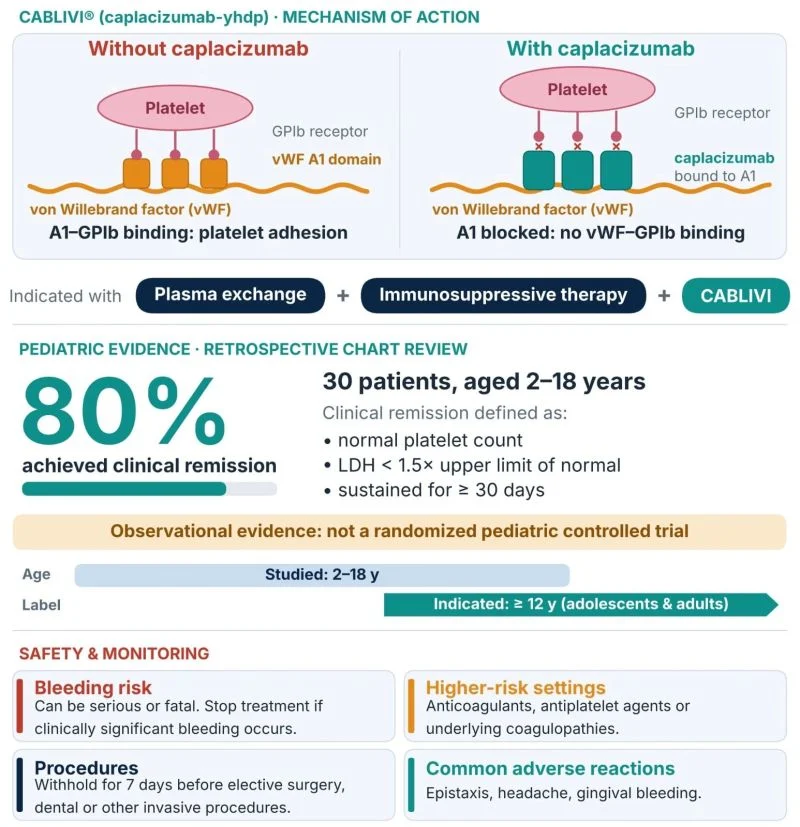
Caplacizumab is a von Willebrand factor (vWF)-directed antibody fragment. It binds to the A1 domain of vWF, preventing its interaction with platelet glycoprotein Ib.
This inhibits vWF-mediated platelet adhesion and microthrombus formation, a key process contributing to the pathophysiology of aTTP.
Clinical Evidence
The pediatric indication expansion was supported by a retrospective chart review involving 30 patients aged 2–18 years.
80% achieved clinical remission.
Clinical remission was defined by normalization of platelet count and LDH below 1.5 times the upper limit of normal, sustained for at least 30 days.
The evidence was observational rather than derived from a randomized pediatric controlled trial.
Safety and Monitoring
The principal safety concern is bleeding, which can be serious or fatal.
Important considerations include:
- Monitor for mucosal and other clinically significant bleeding.
- Exercise caution with concomitant anticoagulants and antiplatelet agents.
- Withhold treatment for 7 days before elective surgery or invasive procedures.
- Common adverse reactions include epistaxis and gingival bleeding.
Why this approval is important
This regulatory expansion extends access to a targeted anti-vWF therapy for adolescents with aTTP, a rare and potentially life-threatening thrombotic microangiopathy.
It also highlights the importance of integrating targeted inhibition of platelet adhesion with plasma exchange and immunosuppressive treatment in aTTP management.
References
- U.S. FDA. FDA Approves Therapy for Rare Blood Disorder in Pediatric Patients 12 Years and Older. January 5, 2026.
- U.S. FDA. CABLIVI Supplement Approval Letter, BLA 761112/S-018. December 23, 2025.
- HCPLive. FDA Approves Caplacizumab-yhdp (Cablivi) as First Pediatric aTTP Therapy. January 2026.”
Fanny Delettre, Director of EFS Bourgogne–Franche-Comté at EFS:
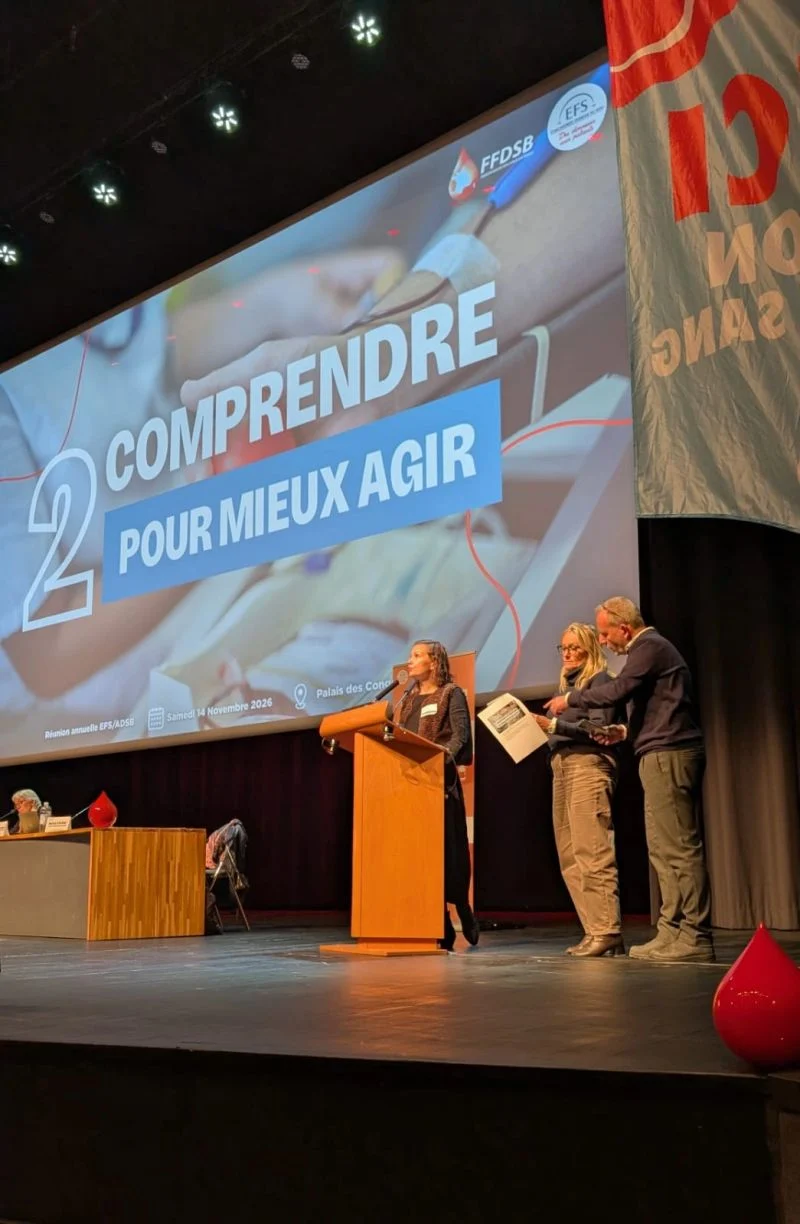
“A look back at our Volunteer Blood Donor Friends Day!
A key moment of meeting, sharing and exchanges around our common ambitions.
This day was an opportunity to present our 2026 results and our challenges for 2027, but also to share our vision of future developments.
Together, we must understand and engage in the organizational transformations necessary to better meet the needs of tomorrow’s patients.
It is by moving forward collectively, by crossing our views and experiences, that we will build the appropriate responses to the challenges ahead.
This meeting was also an opportunity to warmly thank our Amicales and all their volunteers for their daily commitment, the time they devote to our actions and the values they bring to life through their involvement.
Thank you also to the blood donors for their generosity and their gesture of solidarity, which contributes concretely to saving lives.
And finally, a big thank you to the collection and communication/marketing teams of the BFC EFS for their commitment.”
Davide Antonio Mei, Medical Doctor – PhD in Clinical and Experimental Medicine at University of Modena and Reggio Emilia:
“Excited to share our new Controversy, now out in Europace!
Anticoagulants need to be maintained after catheter ablation of atrial fibrillation in patients at risk of stroke – Pro and Contra.
We discuss a highly topical question in AF management: should oral anticoagulation be continued or discontinued after successful catheter ablation?
We explore the arguments for and against stopping anticoagulation, considering the latest evidence from randomized clinical trials, observational studies, and meta-analyses.
An important ongoing debate at the intersection of rhythm control, stroke prevention, and bleeding risk.”
Ahmed Bennis, Professor of Cardiology at Ibn Rochd University Hospital:
“Aspirin Therapy — Enough after Arthroplasty?
Results from the EPCAT III and PEPPER trials suggest that aspirin therapy from the outset after surgery is a reasonable option for many patients at standard risk for thrombosis, but the results do not establish that aspirin and anticoagulants provide equivalent protection against VTE.”
Chukwuemeka Amarachi, Medical Laboratory Scientist (BMLS):
“Complex Blood Grouping: Beyond ABO And Rh Typing
In transfusion medicine, blood grouping is not always as straightforward as identifying whether an individual belongs to blood group A, B, AB or O.
Sometimes, unexpected serological reactions make routine blood grouping and compatibility testing challenging. This is where Complex Blood Grouping becomes important.
What Is Complex Blood Grouping?
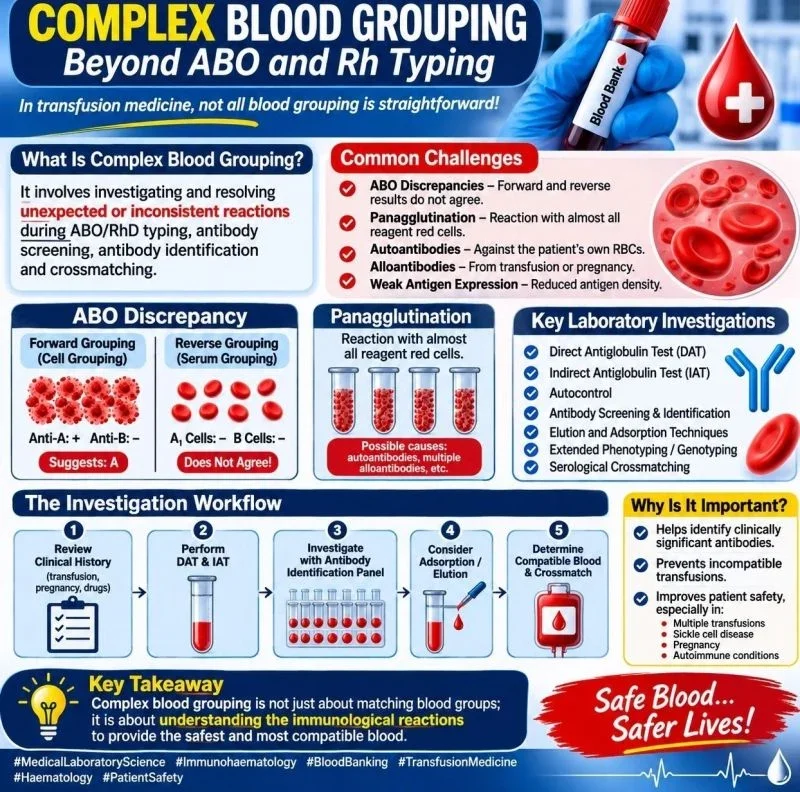
Complex blood grouping involves investigating and resolving unusual or inconsistent reactions encountered during ABO/RhD typing, antibody screening, antibody identification and crossmatching.
Common Challenges in Complex Blood Grouping
- ABO Discrepancies: When forward and reverse grouping results do not agree.
- Panagglutination: When a patient’s serum or plasma reacts with almost all reagent red blood cells in an antibody identification panel.
- Autoantibodies: Antibodies directed against the individual’s own red blood cell antigens.
- Alloantibodies: Antibodies produced against foreign red blood cell antigens following transfusion or pregnancy.
- Weak Antigen Expression: Reduced expression of certain red cell antigens can make routine blood grouping difficult.
Important Laboratory Investigations
- Direct Antiglobulin Test (DAT).
- Indirect Antiglobulin Test (IAT).
- Autocontrol.
- Antibody screening and identification.
- Elution and adsorption techniques.
- Extended red cell phenotyping and genotyping.
- Serological crossmatching.
Why Is Complex Blood Grouping Important?
It helps medical laboratory scientists identify clinically significant antibodies, investigate unexpected reactions, prevent incompatible transfusions and improve patient safety.
Blood transfusion is not just about matching blood groups; it is about understanding the immunological reactions behind compatibility.”
Raja Prince, Founder and BOD of BLEEDnFIRE Therapeutics:
“Excited to present our latest research on Protein S silencing in FXI deficiency, von Willebrand disease and hemophilic arthropathies, together with Rim Diab and Siavash Rahimi at SOHC 2026!
Proud to share this moment highlighting our collective efforts to advance innovative therapies for bleeding disorders.
Looking forward to inspiring discussions!”
Cyrus Shariat, ICU Medical Director of Washington Hospital:
“HIT Happens
Heparin is one of the most common drugs in the hospital—and usually, it saves lives by preventing or treating clots.
But in an uncommon subset of patients, it triggers an immune reaction that activates platelets, leading to dangerous clotting while platelet counts drop.
This is heparin-induced thrombocytopenia (HIT).
Normally, low platelets mean a higher risk of bleeding. In HIT, it’s the opposite; without treatment, 30–50% of patients develop thrombosis. In the ICU, I’ve seen HIT cause strokes, pulmonary embolisms, and limb loss.
Because the clotting risk is so high, suspected HIT requires immediate treatment with a non-heparin anticoagulant.
Is it HIT?
The 4Ts score is a validated scoring system that uses clinical and lab data to determine the probability of HIT.
But to prove HIT, we need a confirmatory blood test.
One problem: Many community hospitals have to send the test to an outside lab and it may take 2-5 days to get results.
Let me get this straight.
HIT requires immediate treatment even though we may not be able to confirm the diagnosis for days?
YES. If the clinical suspicion is intermediate or high, we need to start empiric treatment without waiting for confirmation.
This makes HIT especially relevant in the medico-legal realm because timing of diagnosis and treatment are paramount.
When reviewing a chart, here’s what I look for:
- What was the timing and degree of platelet drop?
- When did the physicians consider HIT as a potential diagnosis?
- If the 4Ts score wasn’t documented, did the team’s clinical reasoning align with it?
- Were there signs of clotting on the exam that were missed by the treating team?
- If the suspicion for HIT was intermediate or high, was heparin discontinued and an alternate anticoagulation started without delay?
Ok. I think that I’ve HIT on all the main points.”
Farhad Sheikh, Medical Doctor at University of Tehran:
“Among unselected patients undergoing PCI for an acute coronary syndrome, treatment under a default policy of prasugrel did not lead to a lower risk of a composite of death, myocardial infarction, or stroke at 1 year than treatment under a default policy of ticagrelor․”
Courtney Lawrence, Divisional Chief Medical Officer at the American Red Cross:
“Join us for the next Journal Club by Immunohematology, Journal of Blood Group Serology and Molecular Genetics!
This session features Tiffany Wafford, who will discuss her article examining the relationship between HLA antibodies, eplet patterns, and platelet transfusion refractoriness in Hispanic patients.
The conversation will provide insight into the science behind transfusion challenges and potential implications for clinical practice.
No journal subscription is required, and the event is open to everyone interested in transfusion medicine and laboratory science.
December 2, 2026
1:00 to 2:00 p.m. CST
Open to the public
Muhammad Sameed Altaf, Lead Manager Business Development at The Searle Company Ltd.:
“It has been almost more than 10 years that we as a society have been working together to create awareness about Thalassemia and to support Thalassemic patients.
Our collective mission stands on 3 pillars:
- Arrange Blood: For them, blood is life. We must ensure no patient suffers due to shortage.
- Keep Them Alive: Until a breakthrough comes. Research is ongoing, and we must keep hope alive together.
- Prevention Through Awareness: Two Thalassemia Minors should not marry each other. Testing before marriage is our social responsibility.
Awareness today can save a life tomorrow.
Let us all play our part.”

Stay updated with Hemostasis Today.
-
Nov 21, 2026, 14:21Two Emerging Mechanisms Linking Sickle Cell Disease to Thrombosis
-
Nov 21, 2026, 13:06Christine Faressa: Precision PRP and Platelet Biology in Musculoskeletal Care
-
Nov 21, 2026, 13:04Eyad Jamileh: Atrial Fibrillation – Bridging the Global Gaps in Diagnosis and Stroke Prevention
-
Nov 21, 2026, 12:49Thibault Veyron: Optimizing Bivalirudin Treatment in HIT
-
Nov 21, 2026, 12:44Paulus Kirchhof: Left Atrial Appendage Occlusion vs DOACs
-
Nov 21, 2026, 12:19Jiyeon Kim: Human Platelet Lysate – Advancing Cell Therapy and Space Research
-
Nov 21, 2026, 12:13Chaza Alaji: DVT in Early Pregnancy – Why Anticoagulation Decisions Matter
-
Nov 21, 2026, 12:06Salih Ehsan: Why Iron Therapy May Not Work
-
Nov 21, 2026, 11:59Edward Lee Carter: DOACs vs Warfarin for LV Thrombus – Are We Getting Closer to an Answer?