


Sara Altayeb: From Diagnosing Anaemia to Recognising Iron Deficiency Earlier
Sara Altayeb, Internal Medicine Specialist at Virtual Sudan Clinic, shared on LinkedIn:
”IDA Revisited: What Has Changed in 2026?
From Diagnosing Anaemia to Recognising Iron Deficiency Earlier:
Iron deficiency is not synonymous with anaemia.
The 2026 ASH guidelines bring an important shift in how we approach iron deficiency:
Earlier recognition, more clinically relevant ferritin thresholds, and better assessment in patients with inflammation.
Here are some practice-changing clinical pearls from the updated evidence:
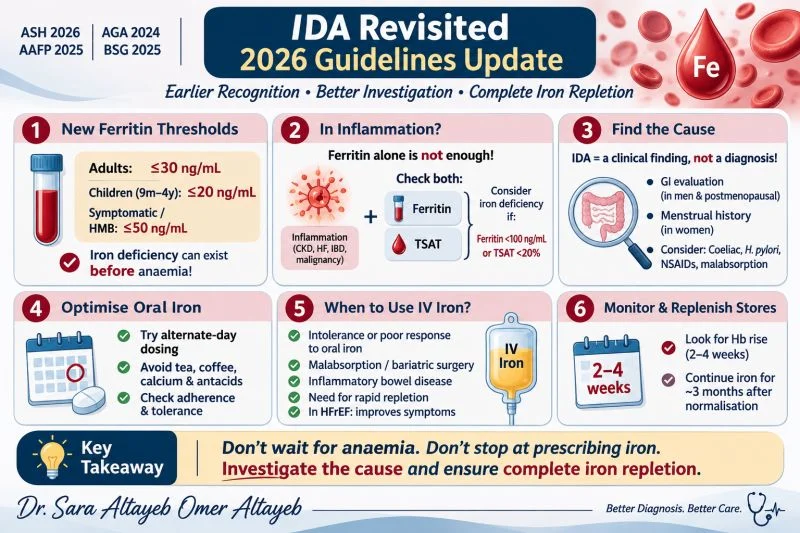
1.Rethinking ferritin cut-offs:
Don’t rely solely on traditional laboratory reference ranges.
The new ASH 2026 recommendations suggest:
- Adults: Ferritin less than 30 ng/mL (rather than less than 15).
- Children aged 9 months–4 years: less than 20 ng/mL (rather than less than 12).
- Patients with symptoms or risk factors, including heavy menstrual bleeding: less than 50 ng/mL may be appropriate.
Importantly, iron deficiency can exist long before haemoglobin starts falling.
2. Ferritin alone is not enough in inflammatory states!
Ferritin is an acute-phase reactant.
In patients with CKD, heart failure, IBD, malignancy or chronic inflammatory conditions:
- Request BOTH ferritin and transferrin saturation (TSAT).
- TSAT less than 20% or ferritin less than 100 ng/mL may indicate iron deficiency in the context of inflammation.
- ASH suggests obtaining TSAT after a 5–9-hour fast, including withholding iron supplements.
3. Investigate the cause, not just the haemoglobin!
IDA is a clinical finding, not a final diagnosis.
- Men and postmenopausal women: Consider bidirectional endoscopy to exclude gastrointestinal pathology, including malignancy.
- Premenopausal women: Take a proper menstrual history and investigate heavy menstrual bleeding.
- Don’t overlook coeliac disease, H. pylori, NSAID use, malabsorption and occult blood loss.
A plausible explanation should not automatically exclude another underlying pathology.
4. Optimise oral iron therapy:
Alternate-day oral iron is a useful strategy.
Why?
Oral iron increases hepcidin, which temporarily reduces intestinal iron absorption.
Practical points:
- Avoid unnecessarily frequent dosing.
- Separate iron from tea, coffee, calcium and antacids.
- Assess tolerance and adherence before declaring treatment failure.
5. Know when to escalate to IV iron:
Consider IV iron when there is:
- Intolerance or inadequate response to oral therapy.
- Significant malabsorption or bariatric surgery.
- Active inflammatory bowel disease.
- A need for rapid iron replacement in selected clinical situations.
In symptomatic HFrEF with iron deficiency, IV iron can improve exercise capacity and quality of life.
6. Monitor the response and replenish iron stores:
A prescription is only the beginning.
- Reticulocyte response: usually begins within the first week.
- Haemoglobin: should show a meaningful rise within 2–4 weeks.
- If there is inadequate response, reassess adherence, ongoing blood loss, malabsorption and the diagnosis.
- Continue oral iron for approximately 3 months after haemoglobin normalisation to replenish iron stores.
An additional IV iron safety pearl:
Ferric carboxymaltose can cause FGF23-mediated hypophosphataemia, particularly with repeated doses.
Consider phosphate monitoring in patients at risk.
The take-home message:
The most important shift is conceptual:
Don’t wait for microcytosis or a falling haemoglobin to recognise iron deficiency.
Don’t stop at prescribing iron.
And never forget to investigate why the patient became iron deficient in the first place.
Better diagnosis. Better aetiological investigation. Better treatment. Better follow-up.
Because treating the anaemia without addressing its cause is only half the job!”
Stay updated with Hemostasis Today.
-
Nov 26, 2026, 15:35Farjah Hassan Algahtani: Hydroxyurea Use and Quality of Life in Sickle Cell Anaemia
-
Nov 26, 2026, 15:32Micah Robert: Balancing LAAO and Anticoagulation in Patients With Atrial Fibrillation
-
Nov 26, 2026, 15:23Anne Juanós: SHN Physiotherapy Group Receives Research Grant for Haemophilia
-
Nov 26, 2026, 15:21Alessandro Armaro։ Rethinking DAPT Duration After CABG
-
Nov 26, 2026, 15:16Junedh M Amrute: Decoding the Cellular and Molecular Basis of Coronary Artery Disease
-
Nov 26, 2026, 15:02Antiplatelets May Offer Advantages Over Anticoagulants in Cancer-Associated Stroke – International Journal of Stroke
-
Nov 26, 2026, 14:52Toby Richards: The Hidden Burden of Iron Deficiency Anemia in Women
-
Nov 26, 2026, 14:49Andrew Choong: Could a Painful, Swollen Leg Be a Blood Clot?
-
Nov 26, 2026, 14:24Ilenia Calcaterra: Inferior Thyroid Artery Abnormalities as a Potential Marker of Cardiovascular Risk