


Robert Roland: Uncovering Silent Coronary Atherosclerosis in Type 1 Diabetes Using AI
Robert Roland, Interventional Cardiologist at Institute for Clinical and Experimental Medicine, shared a post on LinkedIn about a recent article, he and his colleagues co-authored, published in Cardiovascular Diabetology adding:
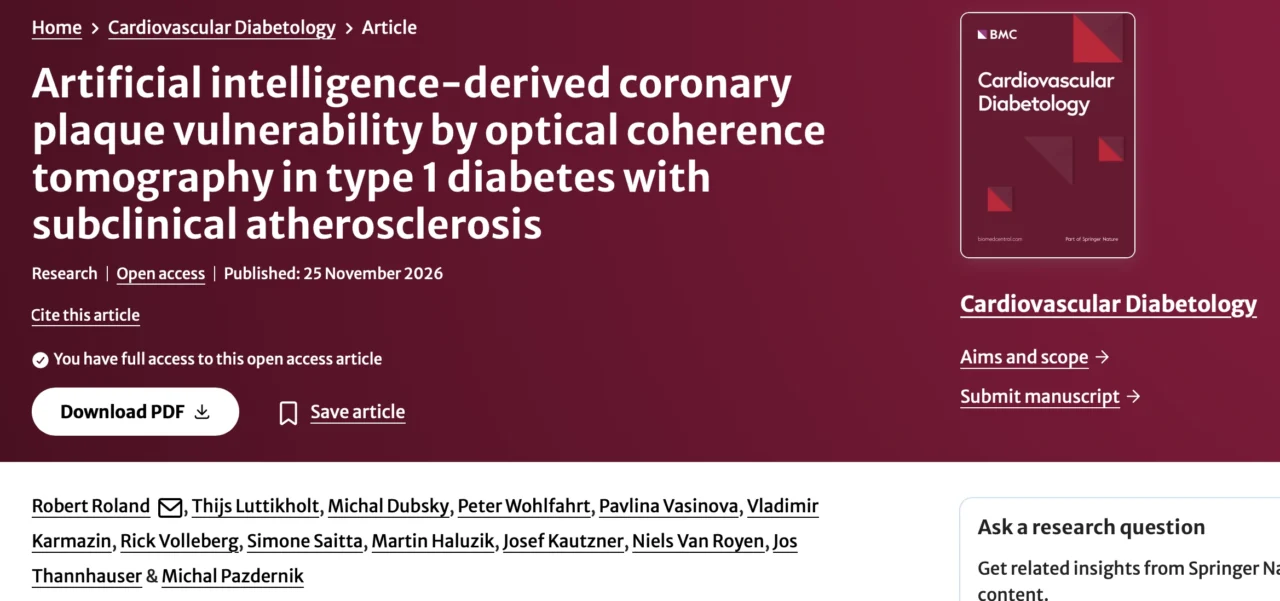
“I’m delighted to share that our research article, ‘Artificial intelligence-derived coronary plaque vulnerability by optical coherence tomography in type 1 diabetes with subclinical atherosclerosis,’ is now published in Cardiovascular Diabetology (IF 15.6).
How common are obstructive coronary artery disease (CAD) and high-risk plaque features in asymptomatic patients with long-standing type 1 diabetes and subclinical atherosclerosis.
Our prospective, single-centre study screened 189 asymptomatic adults with type 1 diabetes and no history of atherosclerotic cardiovascular disease using coronary calcium scoring and carotid ultrasound.
Of these, 29 met prespecified imaging criteria and underwent invasive coronary assessment, including optical coherence tomography (OCT).
A key strength was artificial intelligence-assisted OCT analysis using the OCT-AID algorithm developed by CARA Lab.
Comprehensive manual three-dimensional plaque analysis is time-consuming and susceptible to inter-observer variability.
OCT-AID enabled rapid, consistent automated analysis of OCT images, quantifying plaque characteristics and identifying thin-cap fibroatheroma.
In this selected subgroup:
- 44.8% had obstructive coronary artery disease.
- 41.4% had at least one thin-cap fibroatheroma—a high-risk plaque feature.
- Almost one quarter of patients underwent PCI or were referred for CABG.
These findings help characterize silent coronary artery disease in this subgroup. Future studies are needed to assess screening accuracy and determine whether screening-guided care improves outcomes.
Thank you to all co-authors, including co-first author Thijs Luttikholt, co-senior author Jos Thannhauser from CARA Lab, and the masterminds behind the project, Michal Pazdernik and Michal Dubský from Institute for Clinical and Experimental Medicine (IKEM).”
Title: Artificial intelligence-derived coronary plaque vulnerability by optical coherence tomography in type 1 diabetes with subclinical atherosclerosis
Authors: Robert Roland, Thijs Luttikholt, Michal Dubsky, Peter Wohlfahrt, Pavlina Vasinova, Vladimir Karmazin, Rick Volleberg, Simone Saitta, Martin Haluzik, Josef Kautzner, Niels Van Royen, Jos Thannhauser, Michal Pazdernik
Stay updated on all scientific advances with Hemostasis Today.
-
Nov 27, 2026, 03:11Alex Slater: Understanding Platelet Receptors for Better Antithrombotic Drug Development
-
Nov 27, 2026, 03:01Shinya Goto: Catheter-Directed Thrombolysis and OAC Looks better than OAC Alone in Moderate or Severe PE
-
Nov 27, 2026, 02:54Emmanuel J Favaloro: Advancing Global Equity in Venous Thromboembolism Research
-
Nov 27, 2026, 02:54Seshika Ratwatte: Addresses Diastolic Dysfunction Challenges in Adults with Congenital Heart Disease
-
Nov 27, 2026, 02:43Increasing Demand for Ro Blood in Sickle Cell Disease – NTLM
-
Nov 27, 2026, 02:42Managing Teenage Pregnancy in von Willebrand Disease Through Multidisciplinary Care – Haemophilia Journal
-
Nov 27, 2026, 01:57Berkan Kurt: GLP-1 Receptor Agonists and the Role of Inflammation in Cardiovascular Protection
-
Nov 27, 2026, 01:17Transforming Hemophilia Care in Bangladesh Through Humanitarian Support – World Federation of Hemophilia
-
Nov 27, 2026, 01:08Sneha Singh: Inferior Thyroid Artery Abnormalities as a Potential Marker of Cardiovascular Risk