


Danny Hsu: Navigating a Rebalanced Hemostatic State in Decompensated Cirrhosis
Danny Hsu, President of THANZ, Director of Therapeutic Apheresis, Immune and Obstetric Haematology at South Western Sydney Local Health District, reposted from JTH on LinkedIn, adding:
”Navigating the tightrope: Thrombosis and Decompensated Cirrhosis
There are few clinical scenarios as complex as managing anticoagulation in patients with decompensated cirrhosis.
We historically assumed that a prolonged PT/INR and thrombocytopenia naturally protected these patients from thrombosis.
However, we now know that cirrhosis creates a state of ‘rebalanced hemostasis,’ where many patients actually exhibit hypercoagulable features and are at a significantly increased risk for both atrial fibrillation (AF) and venous thromboembolism.
A fantastic new ‘JTH In Clinic’ review by Bell et al. breaks down three of our most challenging scenarios. Here is a look at the key takeaways for our THANZ community:
- AF and Elevated PT/INR: For stroke prevention in patients with Child-Pugh A and B cirrhosis, DOACs demonstrate a better safety profile compared to warfarin. Meta-analyses show DOACs offer a 26% to 46% relative reduction in the risk of major bleeding, with emerging data suggesting apixaban may pose a lower bleeding risk than rivaroxaban in this population.
- AF with Recurrent Bleeding: When the bleeding risk on anticoagulation becomes unacceptable, we need to think outside the pillbox. Non-pharmacologic strategies, such as Left Atrial Appendage Closure (LAAC), can be considered on a case-by-case basis for patients at high risk for stroke who have a sufficient life expectancy.
- PVT and Thrombocytopenia: Treating Portal Vein Thrombosis (PVT) can significantly reduce all-cause mortality and improve survival for patients undergoing liver transplantation. Crucially, platelet counts are poor predictors of bleeding in cirrhosis. Therapeutic anticoagulation should still be considered even when a patient’s platelet count is <50×10^9/L.
These patients require highly individualized, multidisciplinary care, but it is incredibly encouraging to see the evidence base continuing to grow to support our clinical decisions.
How are you approaching PVT management in your cirrhotic patients with low platelets?
Let’s discuss in the comments!”
Journal of Thrombosis and Haemostasis (JTH) shared on LinkedIn about a recent article by Conor Bell et al, adding:
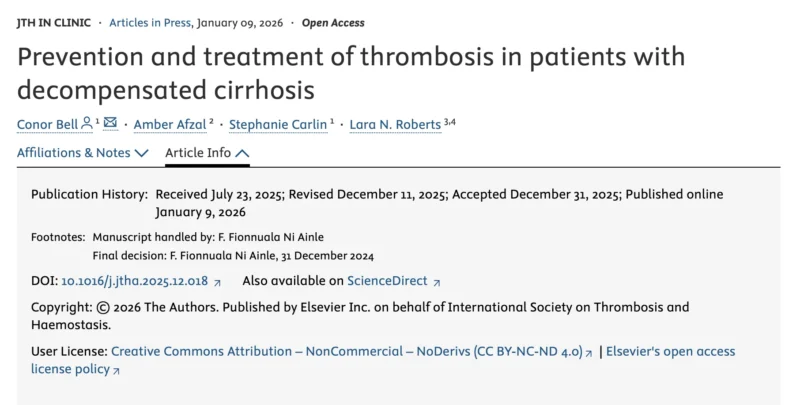
”Prevention and Treatment of Thrombosis in Patients with Decompensated Cirrhosis
Patients with decompensated cirrhosis often need anticoagulation for conditions like atrial fibrillation and portal vein thrombosis, yet altered drug metabolism and bleeding risks make safe management a major clinical challenge requiring individualized approaches.”
Title: Prevention and treatment of thrombosis in patients with decompensated cirrhosis
Authors: Conor Bell, Amber Afzal, Stephanie Carlin, Lara Roberts
Read the Full Article on JTH
Stay updated on all scientific advances with Hemostasis Today.
-
Sep 25, 2026, 09:49Haley Coleman: Volunteering to Support Hemophilia Awareness
-
Sep 25, 2026, 08:55Hitarth Mehta: BHMS Students Gain Practical Exposure to Haemophilia Diagnosis
-
Sep 25, 2026, 07:25Varun Capoor: How Therapeutic Apheresis and Transfusion Medicine Can Complement Clinical Management in SCD
-
Sep 25, 2026, 07:14Manshi Kesharwani: SAK-GQDs Modulate Thrombus Burden and Endothelial Function in Deep Vein Thrombosis
-
Sep 25, 2026, 06:20Farjah Hassan Algahtani: How Can We Better Identify Patients at Risk of Blood Clots after Metabolic and Bariatric Surgery?
-
Sep 25, 2026, 05:59Carla Lewis: Kids Conquering Sickle Disease Joins Nemours Children’s Hospital for 2nd Annual Awareness Event
-
Sep 25, 2026, 05:47Omid Seidizadeh: Evolutionary Constraint and Population Variation Across Coagulation Genes
-
Sep 25, 2026, 05:40Gerald Bertrand: Presenting UMi-NGS Non-Invasive Foetal HPA Genotyping at DGTI 2026
-
Sep 25, 2026, 05:33Urge Congress to support the Sickle Cell Disease Comprehensive Care Act – ASH