


Carlos Henrique Del Carlo: HFpEF Reimagined as an Adipose Tissue Driven Disease
Carlos Henrique Del Carlo, Collaborating Professor at University of São Paulo Medical School, shared a post on LinkedIn:
”HFpEF: Does it start in the Heart — or in the Adipose Tissue?
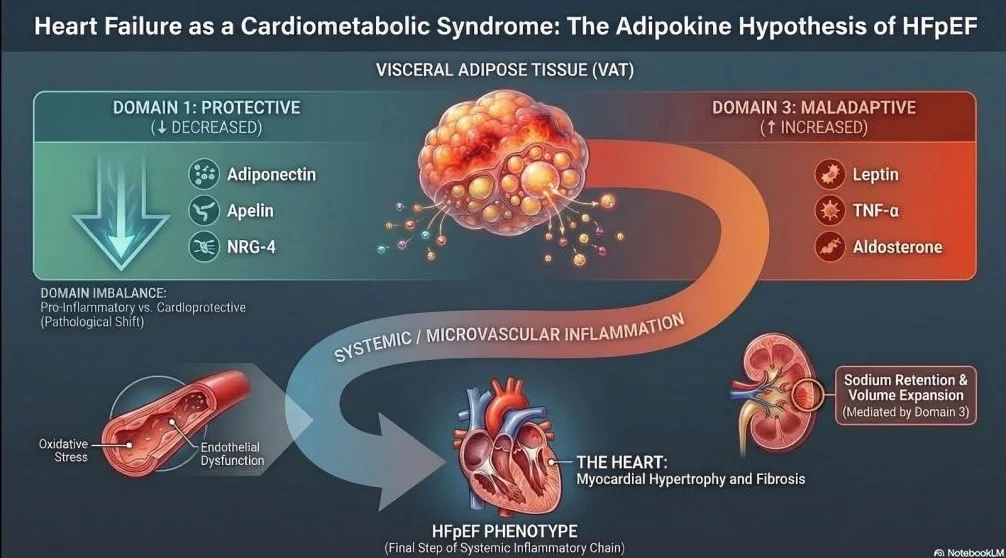
The traditional heart failure model focuses predominantly on the myocardium. However, the ‘Adipokine Hypothesis,’ recently proposed by Milton Packer (JACC 2025), suggests a radical paradigm shift: HFpEF may actually be the cardiac manifestation of systemic visceral adipose tissue dysfunction.
In this framework, adipose tissue is not merely an energy reservoir; it is an active endocrine organ that dictates cardiovascular biology.
The Proposed Pathophysiological Cascade:
- Visceral Adiposity: Expansion and dysfunctional transformation of adipose tissue (adipopathy).
- Adipokine Imbalance: A decline in cardioprotective molecules (Domain I) and a surge in pro-inflammatory and anti-natriuretic signals (Domain III).
- Systemic Inflammation: Microvascular oxidative stress and reduced nitric oxide bioavailability.
- Sodium Retention: Plasma volume expansion mediated by adipose biology, occurring even before overt cardiac failure.
- Myocardial Fibrosis: The heart as the “end-organ” target of a systemic insult that began in the periphery.
Why does this change our practice?
It explains why the most impactful therapies today – such as SGLT2 inhibitors and GLP-1 receptor agonists – are so effective: they target the metabolic and inflammatory substrate, not just cardiac mechanics.
When treating HFpEF, we are no longer just managing congestion; we are attempting to modulate the biological drivers of the disease.
Question for debate: Do you believe that, in the future, HFpEF management will be guided primarily by the biology of inflammation and adipose tissue, rather than just hemodynamics?
Reference: Packer M. The Adipokine Hypothesis of Heart Failure With a Preserved Ejection Fraction. J Am Coll Cardiol. 2025;86(16):1 801-1815.
Check the infographic below (produced with NotebooLM) for a visual summary of the adipokine hypothesis of HFpEF.”
Marwan Refaat Tenured Professor of Medicine, Biochemistry and Molecular Genetics at the American University of Beirut, shared this post on Linkedin, adding:
”Cardiovascular-kidney-metabolic (CKM) syndrome HFpEF Metabolic-Obese phenotype Visceral adiposity Systemic inflammation Microvascular dysfunction.”
Stay updated with Hemostasis Today.
-
Oct 20, 2026, 03:24Chaza Alaji: Diagnosing Protein C and Protein S Deficiency
-
Oct 20, 2026, 03:24Mou Nandi: How Maternal Health During Pregnancy May Shape Infant Development
-
Oct 20, 2026, 03:13Sumyea Kabir: Pre-Analytical Quality in Phlebotomy – Preventing In Vitro Hemolysis
-
Oct 20, 2026, 02:37M. Sekip Altunkan: Can Anticoagulation Be Safely Stopped After AF Ablation?
-
Oct 20, 2026, 02:26Ahmed Ammar: Managing VT Recurrence Post-Ablation
-
Oct 20, 2026, 01:43Oliver Weingärtner: Deprescribing of Lipid Lowering Drug after MI is Associated with Cardiovascular Events
-
Oct 19, 2026, 19:44Where You Live Should not Determine Whether You Receive Care – World Federation of Hemophilia
-
Oct 19, 2026, 19:42Belen Bianco: Prevention, Early Suspicion and an Interdisciplinary Approach Save Lives
-
Oct 19, 2026, 19:40Christina Chrysohoou: Catheter-Based LAAC vs OAC for Stroke Prevention in Atrial Fibrillation