

Imran Khan: Balancing Benefit and Risk in Long-Term Anticoagulation
Imran Khan, Global Medical Leader at Pfizer, shared Amaia Irizar‘s post on LinkedIn:
“Delighted to share that we now have two publications from a study in which we attempted to better define the impact of long-term anticoagulation on two competing risks: recurrent thrombosis and bleeding.”
Amaia Irizar, CEO at ForecomAI and Senior Toxicology Associate at IFRA, shared ForecomAI‘s post on LinkedIn about a recent article she and her colleagues co-authored, published in JTH, adding:
“I’m thrilled that our two manuscripts on the analysis of Real World Data have just been published.
How long should you treat venous thromboembolism (VTE)?
There’s no fixed answer — it’s a balance between preventing another clot and avoiding the risk of bleeding.
Our two new studies offer simple tools to help personalise that decision for each patient.
Thanks to our fantastic collaborative team from NHS, industry, academia and ForecomAI, with whom I had the huge privilege to work with.”
ForecomAI shared a post on LinkedIn about a recent article by Alexander T. Cohenet al. published in JTH, adding:
“How long should anticoagulation continue after venous thromboembolism (VTE)?
Every decision about long-term anticoagulation involves balancing two competing risks: recurrent thrombosis and bleeding. Yet accurately quantifying these risks for an individual patient remains one of the most important challenges in thrombosis care.
We are delighted that our two complementary manuscripts have been accepted for publication in the Journal of Thrombosis and Haemostasis (JTH).
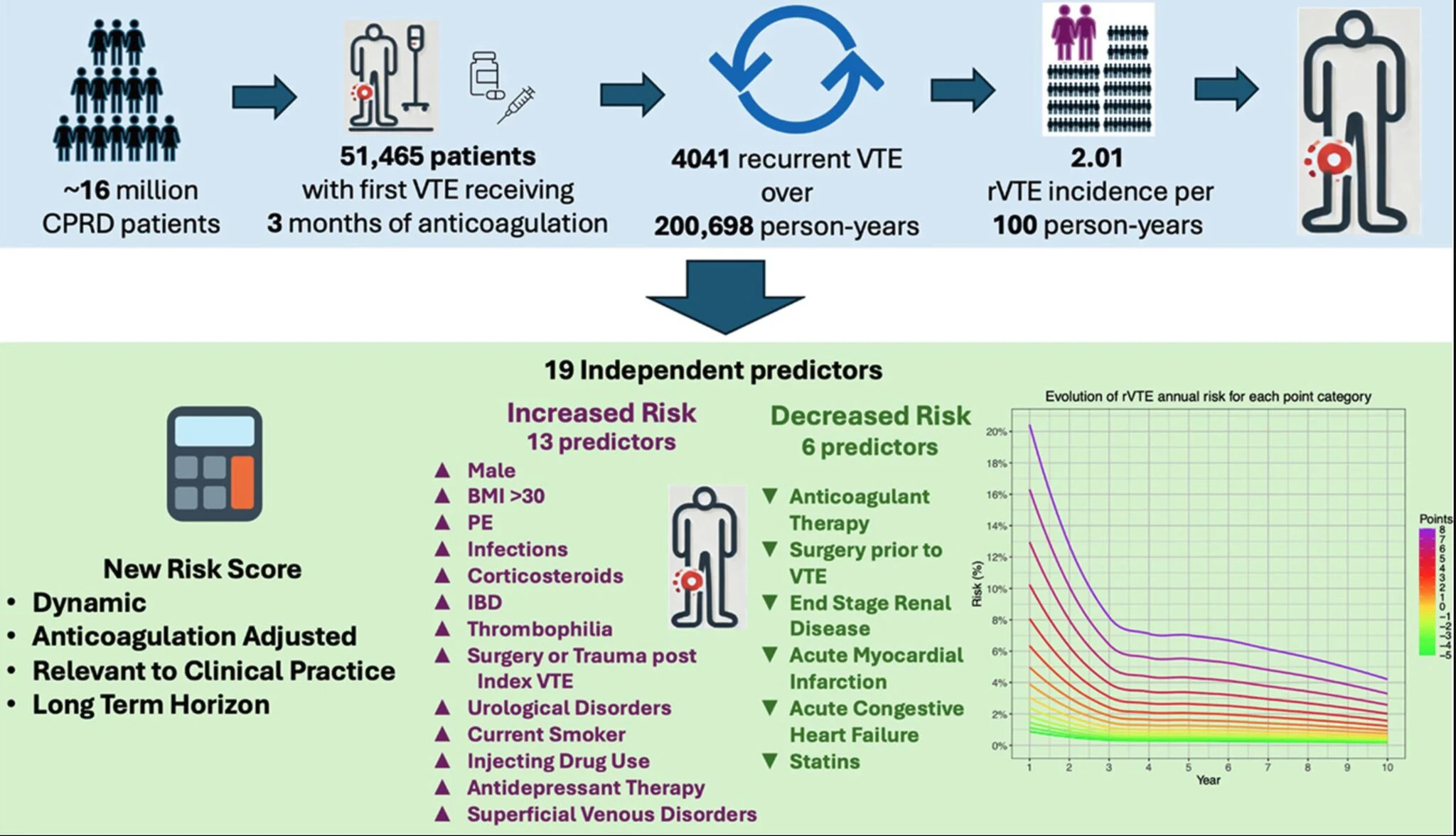
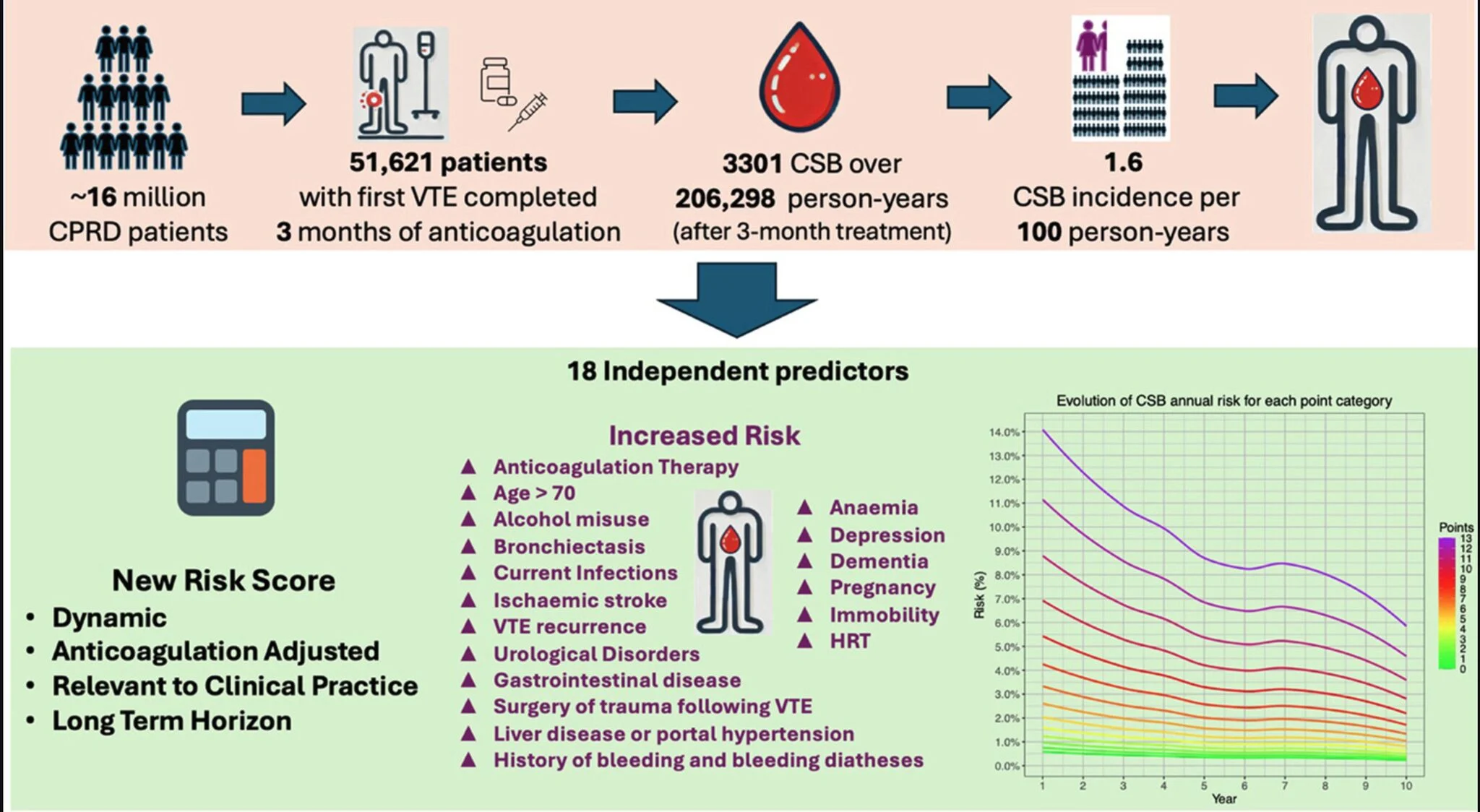
Using over 20 years of UK real-world healthcare data, we analysed more than 50,000 patients and over 200,000 person-years of follow-up to develop dynamic prediction models for both recurrent VTE (rVTE) and clinically significant bleeding (CSB).
The models account for the competing risk of death and are fully explainable, using point-based scoring systems derived from clinically meaningful patient characteristics.
Each score can be broken down into its individual contributing factors, making the predictions clinically interpretable and avoiding the ‘black box’ limitations often associated with predictive models.
The analyses revealed substantial variation in predicted patient risk. First-year recurrence risk ranged from less than 1% to more than 20%, while first-year bleeding risk ranged from 0.6% to 18%.
These findings highlight that VTE patients are far from homogeneous and that risk spans a remarkably broad continuum rather than fitting into simple ‘low-risk’ and ‘high-risk’ categories.
Together, these models provide a framework for quantifying both sides of the anticoagulation decision: the risk of recurrence and the risk of bleeding. We hope they will support more informed and individualised assessment of benefit and risk over time.
This work was made possible through a fantastic collaboration between NHS clinicians, academic researchers, industry experts, and the team at ForecomAI.
For us at ForecomAI, the study demonstrates how rigorous statistical modelling, explainable analytics, and large-scale real-world healthcare data can be combined to generate clinically relevant evidence and practical decision-support tools.”
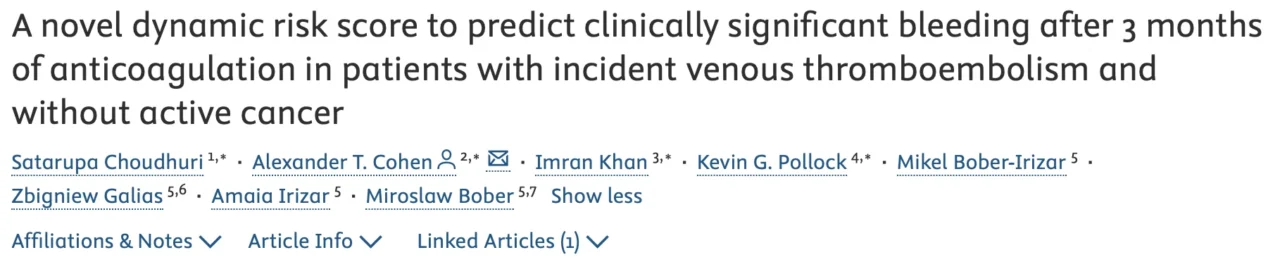
Title: A novel dynamic risk score to predict clinically significant bleeding after 3 months of anticoagulation in patients with incident venous thromboembolism and without active cancer
Authors: Satarupa Choudhuri, Alexander T. Cohen, Imran Khan, Kevin G. Pollock, Mikel Bober-Irizar, Zbigniew Galias, Amaia Irizar, Miroslaw Bober
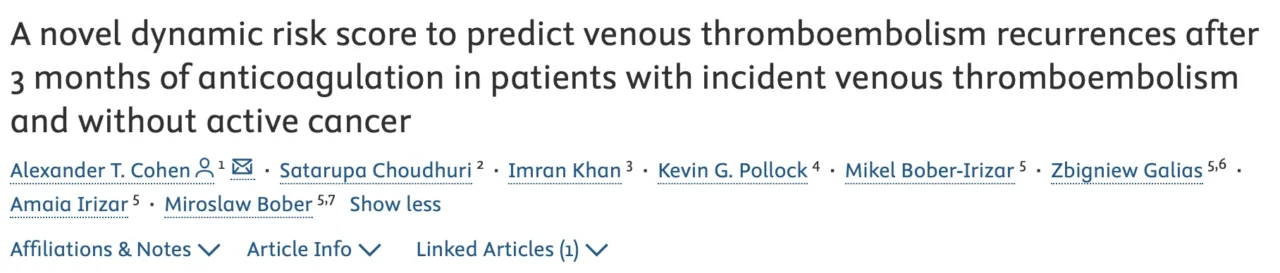
Title: A novel dynamic risk score to predict venous thromboembolism recurrences after 3 months of anticoagulation in patients with incident venous thromboembolism and without active cancer
Authors: Alexander T. Cohen, Satarupa Choudhuri, Imran Khan, Kevin G. Pollock, Mikel Bober-Irizar, Zbigniew Galias, Amaia Irizar, Miroslaw Bober
Stay updated on all scientific advances with Hemostasis Today.
-
Nov 15, 2026, 23:44Pablo César Spada: Prevention of Venous Thromboembolism After Total Hip or Knee Replacement
-
Nov 15, 2026, 23:30Eshal Amir: Factor XI Inhibitors in AFib and Aortic Mortality Trends
-
Nov 15, 2026, 23:19Hamza Bashir: Adding Endovascular Therapy to Anticoagulation Cuts Moderate-to-Severe PTS in Half
-
Nov 15, 2026, 23:06Lanre Tunji-Ajayi: 2 Days of Deliberative Dialogue Hosted by the Network of Rare Blood Disorder Organizations
-
Nov 15, 2026, 23:00Fanny Delettre: Looking Back at Volunteer Blood Donor Friends Day
-
Nov 15, 2026, 20:56Victoria Adedoyin Adisa-Thomas: What I Learned About SCD During My Genetic Counselling Rotation
-
Nov 15, 2026, 20:55Martin Holst Lange: One Step Closer to a Potential New Treatment for Sickle Cell Disease
-
Nov 15, 2026, 20:53Bontha Babu: Health-Related Quality of Life Among Adults with Sickle Cell Disease in India
-
Nov 15, 2026, 20:52Miguel Ángel Herrera Rojas: A First-Line ITP Approach Presented at ASH in 2013 Now Reflected in the 2026 Guidelines