


Martin Vanden Eede: Can We Safely Reduce Anticoagulation During ECMO?
Martin Vanden Eede, Cardiologist and Intensive Care Physician at ZAS, shared a post on LinkedIn about a recent article by Olivier van Minnen et al. published in The Lancet, adding:
“Can we safely reduce anticoagulation during ECMO?
An interesting Multicentre randomized controlled non-inferiority trial compared:
- Standard-dose UFH (current standard of care)
- Low-dose UFH
- Therapeutic low-molecular-weight heparin (LMWH)
The hypothesis was straight forward: Less anticoagulation may reduce bleeding without increasing thrombosis.
The primary endpoint was a composite of:
- Severe bleeding during ECMO
- Severe thromboembolic complications
- All-cause mortality at 6 months
This endpoint reflects the real clinical balance between preventing thrombosis and avoiding bleeding.
Primary endpoint:
- Standard UFH 81%
- Low-dose UFH 72%
- LMWH 75%
Both low-dose UFH and LMWH met the predefined criterion for non-inferiority, meaning they were not worse than standard-dose UFH regarding the combined endpoint.
Equally important was that:
- Reduced-intensity strategies consistently showed fewer bleeding events.
- Lowering anticoagulation did not increase thrombotic complications.
- Similar transfusion requirements between groups
- Fewer oxygenator exchanges with LMWH
- Low-dose UFH showed the highest probability of being cost-effective.
These findings are likely to influence future ECMO anticoagulation guidelines and support a shift toward lower-intensity anticoagulation in appropriately selected patients.
Three Key Points
- Lower-intensity anticoagulation (low-dose UFH or therapeutic LMWH) was non-inferior to standard-dose UFH during ECMO.
- Reducing anticoagulation did not increase thrombotic complications and showed a consistent trend toward fewer severe bleeding events.
- The study provides strong evidence that routine ECMO anticoagulation targets should be reconsidered, potentially making lower-intensity anticoagulation the future standard of care.”
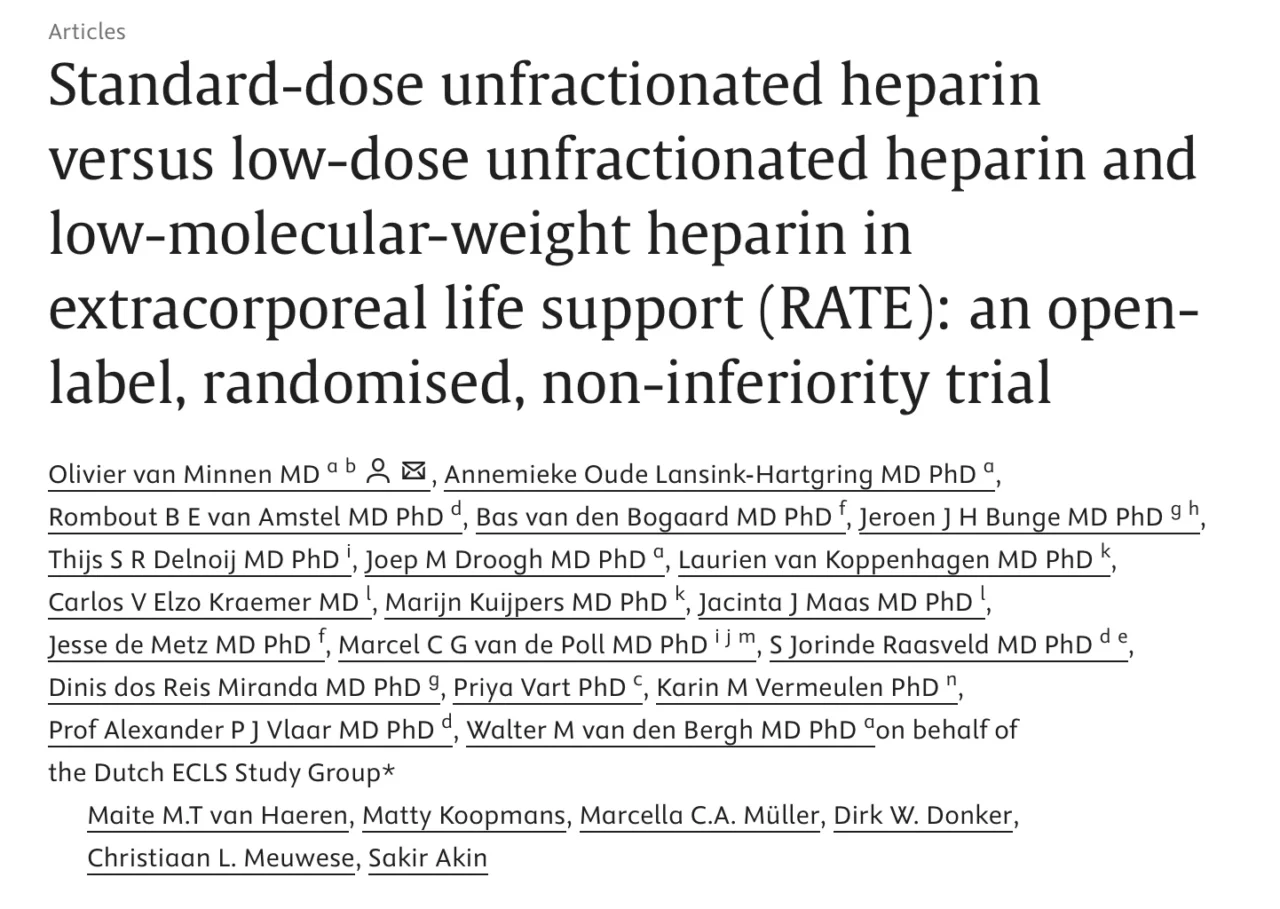
Titile: Standard-dose unfractionated heparin versus low-dose unfractionated heparin and low-molecular-weight heparin in extracorporeal life support (RATE): an open-label, randomised, non-inferiority trial
Authors: Olivier van Minnen, Annemieke Oude Lansink-Hartgring, Rombout B. E. van Amstel, Bas van den Bogaard, Jeroen J. H. Bunge, Thijs S. R. Delnoij, Joep M. Droogh, Laurien van Koppenhagen, Carlos V. Elzo Kraemer, Marijn Kuijpers, Jacinta J. Maas, Jesse de Metz, Marcel C. G. van de Poll, S. Jorinde Raasveld, Dinis dos Reis Miranda, Priya Vart, Karin M. Vermeulen, Alexander P. J. Vlaar, Walter M. van den Bergh, Maite M. T. van Haeren, Matty Koopmans, Marcella C. A. Müller, Dirk W. Donker, Christiaan L. Meuwese, Sakir Akin
Stay updated on all scientific advances with Hemostasis Today.
-
Nov 26, 2026, 16:18Ukti Bhatt: Celebrating an ASH 2026 Oral Presentation and Abstract Achievement Award
-
Nov 26, 2026, 16:05Peter Loffelhardt: Advancing MPN Research Through Patient-Centred Innovation
-
Nov 26, 2026, 15:55Abdul Hanan: Blood Component Separation and Clinical Applications
-
Nov 26, 2026, 15:41Sara Altayeb: From Diagnosing Anaemia to Recognising Iron Deficiency Earlier
-
Nov 26, 2026, 15:35Farjah Hassan Algahtani: Hydroxyurea Use and Quality of Life in Sickle Cell Anaemia
-
Nov 26, 2026, 15:32Micah Robert: Balancing LAAO and Anticoagulation in Patients With Atrial Fibrillation
-
Nov 26, 2026, 15:23Anne Juanós: SHN Physiotherapy Group Receives Research Grant for Haemophilia
-
Nov 26, 2026, 15:21Alessandro Armaro։ Rethinking DAPT Duration After CABG
-
Nov 26, 2026, 15:16Junedh M Amrute: Decoding the Cellular and Molecular Basis of Coronary Artery Disease