


Ifeanyichukwu Ifechidere: What If the Test We’ve Trusted for Decades Has Been Telling Us Half the Story?
Ifeanyichukwu Ifechidere, Specialist Biomedical Scientist at Sheffield Teaching Hospitals NHS Foundation Trust, shared a post on LinkedIn:
“What if the test we’ve trusted for decades has been telling us half the story?
Every warfarin patient knows the ritual: regular INR checks, dose adjustments, the same PT-based formula clinicians have relied on since the 1930s.
But here’s a question that doesn’t get asked enough – is standard PT actually measuring what matters most for warfarin control?
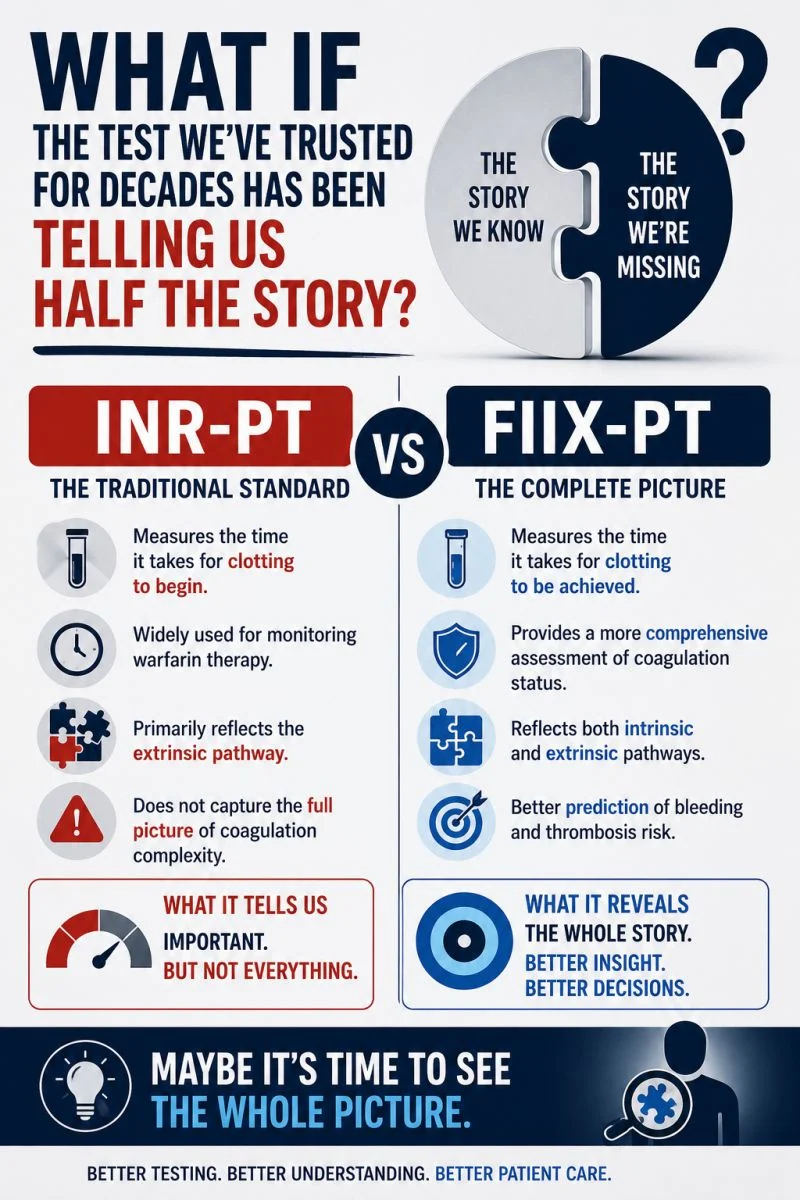
Let’s dig into the curious case of INR-PT vs Fiix-PT
The classic: INR-PT
Standard PT measures the extrinsic and common pathway – Factors II, V, VII, X, and fibrinogen.
The problem? Factor VII has the shortest half-life of the vitamin K-dependent factors.
It drops fast and rises fast, meaning INR-PT is heavily influenced by Factor VII fluctuations that don’t necessarily reflect the patient’s true anticoagulation status.
It can overreact to minor changes – leading to dose adjustments that chase noise, not signal.
The challenger: FiiX-PT
Fiix-PT deliberately excludes Factors VII and V from the equation, focusing instead on Factors II and X – the two factors with longer half-lives that better reflect steady-state anticoagulation.
The theory: fewer short-term fluctuations, more stable dosing decisions, and potentially fewer unnecessary dose changes driven by transient Factor VII swings.
Why this matters clinically
Some studies suggest Fiix-PT-guided dosing leads to more time spent in therapeutic range, with fewer dose adjustments overall compared to conventional INR monitoring.
If true, that’s not a small deal – time in therapeutic range is directly linked to both thrombotic and bleeding risk in warfarin patients.
The curious tension
If Fiix-PT genuinely offers more stable, more clinically meaningful monitoring, why hasn’t it replaced INR-PT globally?
Partly infrastructure – INR is embedded in labs, guidelines, and clinician habits worldwide.
Partly evidence – larger, more diverse trials are still needed before health systems justify the shift.
And partly inertia – a test that’s ‘good enough’ is a hard sell against a test that requires new validation, new reference ranges, new training.
The question worth sitting with
Are we monitoring warfarin the way that’s easiest to standardise – or the way that’s most clinically accurate?
INR-PT built the foundation of anticoagulation monitoring.
But Fiix-PT is a reminder that ‘the way we’ve always done it’ deserves periodic re-examination, not blind loyalty.
This is the kind of emerging science I explore in Coagsimplified.
Have you worked with Fiix-PT, or is this new to you? Let’s discuss below”
Find more posts featuring Ifeanyichukwu Ifechidere on Hemostasis Today.
-
Sep 17, 2026, 20:38Konstantinos Bistas: Reduced Circulating Tregs in Pediatric Chronic Neutropenia
-
Sep 17, 2026, 15:33Gopal Patidar: Honoured to Contribute to the ASFA 2026 Guidelines for Therapeutic Apheresis
-
Sep 17, 2026, 20:36Cosima C. Hoch: Developing a 3D Organotypic Co-Culture Model for Pleomorphic Adenoma
-
Sep 17, 2026, 20:19Riten Kumar: Boston Children’s Hospital Ranked No. 1 in Seven Pediatric Specialties
-
Sep 17, 2026, 20:17Katrina Snow: Whole Blood or Component Therapy – Which Would You Choose?
-
Sep 17, 2026, 16:30Daria Camilli: Empowering Bleeding Disorder Advocacy Through Health Economics
-
Sep 17, 2026, 16:17Mehran Ghasemzadeh: Platelet NK Cell Crosstalk in Advanced Coronary Artery Disease
-
Sep 17, 2026, 16:16Barbara Adams Krolak: Do GLP-1s Affect Blood Clot Risk?
-
Sep 17, 2026, 15:46Heghine Khachatryan: Clinical Context at the Core of Thrombosis and Thrombophilia Management