


Sip Wijchers: How PFA Technology Influences Hemolysis and Renal Safety
Sip Wijchers, Cardiologist-electrophysiologist at Erasmus MC, shared a post on LinkedIn:
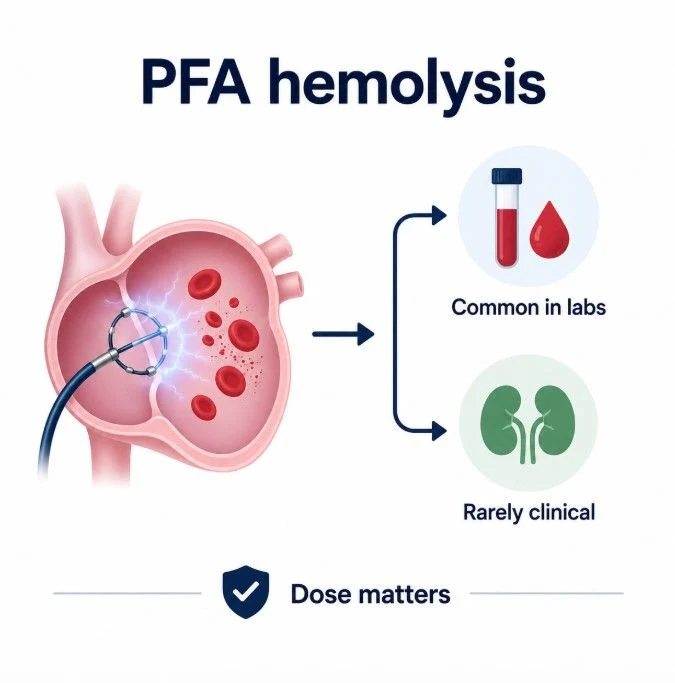
“PFA hemolysis: common in the lab, rarely a clinical problem?
Hemolysis after pulsed field ablation is real.
Erythrocytes are also susceptible to electroporation, and biochemical signs of intravascular hemolysis are therefore common after PFA, with reductions in haptoglobin and increases in free hemoglobin, LDH and bilirubin.
What is becoming more interesting is not whether hemolysis occurs, but what determines its magnitude and when it becomes clinically relevant.
Marino et al. compared three different PFA platforms, including nanosecond and microsecond technology.
Biochemical hemolysis occurred in 93.6 percent of patients, but the magnitude varied considerably.
Significant hemolysis was seen in 70 percent with Nano PFA 360, 79.4 percent with pentaspline and 23 percent with a focal lattice-tip system.
Importantly, nanosecond and microsecond single-shot approaches produced similar hemolytic profiles despite very different pulse durations.
Rocchetti et al. studied 239 patients using pentaspline, balloon-in-basket and lattice-tip PFA.
Again, the biological response differed between technologies.
Haptoglobin depletion was most pronounced with pentaspline, while the other systems showed smaller changes.
Myocardial injury markers also differed, suggesting that lesion footprint, contact and catheter architecture all contribute to the biological effect.
For me, the main message is that hemolysis is probably not explained by one parameter alone.
The hemolytic burden of PFA is likely a product of energy delivery, catheter geometry, blood-pool exposure, contact and total application burden.
That fits with previous work showing a dose-response relationship between application count and hemolysis.
Clinically relevant AKI remains uncommon and seems to occur mainly with extensive lesion sets, high application numbers, reduced renal reserve or additional procedural stressors.
The distinction between biochemical hemolysis and clinical injury is therefore important.
In Marino et al., four patients developed AKI and one temporarily required dialysis, with full recovery.
In Rocchetti et al., AKI was limited to five transient stage I events.
So I would not frame hemolysis as an argument against PFA.
Rather, it is another parameter that helps us understand how different systems interact with blood and tissue.
For standard PVI, biochemical hemolysis appears common while clinically relevant renal injury remains uncommon.
With increasing lesion burden, dose, hydration and renal reserve become more relevant.
Not all PFA is biologically identical.
The better question may be: which combination of energy delivery, catheter design and workflow gives us the desired lesion while minimizing unnecessary blood-pool exposure?”
Stay updated with Hemostasis Today.
-
Sep 18, 2026, 17:48Ronak H. Mistry: Updated ASH Guidelines Bring New Focus to Iron Deficiency
-
Sep 18, 2026, 17:32Hassan Kawtharany: New Ferritin Cutoffs for the Diagnosis of Iron Deficiency With or Without Anemia
-
Sep 18, 2026, 17:20Abhishek G P: GAVE as an Important Cause of Chronic Gastrointestinal Blood Loss
-
Sep 18, 2026, 17:08Irem Karaman Sebin: ASH 2026 Changes a Key Concept in Iron Deficiency
-
Sep 18, 2026, 16:51Adarsh Krishnan Sundara Rajan: Is VTE the Most Underdiagnosed Critical Threat in Modern Healthcare?
-
Sep 18, 2026, 16:19CRISPR and Hemophilia: The Next Frontier of In Vivo Gene Editing
-
Sep 18, 2026, 16:13Christian Irsara: PF4 Immunothrombosis Following Natural Adenovirus Infection
-
Sep 18, 2026, 16:10Leo Nicolai։ The Spleen Emerges as a Key Regulator of Thromboinflammation
-
Sep 18, 2026, 16:05Targeting Factor XI to Reduce Thrombosis Without Compromising Hemostasis – ISTH