

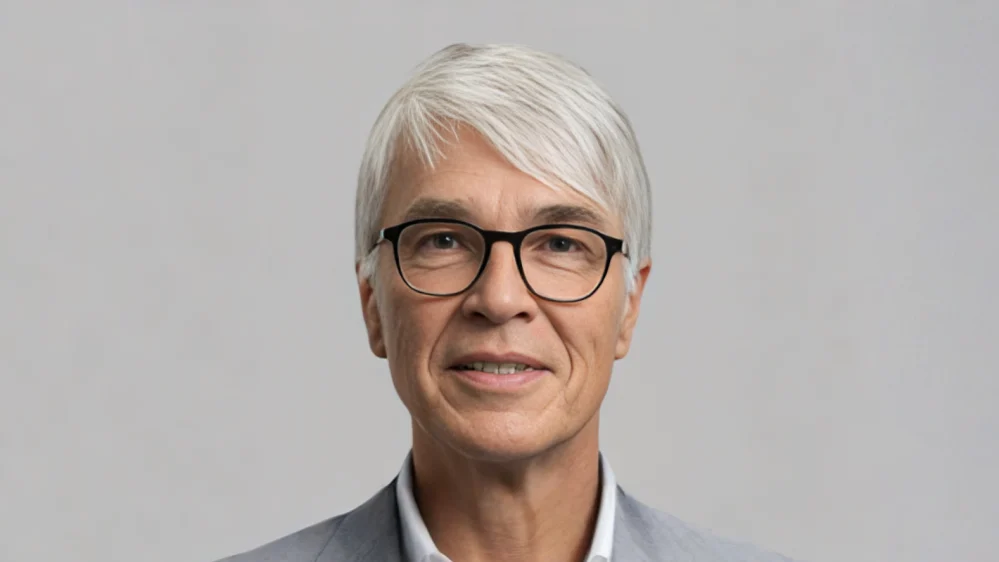
Wolfgang Miesbach: A New Guideline for Critical Bleeding in ITP
Wolfgang Miesbach, Head of the Hemostasis and Hemophilia Center at Department of Medicine II, University Hospital Frankfurt, shared a post on LinkedIn about a recent article by Saifur R. Chowdhury et al., published in Blood Advances, adding:
“A second major ITP guideline this year — this one from the McMaster ITP Emergency Management Group, and it fills a gap nobody had addressed: what to do when a patient with ITP is bleeding into the brain.
Critical bleeds have been excluded from every previous ITP guideline. Rare, but ICH occurs in approximately1.4% of adults and approximately 0.4% of children with ITP, with reported case fatality of 9.7–44%.
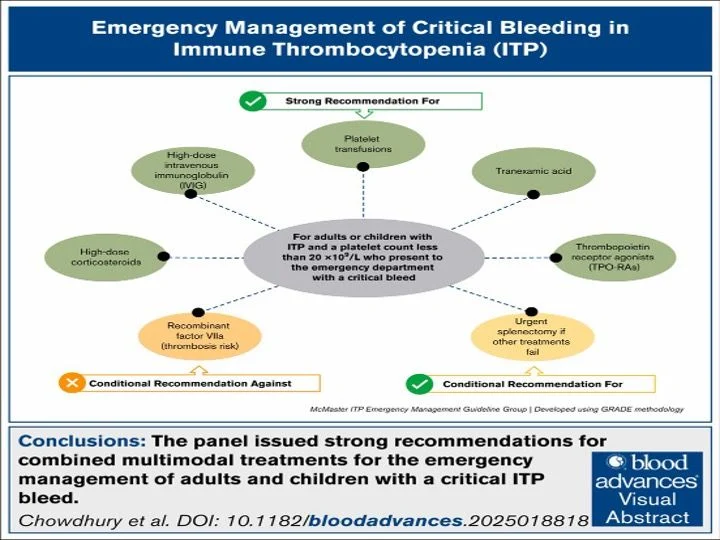
1.Everything at once: for adults or children with a critical bleed and platelets less than 20 ×10⁹/L, all of the following together or in immediate succession – strong recommendations, despite low to very low certainty evidence (adult doses shown; paediatric dosing differs):
- High-dose corticosteroids – dexamethasone 40 mg IV × 4 d, or methylprednisolone 1 g IV × 3 d
- IVIG 1 g/kg for 1–2 days
- Platelet transfusion — even though the increment is short-lived
- Tranexamic acid 1 g IV every 6–8 h for 1–3 days
- A TPO-RA up front — romiplostim 5–10 µg/kg s.c.
The TPO-RA recommendation is the genuinely new element. First time these agents are placed in the emergency algorithm rather than the maintenance one.
2.And two things not to do:
- Recombinant FVIIa – conditional recommendation against, on thrombotic risk; reserved for failure of everything else.
- Urgent splenectomy – rescue only, after medical therapy has failed to secure haemostasis.
Strong recommendations on weak evidence, deliberately — in a bleeding emergency, waiting for better trials is not an option.
Both 2026 ITP guidelines point the same way: stop treating sequentially, start combining up front.”
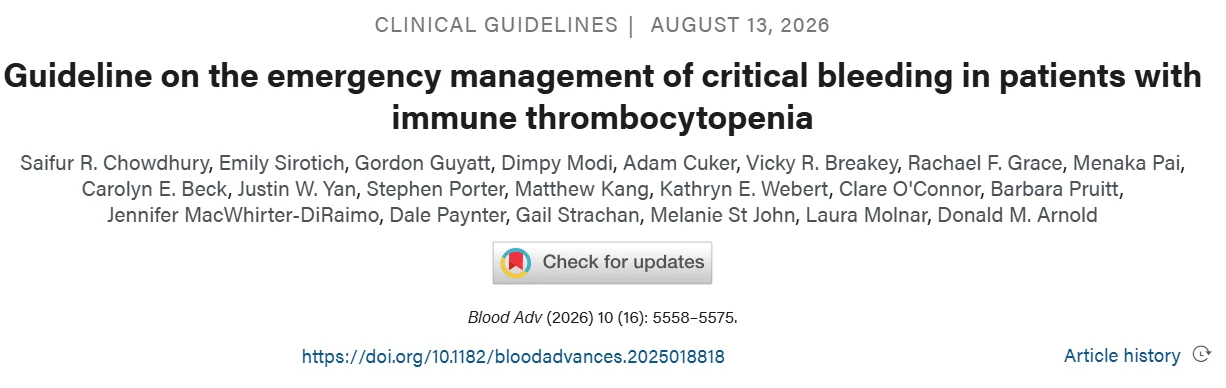
Title: Guideline on the emergency management of critical bleeding in patients with immune thrombocytopenia
Authors: Saifur R. Chowdhury, Emily Sirotich, Gordon Guyatt, Dimpy Modi, Adam Cuker, Vicky R. Breakey, Rachael F. Grace, Menaka Pai, Carolyn E. Beck, Justin W. Yan, Stephen Porter, Matthew Kang, Kathryn E. Webert, Clare O’Connor, Barbara Pruitt, Jennifer MacWhirter-DiRaimo, Dale Paynter, Gail Strachan, Melanie St John, Laura Molnar, Donald M. Arnold
Other posts featuring Wolfgang Miesbach on Hemostasis Today.
-
Oct 20, 2026, 01:43Oliver Weingärtner: Deprescribing of Lipid Lowering Drug after MI is Associated with Cardiovascular Events
-
Oct 19, 2026, 19:44Where You Live Should not Determine Whether You Receive Care – World Federation of Hemophilia
-
Oct 19, 2026, 19:42Belen Bianco: Prevention, Early Suspicion and an Interdisciplinary Approach Save Lives
-
Oct 19, 2026, 19:40Christina Chrysohoou: Catheter-Based LAAC vs OAC for Stroke Prevention in Atrial Fibrillation
-
Oct 19, 2026, 19:38Matthew Flick: A Two-Day Research Meeting on Fibrinogen, Hemostasis and Thrombosis
-
Oct 19, 2026, 19:37Hayat Saeed: Excited to Share Our Publication on the FGL1–Hepcidin Axis in Iron Homeostasis and Disease
-
Oct 19, 2026, 19:08IPAW 2026 Comes to a Close, but the Work Continues – PPTA
-
Oct 19, 2026, 17:44Paul Riley: Moderating a Webinar on Anticoagulation Monitoring
-
Oct 19, 2026, 16:36Christopher Pittman: Blood Clot Prevention Cannot End at Hospital Discharge