

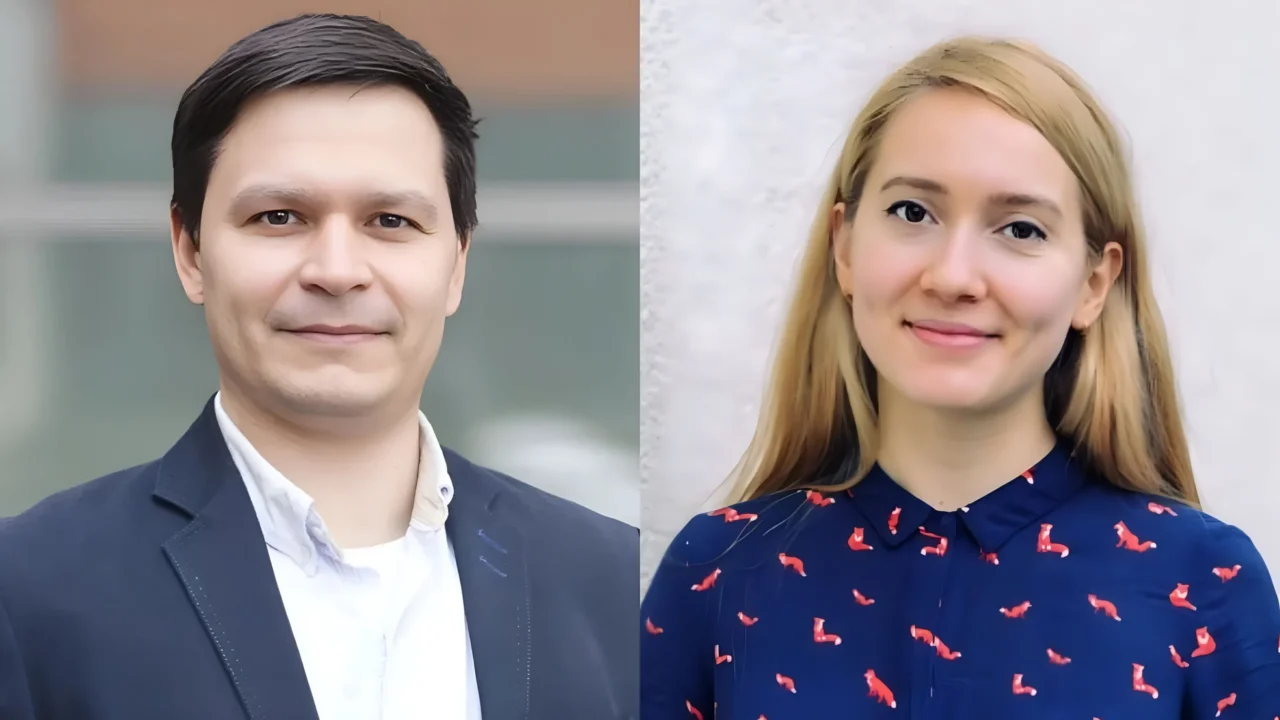
Dmitrii V Kalinin: Cryo-EM Reveals Dynamic Conformational Ensemble of Full-Length FXIa
Dmitrii V Kalinin, Lecturer/Assistant Professor at the University of Galway, shared Alena Siutkina’s post on LinkedIn:
“Very pleased to share our new preprint on the cryo-EM structures of full-length human Factor XIa.
Our results show that activated FXIa is not a single static structure, but a dynamic ensemble of distinct conformational states.
The observed movement of the catalytic domains provides new insight into FXI activation and reveals potential non-catalytic sites for the future development of selective anticoagulants.
This study was a great collaboration between the University of Münster and the University of Galway.
Many thanks to Alena Siutkina for leading the experimental work and to the entire team for making this study possible!”
Alena Siutkina, Postdoctoral Fellowship University of Münster, shared a post on LinkedIn:
“Factor XIa in motion: How activation reshapes a symmetric homodimer
Coagulation Factor XI is known as a symmetric homodimer, but our new cryoEM structures show that its active form, FXIa, is far from static.
Thanks to cryoEM, we can now see that activated human FXIa is far more dynamic.
I am excited to share our latest research, now available on bioRxiv, conducted in collaboration between the University of Münster and the University of Galway.
In this work, we report cryo-EM structures of full-length human apo-FXIa — the activated enzyme in the absence of bound antibodies, inhibitors, or other ligands.
At the achieved resolution, we could observe:
- A full-length apo-FXIa cryo-EM structure at 2.80 Å resolution
- A major activation-associated repositioning of the catalytic domain relative to the apple-domain platform
- Three distinct apo-FXIa conformational states, revealing pronounced catalytic-domain flexibility
- Molecular dynamics evidence that activation rewires allosteric communication between the two catalytic domains
These findings provide new insight into Factor XIa physiology and highlight potential non-catalytic sites for the future design of more selective FXIa modulators.
Many thanks to the entire team — Alexander Neuhaus, Marvin Taterra, Marcel Bermudez, Christos Gatsogiannis, and Dmitrii Kalinin — as well as George Broutzakis and Dr. Anja Blanque for their valuable support in making this investigation possible.”
Proceed to the video attached to the post.
Stay updated with Hemostasis Today.
-
Oct 23, 2026, 16:05Platelet Secretion Defects and Their Role in the Diagnosis of Bleeding Disorders
-
Oct 23, 2026, 16:00Hemophilia Alliance team in New Orleans at the ATHN Data Summit
-
Oct 23, 2026, 15:49Brian Sapp: Why Exact Calf Vein Naming Is Critical for DVT Diagnosis?
-
Oct 23, 2026, 15:33Smitirupa Mishra: A Systematic Approach to Bone Marrow Examination
-
Oct 23, 2026, 15:29José Antonio García Erce: Preoperative Anemia Emerges as a Modifiable Surgical Risk in New POWER Study
-
Oct 23, 2026, 15:13Reza Shojaei: Manufactured Red Blood Cells vs Blood Donation
-
Oct 23, 2026, 14:29Jean Jacques Kiladjian: International Scientific Exchange at IHCAMS in Tianjin
-
Oct 23, 2026, 14:11Aravind Palraj: The Prolonged aPTT Puzzle in SLE
-
Oct 23, 2026, 13:56Chokri Ben Lamine: The Evolving Treatment Landscape of Persistent and Chronic ITP