

Targeted Thrombolysis Beyond tPA
From Fibrin-Only to Multi-Target Clot Dissolution
Targeted thrombolysis is emerging as a model for a broader change in the treatment of thrombotic disorders: moving from activating plasminogen on fibrin toward dismantling the entire clot architecture and, ultimately, personalizing lysis to clot composition.
Traditional tissue plasminogen activator (tPA)–based thrombolysis has saved lives in acute ischemic stroke (AIS), myocardial infarction, and pulmonary embolism (PE), but a substantial proportion of patients experience incomplete recanalization, re-occlusion, or bleeding complications. The emerging therapeutic pipeline is addressing a different question: can we dissolve clots more effectively without relying solely on tPA and without accepting its current limits?
The Defect Is Clot Architecture
The central problem in many thrombotic occlusions is not only insufficient plasmin generation but also a clot structure that resists lysis. Thrombi are heterogeneous, ranging from fibrin-rich ‘red’ clots to platelet-rich ‘white’ clots and mixed clots with abundant extracellular DNA, histones, and matrix proteins.
Non-fibrin components such as neutrophil extracellular traps (NETs), von Willebrand factor (vWF), collagen, fibronectin, and laminin can form a scaffold that limits plasmin access and stabilizes the thrombus. In large-vessel occlusion stroke, high thrombus burden, platelet-rich composition, and NETs are associated with lower recanalization rates and poorer outcomes with tPA alone.
This creates several therapeutic possibilities. Functional lysis can be enhanced with next-generation plasminogen activators, non-fibrin structural elements can be degraded or disrupted, thrombolytics can be delivered locally and amplified with physical energy, and pharmacologic strategies can be combined with device-based approaches to match clot phenotype. These strategies act at different levels of the hemostatic and thrombolytic system.
From tPA-Only to Pathway Diversification
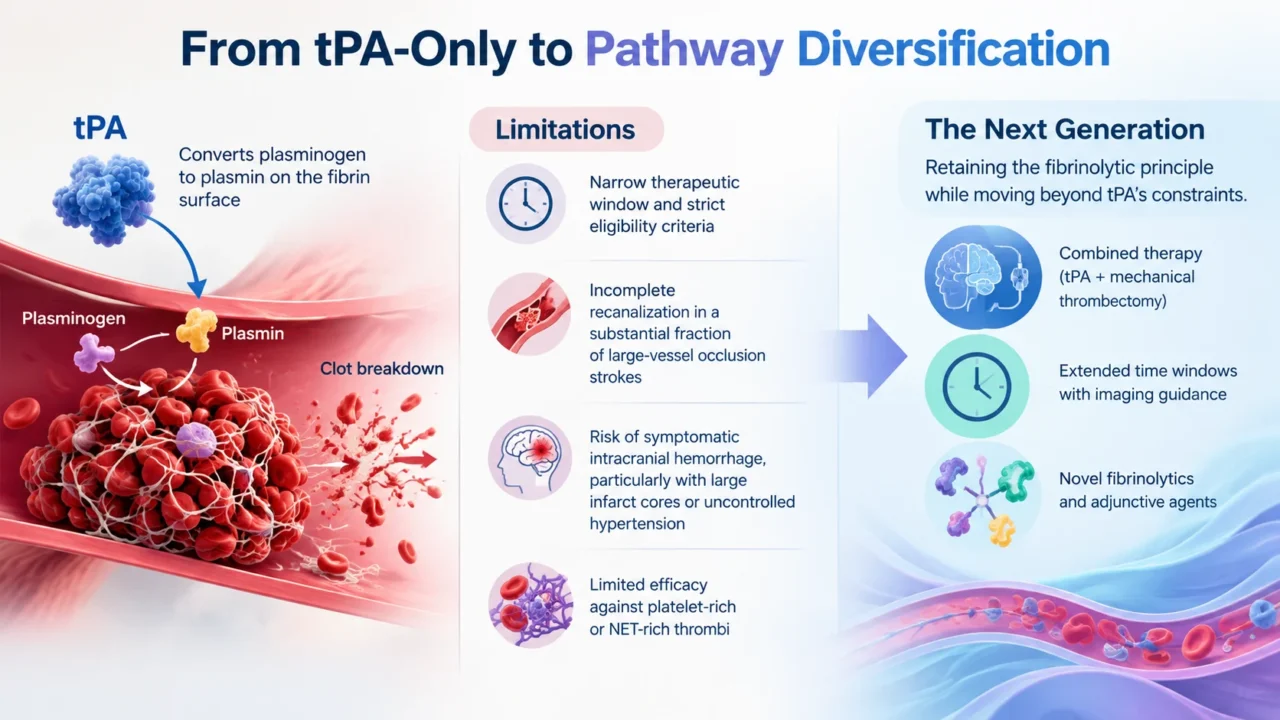
Intravenous alteplase remains the cornerstone of thrombolysis in AIS within 4.5 hours and in selected PE and other indications. It converts plasminogen to plasmin on the fibrin surface, initiating clot breakdown. Its limitations are well recognized.
The therapeutic window is narrow and eligibility criteria are strict. Recanalization is incomplete in a substantial fraction of large-vessel occlusion strokes.
There is a risk of symptomatic intracranial hemorrhage, particularly with large infarct cores or uncontrolled hypertension. Efficacy is limited against platelet-rich or NET-rich thrombi.
For decades, the response has been to refine patient selection, combine tPA with mechanical thrombectomy, or extend time windows with imaging guidance. The next generation of therapies is attempting to retain the fibrinolytic principle while moving beyond tPA’s constraints.
 Next-Generation Plasminogen Activators
Tenecteplase (TNK) is a genetically modified tPA variant with higher fibrin specificity, longer half-life allowing single-bolus administration, and greater resistance to plasminogen activator inhibitor-1 (PAI-1).
In AIS, randomized trials and real-world data suggest non-inferior or potentially superior functional outcomes versus alteplase in selected populations, along with simplified logistics that may improve door-to-needle times and support prehospital or telemedicine protocols.
In 2025, TNK received regulatory approval for AIS in some regions, and further phase III trials versus alteplase are ongoing.
Clinically, TNK does not change the fundamental mechanism of fibrinolysis but offers a more practical and possibly more effective implementation of the same principle, especially in systems prioritizing speed and simplicity.
Targeting Non-Fibrin Clot Components
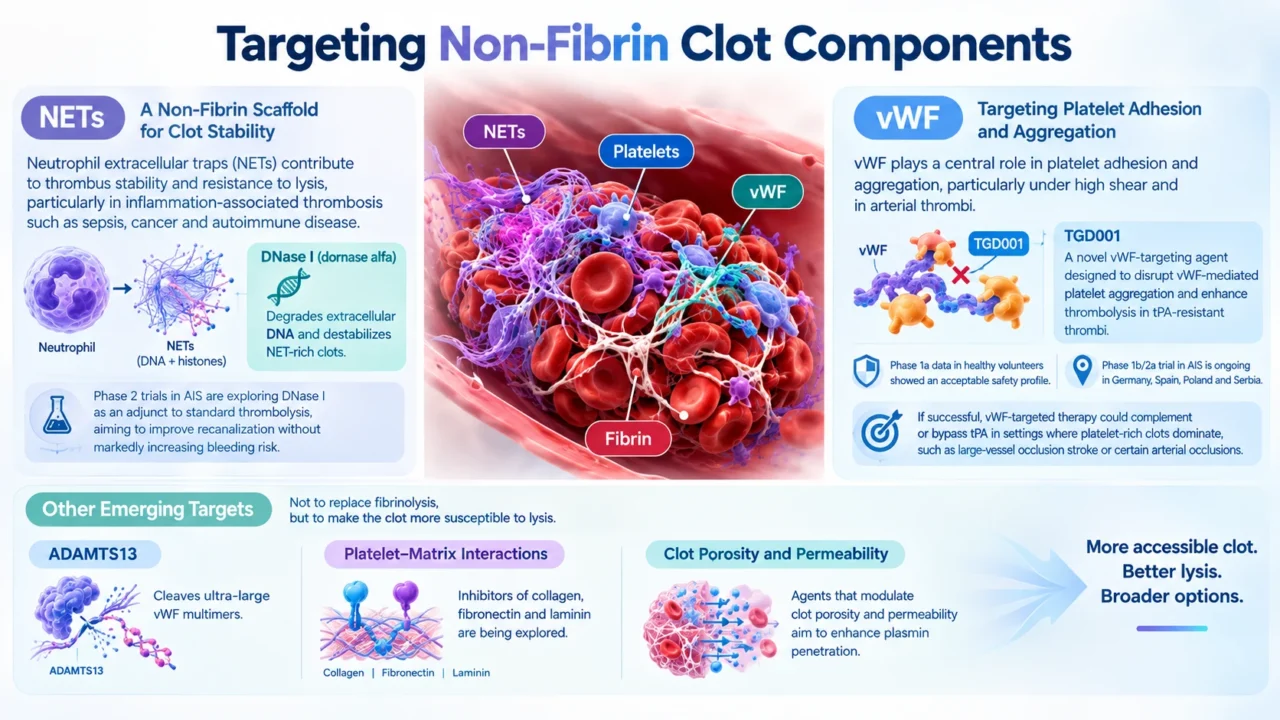
The next conceptual leap is to acknowledge that fibrin is only part of the problem. Neutrophil extracellular traps (NETs) contribute to thrombus stability and resistance to lysis, particularly in inflammation-associated thrombosis such as sepsis, cancer, and autoimmune disease.
DNase I (dornase alfa) can degrade extracellular DNA and destabilize NET-rich clots in preclinical and early clinical studies. Phase 2 trials in AIS are exploring DNase I as an adjunct to standard thrombolysis, aiming to improve recanalization without markedly increasing bleeding risk.
The concept is straightforward: defective lysis due to a non-fibrin scaffold is countered by enzymatic degradation of DNA and histones, which improves plasmin access and clot dissolution.
vWF plays a central role in platelet adhesion and aggregation, particularly under high shear and in arterial thrombi. TGD001 is a novel vWF-targeting agent designed to disrupt vWF-mediated platelet aggregation and enhance thrombolysis in tPA-resistant thrombi.
Phase 1a data in healthy volunteers showed an acceptable safety profile, and a phase 1b/2a trial in AIS is ongoing in Germany, Spain, Poland, and Serbia.
If successful, vWF-targeted therapy could complement or bypass tPA in settings where platelet-rich clots dominate, such as large-vessel occlusion stroke or certain arterial occlusions.
Preclinical and translational work is also exploring ADAMTS13 to cleave ultra-large vWF multimers, inhibitors of platelet–matrix interactions such as collagen, fibronectin, and laminin, and agents that modulate clot porosity and permeability to enhance plasmin penetration. These approaches aim not to replace fibrinolysis but to make the clot more susceptible to lysis.
 Localized and Physically Enhanced Thrombolysis
Another axis of innovation is to deliver thrombolytics more precisely and amplify their effect locally. Ultrasound-enhanced, catheter-directed thrombolysis combines local infusion of low-dose tPA through a dedicated lumen with high-frequency, low-power ultrasound from micro-transducers within the same catheter. Mechanisms include increased fibrin exposure, enhanced tPA and plasminogen penetration into the clot, and microstreaming that loosens clot structure.
In PE and selected DVT, observational and registry data show promising recanalization and symptom improvement. Randomized trials have not yet demonstrated a clear mortality benefit, and optimal patient selection remains under investigation. Pivotal trials will need to show reduction in clinically meaningful endpoints such as mortality, right ventricular dysfunction in PE, or disability in stroke, along with an acceptable bleeding risk compared with standard systemic or catheter-directed thrombolysis, and identification of subgroups most likely to benefit.
Nanotechnology offers another route to targeted thrombolysis. Liposomes or nanoparticles functionalized with fibrin- or platelet-binding ligands such as the CREKA peptide can concentrate thrombolytics at the clot surface. Preclinical models demonstrate enhanced clot penetration and reduced systemic bleeding risk. Lipid-based carriers are leading in translational terms, with first-in-human studies anticipated around 2026. The goal is to decouple efficacy from systemic exposure: more drug where it is needed, less where it is dangerous.
Combination and Adjuvant Approaches
Rather than seeking a single ‘magic bullet,’ the field is moving toward rational combinations. Examples include tPA plus DNase I to target both fibrin and NETs, tPA plus ADAMTS13 or vWF inhibitors to reduce platelet-rich clot stability, low-dose systemic thrombolytic plus local ultrasound or mechanical fragmentation, and small-molecule inhibitors of endogenous fibrinolysis blockers such as TAFI and PAI-1 to prolong plasmin activity. These strategies aim to increase recanalization rates, reduce required tPA doses, and broaden the window or patient population eligible for thrombolysis.
Measuring More Than Recanalization
The impact of new thrombolytic strategies should not be judged solely by angiographic recanalization or early neurological improvement. Meaningful endpoints include reduction in disability such as mRS 0–2 at 90 days in AIS, fewer hospitalizations and ICU admissions for PE or DVT, reduced need for rescue mechanical thrombectomy or surgical embolectomy, lower exposure to high-dose systemic thrombolytics and associated bleeding, and improved quality of life and functional recovery in survivors. Conversely, a therapy that improves recanalization but increases intracranial hemorrhage or systemic bleeding may offer limited net benefit.[pmc.ncbi.nlm.nih]
A New Treatment Architecture
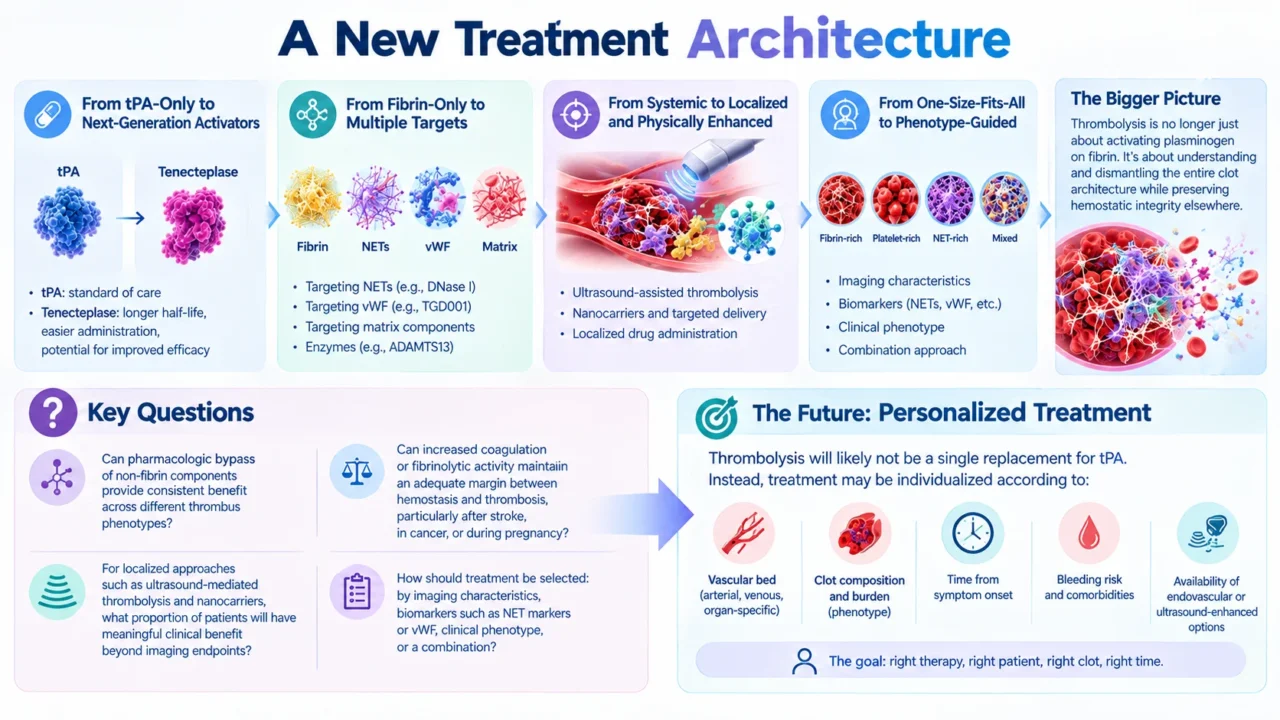
The evolving thrombolysis landscape can be viewed as a progression from tPA-only to next-generation activators such as tenecteplase, from fibrin-only to fibrin plus NETs plus vWF plus matrix, from systemic to localized and physically enhanced, and from one-size-fits-all to clot phenotype–guided, personalized lysis. Thrombolysis is no longer just about activating plasminogen on fibrin. It is increasingly about understanding and dismantling the entire clot architecture while preserving hemostatic integrity elsewhere.
Several questions remain central. Can pharmacologic bypass of non-fibrin components provide consistent benefit across different thrombus phenotypes? Can increased coagulation or fibrinolytic activity maintain an adequate margin between hemostasis and thrombosis, particularly after stroke, in cancer, or during pregnancy? For localized approaches such as ultrasound-mediated thrombolysis and nanocarriers, what proportion of patients will have meaningful clinical benefit beyond imaging endpoints? How should treatment be selected: by imaging characteristics, biomarkers such as NET markers or vWF, clinical phenotype, or a combination?
The future is unlikely to involve a single replacement for tPA. Treatment may instead be individualized according to vascular bed, clot composition and burden, time from symptom onset, bleeding risk and comorbidities, and availability of endovascular or ultrasound-enhanced options.
 A New Direction for Thrombolysis
Targeted thrombolysis illustrates a broader change in thrombotic disease management. For decades, treatment has largely focused on activating plasminogen on fibrin within a narrow time window. New approaches are beginning to address the clot from multiple angles: enhancing plasminogen activation, degrading non-fibrin scaffolds, localizing drug delivery, and eventually matching therapy to clot phenotype.
Tenecteplase is currently the most advanced clinical example of this evolution, with widespread adoption in AIS and ongoing trials. Agents like DNase I and TGD001 represent the next conceptual step, targeting NETs and vWF to make clots more lysable. Ultrasound-enhanced and nanocarrier-based systems aim to concentrate lysis where it is needed while sparing the rest of the vasculature. All remain investigational to varying degrees, and none can yet be considered established care outside specific indications and centers.
The future of thrombolysis may therefore be a layered approach rather than a single therapy: tPA or TNK for eligible acute presentations, adjunctive NET- or vWF-targeted agents for selected phenotypes, localized or device-enhanced strategies for large-burden or resistant clots, and personalized algorithms integrating imaging, biomarkers, and clinical risk. The goal is no longer simply to activate plasminogen on fibrin. It is to make the clot more soluble—and the patient more likely to survive without disability.
FAQ
1. Why is tPA insufficient in some patients?
Many thrombi contain non-fibrin components such as NETs, vWF, and matrix proteins that stabilize the clot and limit plasmin access, especially in platelet-rich or NET-rich clots.
2. What is the main advantage of tenecteplase?
Tenecteplase has higher fibrin specificity, longer half-life, and single-bolus administration, simplifying logistics and potentially improving outcomes in selected AIS patients.frontiersin
3. How do NETs affect thrombolysis?
NETs form DNA-histone scaffolds that resist plasmin-mediated lysis; degrading them with DNase I may enhance recanalization without markedly increasing bleeding risk.
4. What is TGD001?
TGD001 is an investigational vWF-targeting agent designed to disrupt platelet-rich, tPA-resistant thrombi; early-phase AIS trials are ongoing.
5. Why use ultrasound with thrombolytics?
Ultrasound increases fibrin exposure, enhances drug penetration, and loosens clot structure, potentially allowing lower tPA doses and better recanalization.
6. Are nanocarrier-based thrombolytics ready for clinical use?
No. Preclinical data are promising, but first-in-human studies are only anticipated around 2026.
7. Will these approaches increase bleeding risk?
The aim is to improve the efficacy–safety balance by targeting the clot more precisely, but bleeding risk remains a key endpoint in all trials.
8. How might treatment be personalized in the future?
Therapy may be tailored to clot composition, vascular bed, time from onset, and bleeding risk using imaging and biomarkers such as NET markers or vWF.
9. What would define a major advance in thrombolysis?
Beyond higher recanalization, meaningful advances include reduced disability, fewer hemorrhagic complications, broader treatable windows, and improved quality of life.frontiersin
10. When will these therapies become standard?
Some, like tenecteplase in AIS, are already entering practice; others require positive phase III data before routine adoption.
Written by Anna Stepanyan, MD
Stay updated with Hemostasis Today.
-
Sep 19, 2026, 14:17Abdul Mannan: What Exactly Is a Platelet?
-
Sep 19, 2026, 13:39Keisuke Goda: Decoding Platelet Phenotypes in COVID-19 With Optofluidic Imaging
-
Sep 19, 2026, 13:21Paul Armstrong: From Summer Studentship to Young Researcher
-
Sep 19, 2026, 13:06Rabiya Masood: Breaking the Cycle of Thalassemia Through Screening
-
Sep 19, 2026, 10:52Consuela A. Albright: The Critical Role of Black Blood Donors in Sickle Cell Treatment
-
Sep 19, 2026, 10:47Amber Yates: Inside Agios’ Partnership with the Sickle Cell Community
-
Sep 19, 2026, 10:46Anton Farkas: Mechanical Thrombectomy for Acute PE in Early Pregnancy
-
Sep 19, 2026, 10:40Marjolein Smidt: ASH Raises Ferritin Thresholds for Iron Deficiency
-
Sep 19, 2026, 10:34Nawsherwan Mohammad: ASH 2026 Guidelines Redefine How We Detect Iron Deficiency