


Johannes Kaesmacher: Cerebral No-Reflow After Thrombectomy Toward a Standardized Definition
Johannes Kaesmacher, Attending Neuroradiology, Head Clinical Trials at Insel Gruppe, shared a post on LinkedIn about a recent article he and his colleagues co authored, published in Wiley Online Library, adding:
“No reflow is everywhere. Or nowhere?
The number of papers on cerebral no reflow after thrombectomy has exploded over the last few years.
Yet if you put ten studies side by side, you will find ten different definitions: different reperfusion thresholds, different perfusion maps, different time points, different cut offs. Results are hard to compare, almost impossible to pool, and trials of adjunctive treatments have no common target.
Our international Delphi consensus, now published open access in Annals of Neurology, is an attempt to change that: to operationalise the definition of no-reflow, given the current best available evidence, and to give the field a shared framework for reporting and future research.
We invited the corresponding authors of every clinical study on no reflow from the last five years to three Delphi rounds. What the panel agreed on:
- Concept: no reflow equal macrovascular recanalisation with impaired microvascular reperfusion
- Recanalisation, angiography: eTICI 2c without clear distal occlusions and or eTICI 3; eTICI 2b is not enough (100 percent agreement)
- Recanalisation, perfusion: no wedge shaped Tmax TTP delay on post recanalisation CT or MR perfusion
- Microvascular hypoperfusion: CBF and or CBV rather than time based maps, visual inspection first, then quantitative interhemispheric comparison
- Timing: ideally within 30 minutes, at the latest within about 6 hours after recanalisation
- Rule out mimics first: reocclusion, proximal stenosis, vasospasm, pre existing structural changes
Where there was no consensus is just as important: eTICI 2c vs 3 only, and the quantitative CBF CBV threshold (e.g. 15 percent vs 40 percent reduction). These are exactly the questions the next validation studies need to answer.
Common definitions are the precondition for comparable studies, meaningful meta analyses and, ultimately, research that can tell us whether we are really treating no reflow, or are just observing an epiphenomenon of oedematous infarction and or confusing (missed) distal vessel occlusions with microvascular failure.
A big thank you to the co first authors Adnan Mujanovic, Samantha Rivet and Adrien ter Schiphorst, to my co senior authors Jean Claude Baron and Felix Ng, and to every member of the Cerebral No-Reflow Delphi Consensus Group.
Thanks, Felix, for initiating this endeavour: a true team effort with many productive Zoom sessions.”
Title: Cerebral No-Reflow after Thrombectomy: International Delphi Consensus on Definition and Imaging Assessment
Authors: Adnan Mujanovic, Samantha Rivet, Adrien ter Schiphorst, Jean-Claude Baron, Johannes Kaesmacher, Felix Ng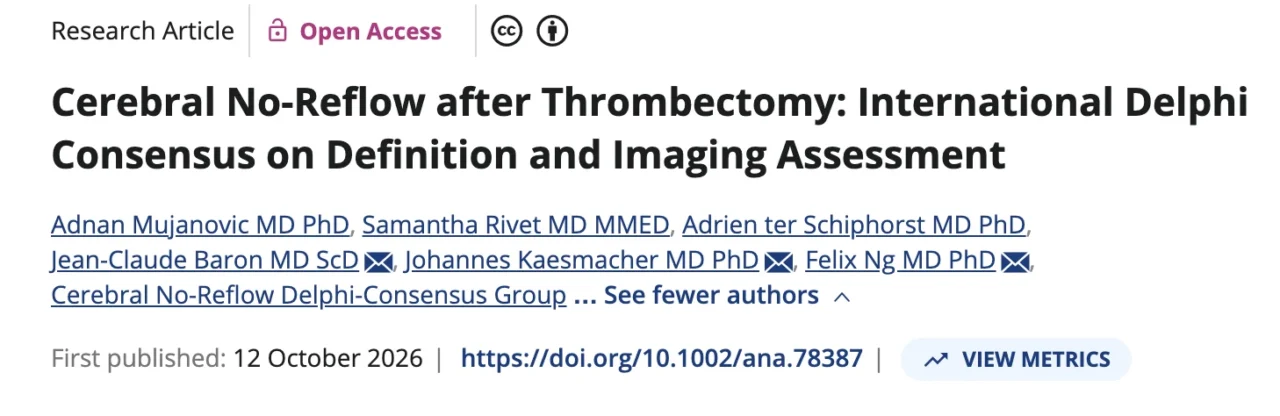
Stay updated on all scientific advances with Hemostasis Today.
-
Oct 19, 2026, 07:33Beth Psaila: Highlights from IACH Annual Meeting and MPN Horizons
-
Oct 19, 2026, 07:29Wolfgang Miesbach: Can Losartan Activate Brown Fat? – Nature Study Explores New Therapeutic Link
-
Oct 19, 2026, 07:22Ruben Mesa: Honored to Speak at the Tandem MPN Meetings of IACH
-
Oct 19, 2026, 07:19Saneha Anjum Shaikh: Parul University Partners with Raktasevak Bike Ride 2026 for Blood Donation Drive
-
Oct 19, 2026, 07:09Alejandro González Veliz: No ST Elevation Does Not Guarantee an Open Coronary Artery
-
Oct 19, 2026, 06:02Thomas Dayspring: Vascular Resilience – What Is It and How Can We Measure It?
-
Oct 19, 2026, 05:53Kevon Dindial: Collaboration for Better Childhood Cancer Outcomes
-
Oct 19, 2026, 05:44Mavis Agnes Kisakye: Raising Awareness about Haemophilia and Other Blood Disorders at Luweero General Hospital
-
Oct 19, 2026, 05:43Mohsen Asadi: Women and Blood Clots – Understanding Risk Across Every Life Stage