


Chaza Alaji: Diagnosing Protein C and Protein S Deficiency
Chaza Alaji, Medical Laboratory Specialist and Supervisor at Privat university-private laboratory-general hospital, shared a post on LinkedIn:
”Protein C and Protein S: Laboratory Assessment and Genetic Diagnosis of Inherited Deficiency:
The balance between coagulation and anticoagulation is essential for preventing pathological thrombosis. Protein C and Protein S are central to this balance, and understanding their biology is critical for accurate thrombophilia assessment.
How Do They Work?
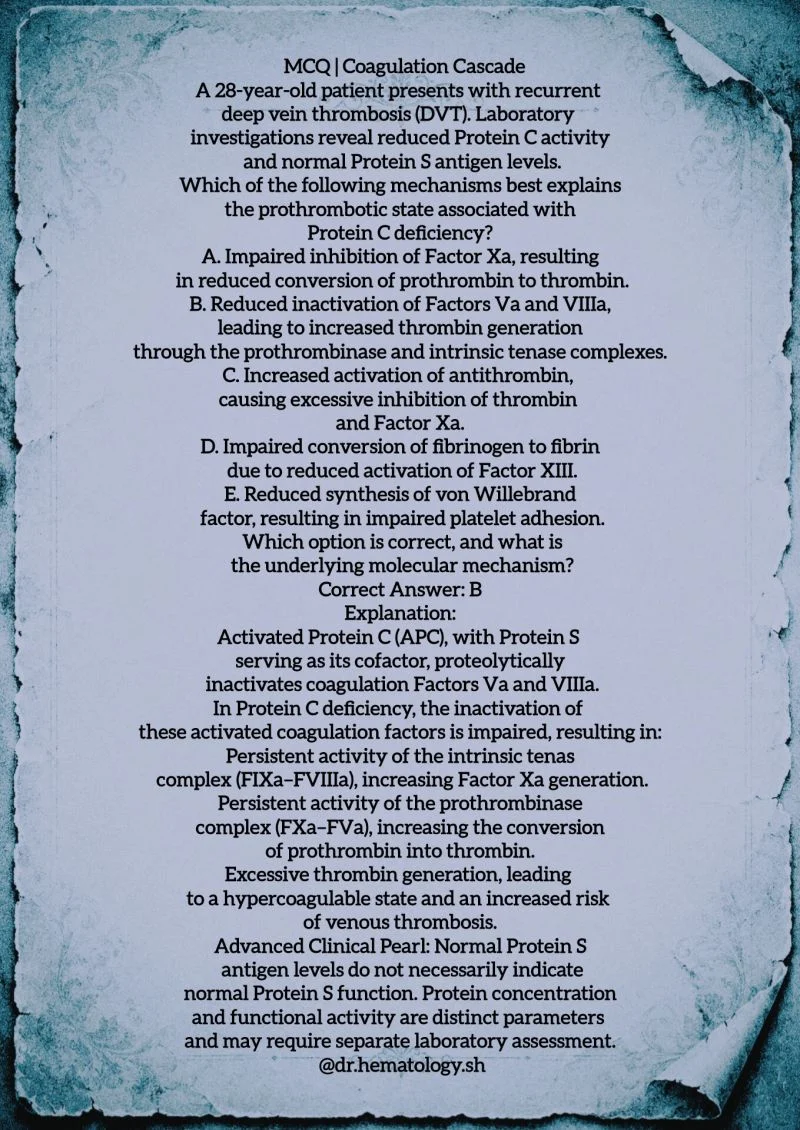
Thrombin bound to endothelial thrombomodulin activates Protein C, with support from the endothelial protein C receptor (EPCR). Activated Protein C (APC), assisted by Protein S, inactivates factors Va and VIIIa, reducing thrombin generation and fibrin formation.
Inherited Deficiency: PROC and PROS1
Pathogenic variants in PROC may cause Protein C deficiency, while variants in PROS1 may cause Protein S deficiency.
Both conditions increase susceptibility to venous thromboembolism, including deep vein thrombosis (DVT) and pulmonary embolism (PE). Severe Protein C deficiency can cause neonatal purpura fulminans.
Protein C deficiency is classified as:
- Type I: Reduced antigen concentration and activity.
- Type II: Reduced functional activity despite a potentially normal antigen concentration.
Protein S deficiency requires careful interpretation of free antigen, total antigen when indicated, and functional activity.
Laboratory Diagnosis: Function First
Assessment may include:
- Protein C activity and antigen.
- Free Protein S antigen, with total antigen and activity when appropriate.
Acquired conditions can mimic inherited deficiency. Liver disease, vitamin K deficiency, pregnancy, estrogen exposure, and anticoagulant therapy may alter results. Testing must therefore be timed and interpreted according to the clinical context.
Molecular Diagnostics: Beyond Conventional Testing
Modern genetic approaches can clarify selected cases:
- Sanger sequencing: Analysis of specific gene regions.
- Next-generation sequencing (NGS): Assessment of PROC, PROS1, or broader thrombophilia panels.
- MLPA: Detection of certain deletions and duplications that sequencing alone may miss.
Variant interpretation using ACMG/AMP criteria must be integrated with the patient’s clinical and laboratory findings.
An Important Diagnostic Principle
A genetic variant does not automatically establish disease. A variant of uncertain significance (VUS) is not diagnostic on its own.
Genetic testing complements, rather than replaces, functional and antigenic assays. It is most useful when the clinical presentation, laboratory phenotype, or family history justifies further investigation and when the result may influence management or family assessment.
The Laboratory Take-Home Message
Accurate diagnosis of Protein C and Protein S deficiency requires integration of functional assays, antigen measurements, genetic findings, and clinical context.
The goal is not merely to identify an abnormal result, but to establish whether it represents a genuine inherited deficiency with clinical significance.”
Stay updated with Hemostasis Today.
-
Oct 20, 2026, 04:13Ifeanyichukwu Ifechidere: DOACs Are Not the Answer to Every Anticoagulation Question
-
Oct 20, 2026, 04:04Sadia Kamal: Honored to Receive the Outstanding Abstract Award at the 20th Midwest Platelet Conference
-
Oct 20, 2026, 04:03Yu-Hsuan Chen: One Antibody, Two Diseases from FcRn Biology to Clinical Translation
-
Oct 20, 2026, 03:49Domenico Simone Castiello: Rethinking Prolonged DAPT in Multivessel PCI – Insights from the DAPT-MVD Trial
-
Oct 20, 2026, 03:37Rucha Patil: Scaling POC Diagnostics for Haemophilia A and VWD Across India
-
Oct 20, 2026, 03:31Zena Vexler: Targeting Neutrophil Elastase and NETosis to Mitigate Infection-Triggered Childhood Stroke
-
Oct 20, 2026, 03:24Mou Nandi: How Maternal Health During Pregnancy May Shape Infant Development
-
Oct 20, 2026, 03:13Sumyea Kabir: Pre-Analytical Quality in Phlebotomy – Preventing In Vitro Hemolysis
-
Oct 20, 2026, 02:37M. Sekip Altunkan: Can Anticoagulation Be Safely Stopped After AF Ablation?