

Fathima Zulfa Mohamed Sattar: Systematic Investigation of Bleeding Disorders and Coagulation Abnormalities
Fathima Zulfa Mohamed Sattar, Medical Laboratory Scientist , shared a post on LinkedIn:
“Bleeding Disorders: Coagulation Studies, Factor Deficiencies and Mixing Studies
A prolonged clotting time is not a diagnosis. It is a laboratory finding that requires systematic investigation.
For medical laboratory scientists, understanding the relationship between coagulation screening tests, factor assays and mixing studies is essential to identifying possible causes of abnormal haemostasis.
Key laboratory principles:
- PT INR and aPTT help identify patterns that guide further coagulation investigations.
- Factor assays help identify specific factor deficiencies when supported by the clinical history and screening results.
- Mixing studies assess whether a prolonged clotting time behaves more like a factor deficiency or an inhibitor.
- Immediate versus incubated mixing a time dependent inhibitor, particularly a factor VIII inhibitor, may become apparent after incubation.
- Lupus anticoagulant and specific factor inhibitors can produce different laboratory patterns and require appropriate follow up testing.
- Anticoagulant interference heparin and direct oral anticoagulants can affect coagulation results, depending on the drug, concentration and assay.
An important diagnostic pitfall: Correction in a mixing study does not automatically confirm a factor deficiency, and failure to correct does not identify a specific inhibitor.
Interpretation depends on the validated method, clinical context and appropriate confirmatory investigations.
Never overlook specimen quality. Incorrect citrate tube filling, unsuitable specimens and contamination can lead to misleading coagulation results.
The key principle: Test systematically. Interpret carefully. Confirm the cause.
Accurate coagulation investigation depends not only on recognising abnormal results, but also on understanding the principles and limitations behind each test.
Educational content for laboratory professionals.
Follow validated laboratory procedures, current guidelines and locally approved interpretation criteria.”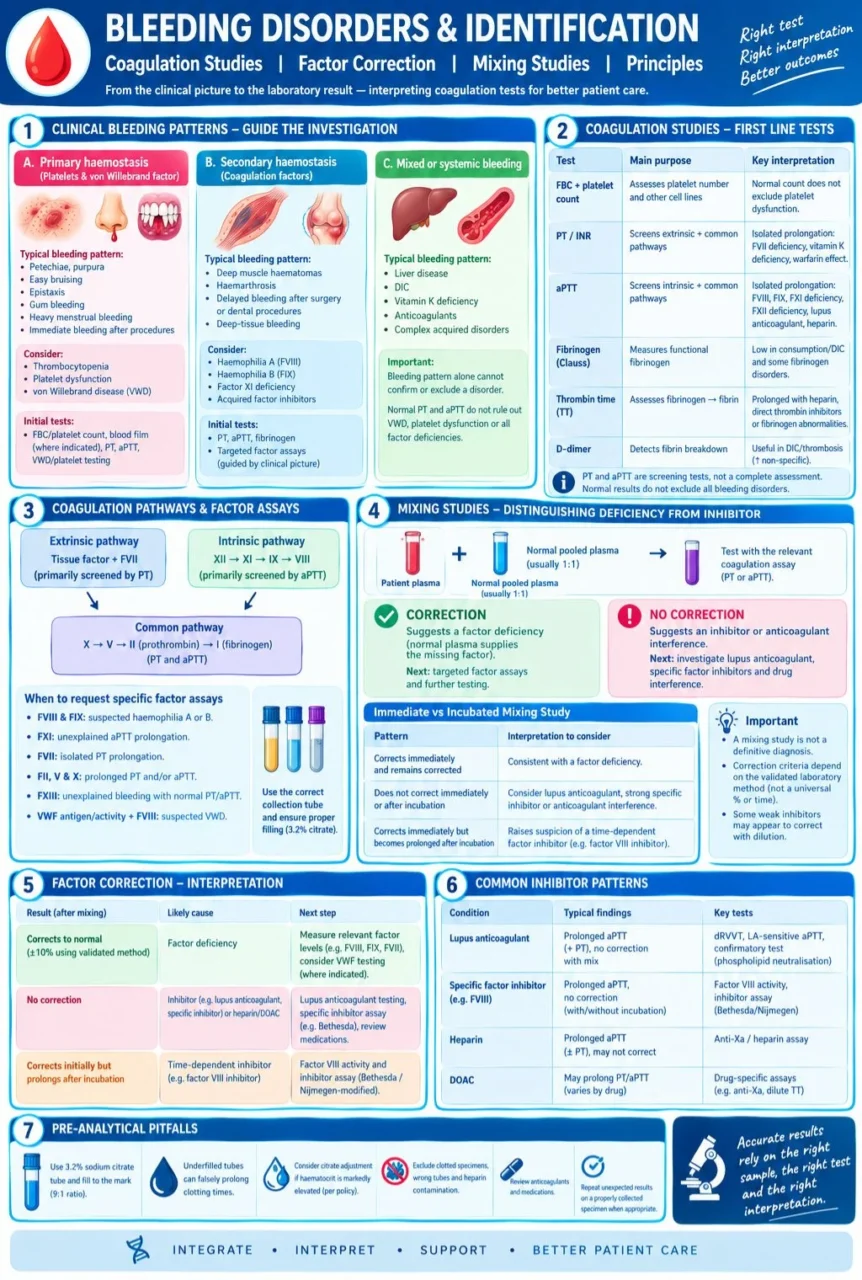
Stay updated with Hemostasis Today.
-
Oct 26, 2026, 10:09Christopher Robinson: Anemia and Postpartum Transfusion Rates at Different Blood Loss Thresholds After Vaginal Delivery
-
Oct 26, 2026, 09:54Hussnain Javaid: IV Iron During Active Bacterial Infection Reassessing the Risks and Benefits
-
Oct 26, 2026, 09:12Robert Major: GFAP as a Point-of-Care Biomarker in Intracerebral Hemorrhage
-
Oct 26, 2026, 08:55Abdulla A. Damluji: LATE-MT Reveals Benefits and Risks of Late Thrombectomy
-
Oct 26, 2026, 05:28Anirban Sen Gupta: Celebrating 20 Years of Research and Innovation
-
Oct 26, 2026, 05:13Shamee Shastry: ScholarGPS Recognises a Highly Ranked Blood Transfusion Scholar
-
Oct 26, 2026, 03:43Shazmah Shaikh: How Laser Atherectomy Helps Clear Blocked Arteries
-
Oct 26, 2026, 03:28Priya Prasad: Protecting Donors and Recipients Through Blood Safety
-
Oct 25, 2026, 19:55Giacomo Buso: LIPLEG Provides the Strongest Evidence to Date on Lipedema Treatment