


Jorge Enrique: Beyond Fibrin Targeting New Strategies for Thrombolysis
Jorge Enrique, Medical Doctor, shared a post on LinkedIn:
”Targeted Thrombolysis Beyond tPA: Understanding the Clot to Improve Reperfusion
What if the future of thrombolysis depends not only on dissolving fibrin, but also on understanding the entire architecture of a thrombus?
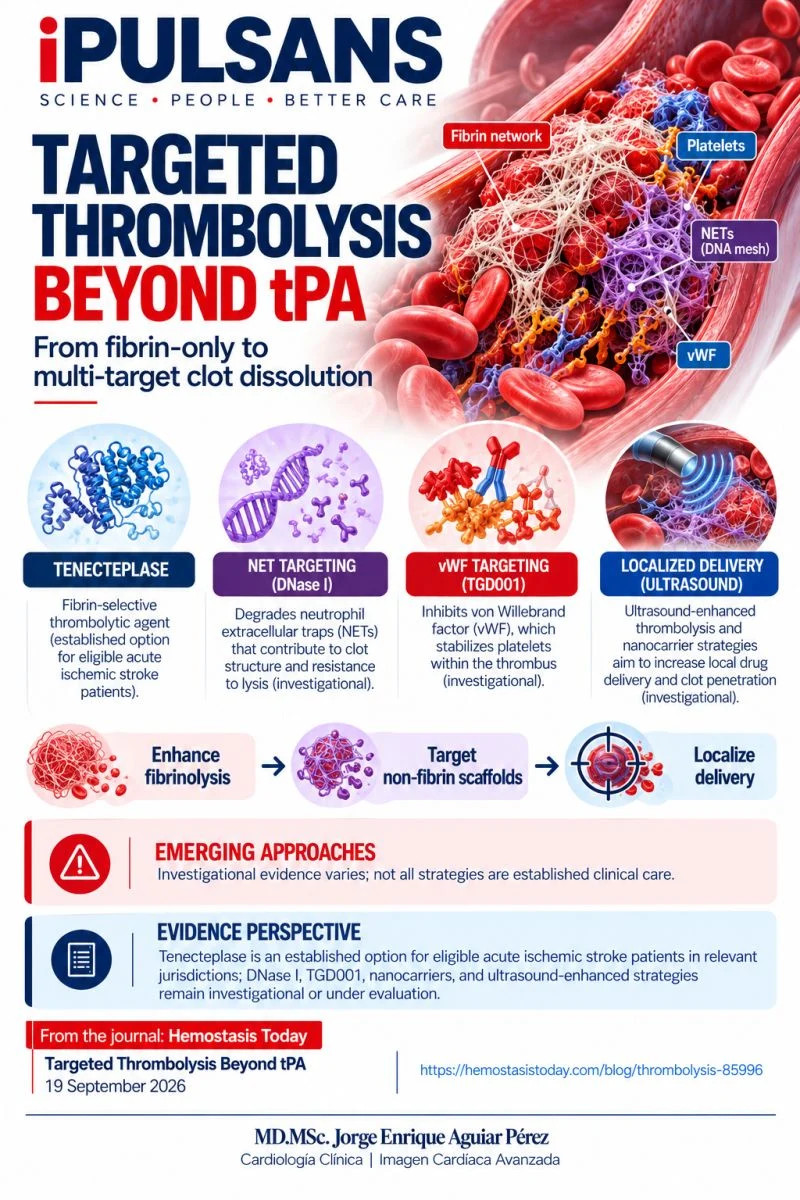
In Targeted Thrombolysis Beyond tPA: From Fibrin-Only to Multi-Target Clot Dissolution, Hemostasis Today explores emerging strategies designed to address the structural complexity of thrombi and the limitations of conventional fibrinolysis.
Key Scientific Insights
- Beyond fibrin: Neutrophil extracellular traps (NETs), von Willebrand factor (vWF), and other structural components may contribute to thrombus stability and resistance to fibrinolysis.
- Next-generation thrombolysis: Tenecteplase, a modified tissue plasminogen activator, offers practical advantages, including single-bolus administration, and is an established option for eligible patients with acute ischemic stroke in jurisdictions where it is approved.
- Targeting NETs: DNase I is being investigated for its potential to degrade extracellular DNA and destabilize NET-rich thrombi.
- Targeting vWF: TGD001 is an investigational agent designed to interfere with vWF-mediated platelet interactions and potentially improve thrombolysis in selected thrombus phenotypes.
- Localized drug delivery: Ultrasound-enhanced thrombolysis and nanocarrier-based approaches aim to improve drug delivery to the thrombus while limiting systemic exposure; their clinical benefits and safety require further evaluation.
Why Does This Matter?
Thrombi are biologically heterogeneous. Their composition, location, burden, and resistance to treatment may influence the response to reperfusion therapy.
The emerging concept is to move from a predominantly fibrin-focused approach toward strategies that address multiple components of the thrombus. However, this remains an evolving field: promising mechanisms and early-stage findings must not be confused with proven clinical benefit.
Tenecteplase has an established role in appropriate clinical settings, whereas DNase I, TGD001, and several ultrasound-enhanced and nanotechnology-based approaches remain investigational or under evaluation.
Future studies must demonstrate improvements in meaningful clinical outcomes—not merely vessel recanalization—while maintaining an acceptable safety profile, particularly regarding intracranial and systemic bleeding.
At iPULSANS, we believe that scientific progress requires both innovation and critical appraisal: understanding what is established, what is promising, and what still needs to be demonstrated.
Editorial note: This is an educational review article, not an original clinical trial or systematic review.”
Stay updated with Hemostasis Today.
-
Oct 26, 2026, 13:36Kefah Mokbel: Targeted Breast Cancer Therapies Linked to Increased Thrombotic Risk
-
Oct 26, 2026, 13:23Priya Sriskandarajah: Treatment Challenges in Elderly and Frail Patients with Philadelphia-Negative MPNs
-
Oct 26, 2026, 12:48Milica Kuzmanovska: Latest Updates in PV, ET, and Myelofibrosis Management
-
Oct 26, 2026, 12:38Hytham Abu Aagla: Daratumumab and Transfusion Compatibility
-
Oct 26, 2026, 10:17Pankaj K.: Genetic Hemolytic Anemias Common Types, Symptoms and Long-Term Management
-
Oct 26, 2026, 10:09Christopher Robinson: Anemia and Postpartum Transfusion Rates at Different Blood Loss Thresholds After Vaginal Delivery
-
Oct 26, 2026, 09:54Hussnain Javaid: IV Iron During Active Bacterial Infection Reassessing the Risks and Benefits
-
Oct 26, 2026, 09:37Fathima Zulfa Mohamed Sattar: Systematic Investigation of Bleeding Disorders and Coagulation Abnormalities
-
Oct 26, 2026, 09:12Robert Major: GFAP as a Point-of-Care Biomarker in Intracerebral Hemorrhage