


William Wallace: More than 1 in 3 People with Parkinson’s Were Low in B6
William Wallace, Co-Founder and Chief Scientific Officer at Supplement Success Solutions, shared a post on LinkedIn:
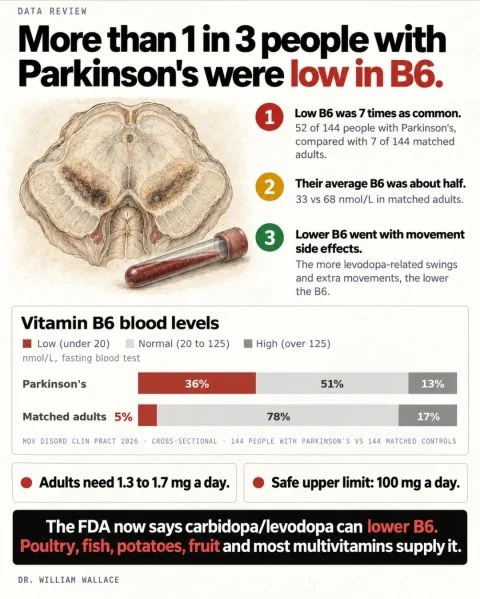
“Vitamin B6 deficiency is supposed to be uncommon. In 144 people with Parkinson’s, more than 1 in 3 were low.
Lizarraga and colleagues at the University of Rochester (Movement Disorders Clinical Practice 2026) picked patients at random from their movement disorders clinic, drew fasting blood and measured the active form of B6.
They compared them with 144 adults from the national NHANES survey, matched for age, sex, diet and vitamin use. Almost everyone with Parkinson’s, 140 of 144, was taking carbidopa or levodopa.
52 of 144 people with Parkinson’s were below the normal range, against 7 of 144 matched adults. That is 36% against 5%, about seven times as common. Their average B6 was about half, 33 nmol/L against 68, even though three in four took a vitamin supplement.
The FDA describes how the drug uses up B6: it is depleted as levodopa is converted to dopamine, and carbidopa binds its active form.
So the expectation was simple: more levodopa, less B6. That is not what the paper found. B6 didn’t track with levodopa dose, years on the drug or disease stage, which the authors call unexpected. With only four people off levodopa, the study can’t separate the drug from the disease.
Lower B6 did go with more levodopa-related motor complications, the on-off swings and extra movements, and the authors recommend active monitoring in people who have them. At the other end, 13% of the Parkinson’s group were above the normal range, close to the controls’ 17%.
It is one blood draw per person, so it shows a link, not a cause. The comparison blood was drawn more than 20 years earlier, 96.5% of participants were White, and the authors call the motor-complication analysis exploratory.
The paper landed six months after the FDA acted. In April the FDA required a warning on every carbidopa or levodopa product: these drugs can cause B6 deficiency and B6 deficiency seizures. Its review found 14 seizure cases, all on more than 1,000 mg of levodopa a day, and all 9 people treated with B6 stopped seizing.
The FDA now directs clinicians to check B6 before carbidopa or levodopa starts, periodically during treatment, and if symptoms appear: seizures, depression, confusion, or numbness and tingling.
Dosing belongs with the prescriber, because more is not better. High-dose B6 taken for a year or longer can cause severe nerve damage. The NIH sets the adult upper limit at 100 mg a day, and Europe set it at 12 mg in 2023.
For most people, food covers it: adults need 1.3 to 1.7 mg a day, and poultry, fish, potatoes and non-citrus fruit are major sources.
The paper doesn’t show that levodopa drains B6. It shows low B6 is common in Parkinson’s, and the FDA has separately made a B6 check part of the standard for anyone on the drug.
- Lizarraga et al., Mov Disord Clin Pract 2026
- FDA Drug Safety Communication, carbidopa or levodopa and vitamin B6, April 2026
- NIH Office of Dietary Supplements, Vitamin B6 Fact Sheet
- EFSA, tolerable upper intake level for vitamin B6, 2023″
Other posts featuring William Wallace on Hemostasis Today.
-
Oct 25, 2026, 19:36Andrés Felipe Escobar González: Individualized Treatment Strategies for HMB in BDUC
-
Oct 25, 2026, 19:34Christophe Nougier: Returning to Burundi for the WFH-Supported Twinning Project
-
Oct 25, 2026, 19:29Bogda Koczwara: Pre-Existing and New CVD in Patients With Cancer Are Associated With Higher Mortality
-
Oct 25, 2026, 19:23Özlem Turan: Advancing Care for Women and Girls With Bleeding Disorders at the European Parliament
-
Oct 25, 2026, 18:36James P. Crowley: Gene Inactivation and Targeted Gene Repair as Two Approaches to CRISPR Gene Editing
-
Oct 25, 2026, 17:43Jan Sloves: Femoral Vein Aneurysm and Chronic Venous Obstruction
-
Oct 25, 2026, 17:31Kasimu Hussaini: Blood Component Therapy From Whole Blood to Targeted Treatment
-
Oct 25, 2026, 17:23Zahra Safarzadeh: When Low Factor VII Activity and Reduced VWF Antigen Coexist
-
Oct 25, 2026, 17:17Anubhav Joshi: Evans Syndrome in CLL A Differential Diagnosis to Remember