


King Harald V’s Illness and the Broader Clinical Burden of Autoimmune Hemolytic Anemia
The death of Norway’s King Harald V on August 28, 2026, brought an end to a 35-year reign and prompted tributes from around the world.
King Harald V, who had served as Norway’s head of state since 1991, was one of Europe’s longest-serving monarchs. Born in 1937, he was a prominent national figure who represented Norway for more than three decades and was widely recognized for his public service and constitutional role.
The 89-year-old monarch died peacefully at Oslo University Hospital after years of health challenges and recent hospitalization.
In the weeks before his death, the Norwegian Royal Palace confirmed that he had been receiving treatment with cortisone for hemolytic anemia. His condition was subsequently complicated by a bacterial bloodstream infection.

But amid the extensive coverage of the life and legacy of Norway’s longest-serving monarch, one phrase stood out:
“Rare blood disease.“
BBC News used this description in its coverage of hemolytic anemia. While factually understandable, the phrase raises a broader issue in rare hematology.
What does “rare” actually tell us about the clinical burden of a disease?
Conditions affecting relatively few people can nevertheless be severe, diagnostically complex and potentially life-threatening. They may require urgent intervention, prolonged treatment and highly specialized care, while the evidence guiding management may remain limited.
For hematologists, rarity should therefore not be interpreted as a measure of clinical significance.
Autoimmune hemolytic anemia (AIHA) is indeed rare.
But rarity describes prevalence – not severity, complexity or unmet clinical need.
What Is Autoimmune Hemolytic Anemia (AIHA)?
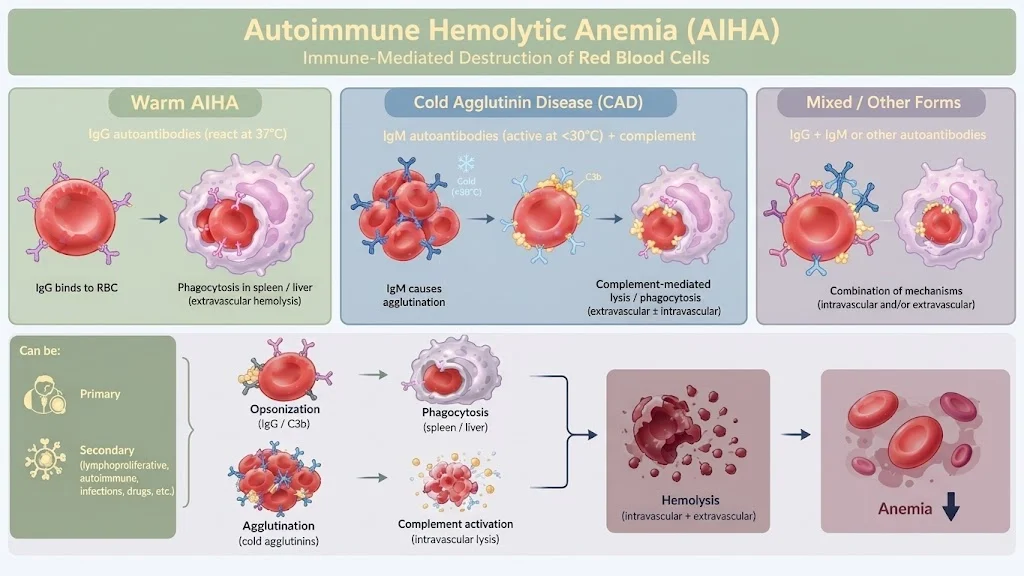
Autoimmune hemolytic anemia (AIHA) is a rare acquired disorder in which the immune system mistakenly targets and destroys the body’s own red blood cells, leading to premature red-cell destruction and anemia.
The disease is heterogeneous and is broadly classified into warm AIHA, cold agglutinin disease, and mixed or other less common forms, depending on the type and thermal characteristics of the autoantibodies involved.
Warm AIHA, the most common form, is generally mediated by IgG autoantibodies that react at body temperature.
Cold agglutinin disease (CAD) is driven predominantly by IgM autoantibodies and complement activation, while mixed and other less common forms represent additional clinical and immunologic phenotypes.
AIHA may occur as a primary disorder or develop secondary to conditions such as lymphoproliferative disorders, autoimmune diseases, infections, immunodeficiencies or certain medications.
Some patients may have relatively stable hemolysis and few symptoms.
Others can present with severe anemia, marked fatigue, dyspnea, tachycardia, jaundice or other manifestations of significant red-cell destruction. In the most severe cases, hemoglobin can fall rapidly, creating an urgent need for transfusion support and disease-directed therapy.
AIHA can be relapsing and chronic, exposing patients to repeated episodes of hemolysis and repeated courses of treatment.
Corticosteroids, while often effective in the initial management of warm AIHA, may be associated with substantial cumulative toxicity when prolonged treatment is required. Patients who relapse or fail to respond adequately may require additional immunosuppressive or targeted therapies.
AIHA is rare by prevalence, but its clinical burden and therapeutic complexity are substantial.
A Diagnosis That Can Be Deceptively Difficult
AIHA is not simply a diagnosis of anemia.
The first step is to establish that the anemia is caused by hemolysis. Elevated LDH and indirect bilirubin, reduced haptoglobin, reticulocytosis and supportive blood smear findings can indicate ongoing red-cell destruction.
The next question is whether the hemolysis is immune-mediated.
The direct antiglobulin test (DAT) is central to the diagnosis. It detects immunoglobulin and/or complement bound to the surface of red blood cells.
However, the DAT is not an absolute rule-in or rule-out test.
Its sensitivity depends on the testing method. Some patients with clear clinical and laboratory evidence of AIHA may have a negative conventional DAT.
This is where additional testing can become important.
More sensitive methods, including flow-cytometric detection of erythrocyte-bound immunoglobulins, may help identify DAT-negative cases.
Further evaluation may also be needed to identify secondary causes of AIHA.
In cold agglutinin disease, this may include investigation for an underlying clonal B-cell disorder.
The diagnosis therefore requires more than a single laboratory result.
Clinicians need to consider the pattern of hemolysis, DAT findings, antibody characteristics, blood smear, secondary causes and possible underlying immune or clonal disease.
For patients, this diagnostic complexity can mean repeated investigations, transfusion support and hospitalization during severe hemolytic episodes.
For clinicians, the key message is simple:
A negative DAT does not always exclude AIHA. A positive DAT does not establish the diagnosis by itself.
The goal is to identify why the red cells are being destroyed, which immune mechanism is involved and whether an underlying disorder is driving the disease.
An Area Where Evidence Still Lags Behind Need
The treatment of AIHA has evolved considerably, but the therapeutic landscape remains far from ideal.
For warm AIHA, corticosteroids continue to form the foundation of initial treatment, with rituximab playing an increasingly important role—particularly in severe disease, inadequate steroid response, or relapse.
For patients with cold agglutinin disease (CAD) who require treatment, therapeutic strategies are fundamentally different, reflecting the central role of B-cell clones and complement activation. The distinction between these entities is therefore not merely diagnostic; it directly determines treatment.
Yet the field has long faced a fundamental problem: the evidence base has not kept pace with the clinical need.
The First International Consensus Meeting on AIHA, published in Blood Reviews in 2020, made this particularly clear.
At that time, the authors noted that there was no licensed treatment for AIHA and that the paucity of clinical trials meant that many recommendations for diagnosis and therapy were based on expert opinion and national guidelines rather than robust prospective evidence.
The consensus group emphasized the need for standardized diagnostic and treatment approaches and called for an international AIHA network to facilitate collaboration and research.
This is not simply a historical observation.
AIHA presents a difficult environment for clinical research. The disease is rare and heterogeneous, encompassing different antibody profiles, mechanisms of hemolysis, clinical courses and responses to therapy.
Patients may also have secondary AIHA associated with conditions such as lymphoproliferative disorders or autoimmune disease.
These factors make it difficult to assemble large, biologically uniform patient populations for randomized clinical trials.
The therapeutic pipeline is increasingly diverse, with approaches targeting B cells, plasma cells, complement, FcRn, intracellular signaling pathways and other components of the immune response.
This represents an important shift toward mechanism-based treatment. Yet innovation has not eliminated the unmet need: the ideal therapy has still not been identified for either warm AIHA or CAD, and evidence-based options remain particularly limited for rarer subtypes.
King Harald’s Illness And The Importance of Diagnostic Restraint
The public discussion surrounding King Harald’s illness also illustrates an important principle in clinical medicine: a reported diagnosis should not be expanded beyond the evidence available.
The Royal Palace reported hemolytic anemia and cortisone treatment, followed by a bacterial bloodstream infection.
However, the publicly available information does not establish the precise subtype, etiology, or immunologic characteristics of the hemolytic anemia.
Accordingly, it would be inappropriate to retrospectively classify the King’s illness as a particular form of AIHA – or to attribute his death directly to hemolytic anemia – without access to his complete clinical record.
This distinction is clinically important because hemolytic anemia is a syndrome, whereas AIHA is a specific immune-mediated diagnosis.
The case therefore should not be used to speculate about an individual patient’s diagnosis. It can, however, prompt a broader discussion about how hematologic diseases are described in public discourse.
Beyond the Headline
King Harald V will be remembered for decades of public service to Norway and for his enduring role in the country’s modern constitutional monarchy. The circumstances surrounding his final illness, however, have also drawn public attention to an important hematologic disorder.
Autoimmune hemolytic anemia (AIHA) is uncommon, but its clinical burden can be substantial.
Diagnosis may require careful integration of clinical findings, laboratory evidence of hemolysis and specialized immunohematologic testing, while management can involve urgent treatment, treatment-related complications, relapse and prolonged follow-up.
The broader significance of such cases extends beyond the individual patient.
Rarity should not be equated with limited clinical importance. Rare hematologic diseases frequently expose gaps in diagnostic recognition, therapeutic evidence and access to specialized care, underscoring the need for collaborative research and continued development of evidence-based treatment strategies.
The most valuable consequence of increased public attention is therefore not simply greater awareness of hemolytic anemia, but a clearer recognition that rare diseases warrant the same commitment to diagnostic precision, clinical research and therapeutic innovation as more prevalent disorders.
AIHA may be rare in prevalence. Its clinical importance is not.
FAQ
1.How rare is AIHA – and does “rare” mean mild?
AIHA has an incidence of approximately 1–3 cases per 100,000 person-years and a prevalence of approximately 6–21 per 100,000. Despite its rarity, AIHA can cause severe anemia, transfusion dependence, relapse and life-threatening complications.
Rare does not mean clinically insignificant.
2.What is AIHA, and what are its principal subtypes?
AIHA is an acquired disorder characterized by autoantibody-mediated destruction of red blood cells. It is classified primarily as warm AIHA, usually mediated by IgG at approximately 37°C, and cold agglutinin disease, predominantly mediated by IgM and complement. Mixed and other less common forms also occur.
3.How is AIHA diagnosed – and can the DAT be negative?
Diagnosis requires evidence of hemolysis – typically increased LDH and indirect bilirubin, reduced haptoglobin and reticulocytosis – together with demonstration of red-cell-bound immunoglobulin and/or complement by the direct antiglobulin test (DAT). A minority of patients have DAT-negative disease because of low-density, low-affinity or non-IgG antibodies, or IgA-mediated disease. When clinical suspicion remains high, enhanced DAT methods and specialized immunohematologic testing may be required.
4.What are the principal treatment strategies?
For warm AIHA, corticosteroids remain the conventional first-line treatment, with rituximab an important second-line or steroid-sparing strategy, particularly in severe, refractory or relapsing disease. In cold agglutinin disease, corticosteroids are generally ineffective; treatment is directed toward the underlying clone and/or B-cell or complement-mediated mechanisms, depending on disease characteristics.
5.Why is the evidence base for AIHA still limited?
The rarity and biological heterogeneity of AIHA make adequately powered randomized trials difficult to conduct. Consequently, important aspects of management continue to rely on limited clinical trial data, observational studies and expert consensus. International collaboration, prospective registries and well-designed clinical trials remain essential to strengthen the evidence base and improve outcomes.
Written by Marieta Aleksanyan, MD
Stay updated with Hemostasis Today.
-
Oct 23, 2026, 17:45Lucy Brook: Had the Privilege of Attending the Blood 2026 Conference with New Zealand Blood Service
-
Oct 23, 2026, 16:05Platelet Secretion Defects and Their Role in the Diagnosis of Bleeding Disorders
-
Oct 23, 2026, 16:00Hemophilia Alliance team in New Orleans at the ATHN Data Summit
-
Oct 23, 2026, 15:49Brian Sapp: Why Exact Calf Vein Naming Is Critical for DVT Diagnosis?
-
Oct 23, 2026, 15:33Smitirupa Mishra: A Systematic Approach to Bone Marrow Examination
-
Oct 23, 2026, 15:29José Antonio García Erce: Preoperative Anemia Emerges as a Modifiable Surgical Risk in New POWER Study
-
Oct 23, 2026, 15:13Reza Shojaei: Manufactured Red Blood Cells vs Blood Donation
-
Oct 23, 2026, 14:29Jean Jacques Kiladjian: International Scientific Exchange at IHCAMS in Tianjin
-
Oct 23, 2026, 14:11Aravind Palraj: The Prolonged aPTT Puzzle in SLE