


Beyond Platelet Aggregation: Targeting Mitochondrial Pore Opening to Prevent Thrombosis
Antithrombotic therapy remains a cornerstone of cardiovascular medicine, particularly in the prevention and treatment of myocardial infarction, ischemic stroke, and other thrombotic complications. However, most currently available antithrombotic agents achieve their effects by broadly interfering with platelet activation, platelet aggregation, or coagulation factor activity.
An emerging therapeutic concept involves targeting the mitochondrial permeability transition pore (mPTP), a mitochondrial signaling mechanism that plays an important role in platelet procoagulant transformation.
Rather than suppressing platelet activation globally, this approach aims to selectively interfere with the development of the highly procoagulant platelet phenotype, which supports thrombin generation and fibrin formation.
A particularly important development came in October 2026, when Zhang and colleagues published a study in Blood demonstrating that small-molecule inhibitors of mitochondrial permeability transition could suppress thrombogenic platelet procoagulant activity while preserving multiple conventional platelet functions.
Their findings provide experimental support for mPTP opening as a potentially druggable checkpoint in platelet-mediated thrombosis.
Platelet Activation: Why Not All Activated Platelets Are The Same
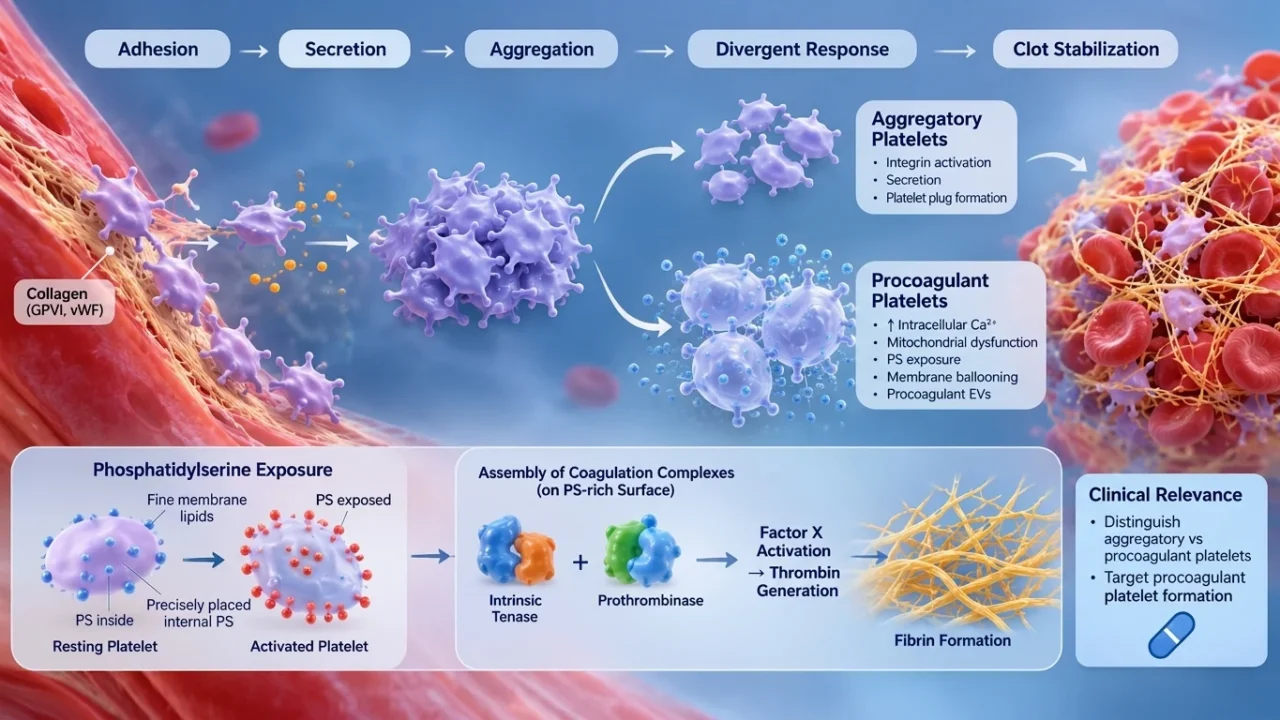
Traditionally, platelet activation has been understood primarily through the processes of adhesion, secretion, aggregation, and subsequent clot stabilization. Following vascular injury, platelets adhere to exposed subendothelial structures, including collagen, through receptors such as glycoprotein VI (GPVI) and von Willebrand factor-dependent mechanisms.
Subsequent activation leads to intracellular calcium mobilization, granule secretion, and activation of integrin αIIbβ3, allowing platelets to interact with one another and form a primary hemostatic plug.
However, activated platelets are functionally heterogeneous. A proportion of strongly stimulated platelets undergoes a distinct transformation into highly procoagulant cells. These platelets are characterized by sustained intracellular calcium elevation, mitochondrial dysfunction, phosphatidylserine (PS) exposure, membrane ballooning, and the release of procoagulant extracellular vesicles.
The exposure of PS on the outer leaflet of the platelet plasma membrane is particularly important. Under resting conditions, PS is predominantly located on the inner membrane leaflet. Following strong platelet stimulation, membrane lipid asymmetry is disrupted, allowing PS to become externally exposed.
This negatively charged phospholipid provides a catalytic surface for the assembly of coagulation enzyme complexes, particularly intrinsic tenase and prothrombinase. These complexes facilitate factor X activation and the conversion of prothrombin into thrombin, ultimately accelerating fibrin formation.
Consequently, procoagulant platelets do not simply contribute to platelet aggregation; they provide a surface that substantially amplifies coagulation.
The distinction between aggregatory and procoagulant platelets is clinically relevant. Aggregatory platelets primarily contribute to platelet plug formation through integrin activation, secretion, and intercellular interactions. Procoagulant platelets, in contrast, support thrombin generation and fibrin formation through PS-dependent mechanisms.
These responses are complementary during physiological hemostasis. However, excessive procoagulant platelet activity may contribute to pathological thrombus development, particularly in conditions characterized by strong platelet stimulation and thromboinflammation.
The possibility of selectively interfering with procoagulant platelet formation without completely suppressing aggregation represents an attractive therapeutic strategy.
Mitochondria as regulators of platelet function
Although platelets lack nuclei, they contain metabolically active mitochondria that contribute to energy production, intracellular calcium regulation, reactive oxygen species (ROS) signaling, and platelet survival.
Mitochondria support platelet function through oxidative phosphorylation and the tricarboxylic acid cycle. They also participate in the regulation of intracellular calcium concentrations by taking up calcium released from intracellular stores or entering through the plasma membrane.
During platelet activation, mitochondrial calcium uptake occurs primarily through the mitochondrial calcium uniporter (MCU). Under physiological conditions, this process contributes to calcium homeostasis and mitochondrial metabolism.
However, excessive mitochondrial calcium accumulation, particularly in the presence of oxidative stress, can trigger mitochondrial permeability transition.
Mitochondria also produce ROS, which participate in intracellular signaling and can amplify platelet activation. Nevertheless, excessive ROS production may promote mitochondrial dysfunction and increase the susceptibility of mitochondria to permeability transition.
These mechanisms place mitochondria at an important intersection between platelet activation, metabolic regulation, and procoagulant transformation.
The Mitochondrial Permeability Transition Pore
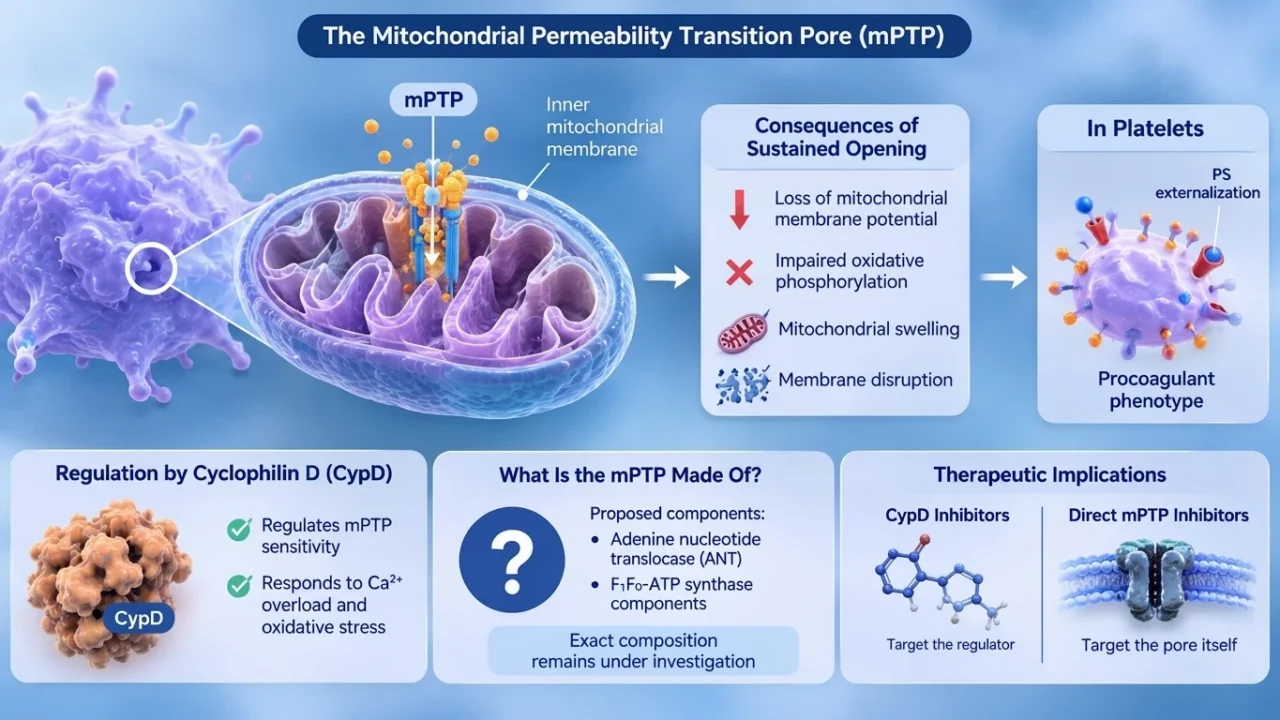
The mPTP is a high-conductance permeability pathway associated with the inner mitochondrial membrane. Its opening increases membrane permeability to small solutes, disrupting the electrochemical gradient required for mitochondrial function.
Sustained opening results in the loss of mitochondrial membrane potential, impaired oxidative phosphorylation, mitochondrial swelling, and potentially the disruption of mitochondrial membrane integrity.
In platelets, these events are closely associated with the development of the procoagulant phenotype, including PS externalization and membrane remodeling.
Cyclophilin D (CypD), a mitochondrial matrix protein, is an important regulator of mPTP sensitivity. It contributes to the regulation of pore opening in response to mitochondrial calcium overload and oxidative stress.
However, the precise molecular composition of the mPTP remains an area of active investigation. Although proteins such as adenine nucleotide translocase and components of the F1F0-ATP synthase complex have been implicated in proposed pore-forming mechanisms, their exact structural and functional contributions remain debated.
CypD is best regarded as an important regulatory factor rather than necessarily the structural component of the pore itself.
This distinction is relevant when considering therapeutic approaches because compounds that inhibit CypD and compounds that directly interfere with mitochondrial permeability transition may have different pharmacological properties.
From Mitochondrial Calcium Overload to Procoagulant Platelet Formation
The relationship between mitochondrial function and platelet procoagulant activity has been investigated in several experimental studies.
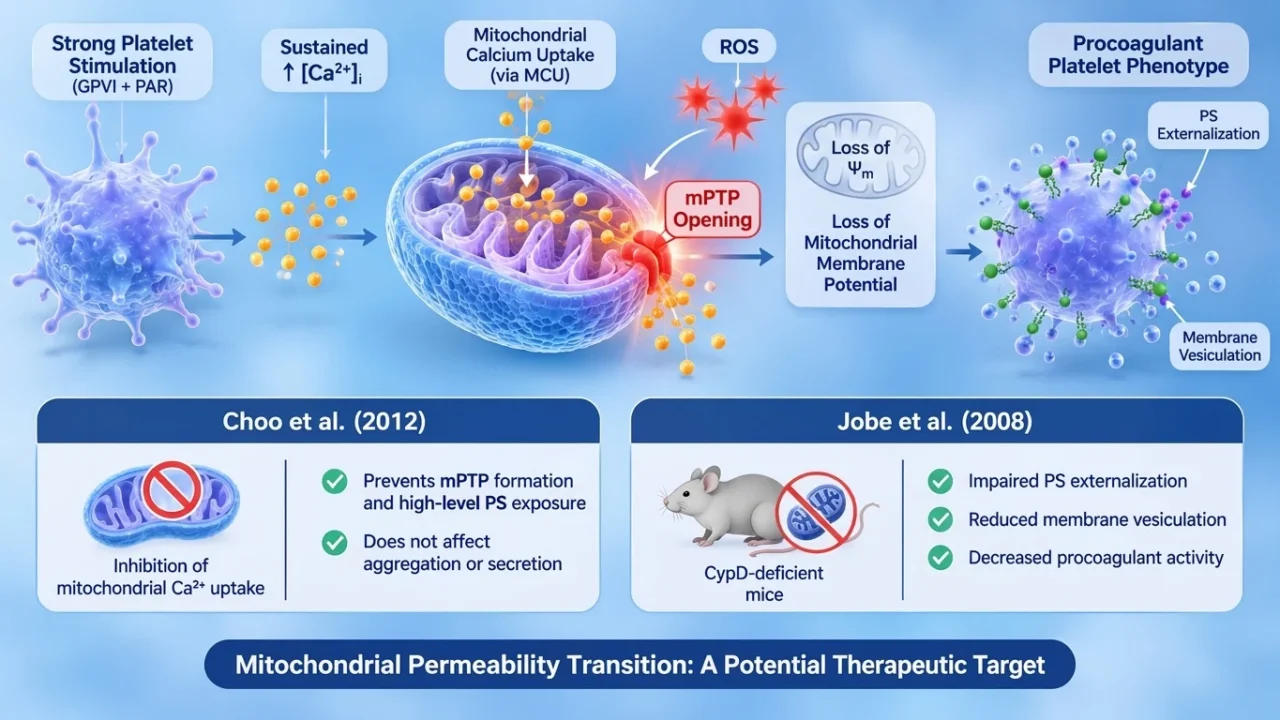
Strong platelet stimulation, particularly through combined GPVI and protease-activated receptor (PAR) signaling, produces sustained elevations in intracellular calcium. Calcium enters the cytoplasm through plasma membrane channels and is also released from intracellular stores.
Mitochondria take up a proportion of this calcium through the MCU. When mitochondrial calcium accumulation becomes excessive, especially in the presence of ROS, the threshold for mPTP opening may be reached.
The subsequent loss of mitochondrial membrane potential is an important event in the transition toward the highly procoagulant platelet phenotype.
In 2012, Choo and colleagues demonstrated that mitochondrial calcium accumulation and ROS production were important regulators of agonist-induced PS exposure. In their experimental models, inhibition of mitochondrial calcium uptake prevented mPTP formation and high-level PS exposure without suppressing platelet aggregation or granule release.
These findings provided early evidence that mitochondrial signaling could be selectively manipulated to influence procoagulant platelet activity.
The relationship between mitochondrial permeability transition and platelet function was also investigated by Jobe and colleagues in 2008. Their study demonstrated that platelets from CypD-deficient mice exhibited impaired PS externalization, reduced membrane vesiculation, and decreased procoagulant activity.
These findings established an important connection between CypD-dependent mitochondrial regulation and platelet-mediated coagulation.
Together, these investigations helped establish mitochondrial permeability transition as a potential therapeutic target rather than simply a consequence of platelet activation.
The Therapeutic Opportunity: Inhibiting Procoagulant Transformation Rather Than Platelet Activation
Conventional antiplatelet drugs, including aspirin and P2Y12 receptor inhibitors, interfere with pathways that are essential for platelet activation and aggregation. Their clinical efficacy is well established, but their effects on normal hemostatic mechanisms contribute to bleeding complications.
Targeting mitochondrial permeability transition represents a different therapeutic concept. Instead of blocking the initial activation of platelets, the objective is to interfere with intracellular signaling events that promote the development of the procoagulant phenotype.
This distinction is particularly relevant because aggregatory and procoagulant platelet responses are regulated through partially distinct signaling pathways.
An important prerequisite for this strategy is the identification of pharmacological agents that can inhibit pathological mitochondrial permeability transition without disrupting essential mitochondrial functions or conventional platelet activation.
Cyclophilin Inhibition: an Earlier Approach
Early investigations focused on CypD because of its established role in regulating mPTP opening.
Cyclosporine A is a well-known cyclophilin inhibitor that can inhibit mitochondrial permeability transition. However, its immunosuppressive activity and additional cellular effects limit its suitability as a selective antithrombotic agent.
In 2023, Van Bael and colleagues investigated two non-immunosuppressive small-molecule cyclophilin inhibitors and demonstrated that they reduced platelet procoagulant activity following dual-agonist stimulation.
The compounds reduced PS exposure, mitochondrial depolarization, procoagulant platelet-dependent clotting, and fibrin formation under flow conditions. Importantly, conventional platelet activation parameters, including P-selectin expression and integrin αIIbβ3 activation, were largely preserved. Unlike cyclosporine A, the investigated compounds did not increase ADP-induced platelet aggregation.
These results supported the possibility of targeting mitochondrial regulatory pathways without broadly suppressing platelet function.
Nevertheless, cyclophilins participate in several cellular processes beyond mitochondrial permeability transition. Consequently, inhibition of CypD may not necessarily provide the same degree of selectivity as directly targeting the mitochondrial permeability transition process.
This limitation encouraged the investigation of alternative small molecules capable of inhibiting mPTP opening independently of CypD.
A Major Development in 2026: Cyclophilin D-independent mPTP Inhibitors
A particularly important contribution to this field was published by Zhang and colleagues in Blood in October 2026.
In their study, entitled ‘Inhibition of mitochondrial permeability transition selectively suppresses thrombogenic platelet procoagulant activity,’ the investigators evaluated three newly developed small-molecule mPTP inhibitors: MC63, TR001, and TR002.
Unlike conventional approaches based on cyclophilin inhibition, these compounds were investigated as cyclophilin D-independent inhibitors of mitochondrial permeability transition.
The investigators examined their effects on mitochondrial function, platelet activation, procoagulant transformation, thrombin generation, fibrin formation, and experimental thrombosis.
- Effects on platelet mitochondrial function
Under strong GPVI/PAR-driven procoagulant conditions, the investigated inhibitors preserved mitochondrial membrane potential and prevented excessive intracellular calcium accumulation. This was accompanied by a reduction in PS-positive and P-selectin-positive platelet populations, microparticle release, and membrane blebbing.
These findings indicate that inhibiting mitochondrial permeability transition can interfere with the development of the procoagulant phenotype at a stage downstream of initial platelet activation.
- Preservation of conventional platelet functions
One of the most important aspects of the study was the preservation of several platelet functions despite reduced procoagulant activity.
MC63, TR001, and TR002 did not substantially impair:
- Agonist-induced calcium mobilization.
- Platelet secretion.
- Integrin activation.
- Platelet aggregation.
- F-actin assembly.
- Clot retraction.
This distinction is central to the proposed therapeutic advantage. Rather than preventing platelets from responding to vascular injury, mPTP inhibition appeared to selectively interfere with their conversion into highly procoagulant cells.
The preservation of integrin activation and aggregation is particularly relevant because these mechanisms contribute directly to the formation and stabilization of the primary platelet plug.
- Effects on thrombin generation and fibrin formation
The investigators also demonstrated that the compounds reduced platelet-dependent thrombin generation and fibrin formation. Importantly, platelet-independent thrombin activity was not directly affected.
This observation supports the interpretation that the antithrombotic effects were mediated primarily through changes in platelet procoagulant activity rather than direct inhibition of thrombin itself.
- Evidence from experimental thrombosis models
The antithrombotic potential of the compounds was further investigated using whole-blood perfusion and in vivo thrombosis models. During whole-blood perfusion over collagen, mPTP inhibition reduced the proportion of PS-positive platelets within developing thrombi without significantly impairing platelet accumulation at the injury surface.
In a laser-induced arteriolar injury model, treatment reduced platelet and fibrin accumulation at the site of vascular injury. Importantly, these antithrombotic effects were not accompanied by prolonged tail bleeding time. The investigators also reported no prolongation of tail bleeding when mPTP inhibitors were administered in combination with acetylsalicylic acid.
Together, these findings provide experimental evidence that mPTP inhibition can reduce platelet-dependent thrombus formation while preserving several important hemostatic functions.
However, it is essential to emphasize that these findings are preclinical. Animal bleeding-time measurements cannot establish clinical safety or demonstrate that the same therapeutic window will exist in humans.
Clinical Implications: Where Could This Strategy Be Useful?
The possibility of reducing platelet-dependent coagulation while preserving conventional platelet activation has several potential clinical implications.
- Arterial thrombosis and cardiovascular disease
Platelet activation and thrombin generation are central to arterial thrombus development, particularly in acute coronary syndromes and ischemic stroke.
A therapeutic strategy that selectively reduces procoagulant platelet activity could potentially complement conventional antiplatelet therapy.
However, whether mPTP inhibitors can provide additional clinical protection against arterial thrombosis without increasing bleeding remains to be established.
- Combination with conventional antiplatelet agents
One of the most interesting observations from the 2026 study was the absence of prolonged tail bleeding in mice receiving mPTP inhibitors together with aspirin.
This raises the possibility of combining mitochondrial-targeted antithrombotic agents with established antiplatelet therapies.
Such an approach could theoretically target different components of platelet-mediated thrombosis: conventional platelet activation and the subsequent development of excessive procoagulant activity.
Nevertheless, the safety and efficacy of these combinations require extensive investigation before clinical application.
- Thromboinflammatory disorders
Procoagulant platelets are increasingly recognized as important contributors to the interaction between coagulation and inflammation.
Recent research has highlighted their involvement in cardiovascular disease, microvascular thrombosis, and several thromboinflammatory conditions.
Because mitochondrial dysfunction and oxidative stress are also associated with inflammatory platelet activation, mPTP inhibition may represent an additional therapeutic direction in selected disorders characterized by excessive platelet-dependent coagulation.
- Biomarker-guided treatment
Another potential area of development involves the identification of patients with increased procoagulant platelet activity.
Potential biomarkers include:
- The proportion of PS-positive platelets.
- Platelet mitochondrial membrane potential.
- Platelet-dependent thrombin generation.
- Procoagulant extracellular vesicle levels.
- Markers of platelet mitochondrial oxidative stress.
- Flow cytometry, using annexin V or lactadherin to detect externalized PS, could provide a means of assessing the procoagulant platelet population.
However, standardized assays and clinically validated thresholds will be necessary before these measurements can be used for patient selection or treatment monitoring.
Future Perspectives: Toward a New Generation of Antithrombotic Agents
The development of mPTP inhibitors introduces an alternative way of thinking about antithrombotic therapy.
For decades, treatment strategies have largely focused on blocking platelet receptors, intracellular activation pathways, or coagulation factors.
However, the increasing recognition of platelet functional heterogeneity suggests that selectively targeting specific platelet responses may offer additional therapeutic opportunities.
The 2026 findings by Zhang and colleagues provide an important proof of concept: it may be possible to reduce the procoagulant activity of platelets without substantially impairing their aggregatory and adhesive functions.
Further research should investigate whether these effects can be reproduced in human whole blood under physiologically relevant flow conditions, whether platelet-specific delivery is feasible, and whether these compounds can provide meaningful protection against thrombosis in established cardiovascular disease models.
Clinical development will also require careful evaluation of pharmacokinetics, dose-response relationships, drug interactions, and potential adverse effects.
Ultimately, the success of this strategy will depend on demonstrating that the reduction in pathological thrombus formation can be achieved without compromising the platelet and coagulation responses required for normal hemostasis.
Conclusion
Targeting platelet mitochondrial permeability transition represents an emerging strategy for separating pathological thrombosis from physiological hemostasis.
The biological rationale is based on the functional distinction between aggregatory and procoagulant platelets. While both populations contribute to normal hemostasis, excessive procoagulant transformation can amplify thrombin generation and fibrin formation, contributing to pathological thrombosis.
Experimental studies have established an important relationship between mitochondrial calcium accumulation, mPTP opening, and platelet PS exposure.
More recently, the 2026 study by Zhang and colleagues demonstrated that cyclophilin D-independent small-molecule mPTP inhibitors can reduce procoagulant platelet activity and experimental thrombus formation while preserving several conventional platelet functions.
Although clinical translation remains at an early stage, these findings introduce an important therapeutic concept: rather than inhibiting platelet activation globally, it may be possible to selectively interfere with the mitochondrial signaling events responsible for excessive platelet-dependent coagulation.
If confirmed through further translational and clinical studies, targeting platelet mitochondrial permeability transition could represent a promising direction in the development of antithrombotic therapies with a more favorable balance between thrombosis prevention and bleeding risk.
FAQs
1. Does platelet mitochondrial permeability transition contribute to thrombosis?
Yes. It promotes procoagulant platelet formation, phosphatidylserine exposure, and thrombin generation.
2. Is platelet activation the same as procoagulant platelet formation?
No. Platelet activation includes aggregation and secretion, whereas procoagulant transformation specifically enhances coagulation.
3. Does inhibiting the mitochondrial permeability transition pore prevent platelet aggregation?
Not necessarily. Experimental mPTP inhibitors can suppress procoagulant activity while preserving platelet aggregation.
4. Is cyclophilin D essential for mitochondrial permeability transition?
No. It is an important regulator, but mitochondrial permeability transition can also occur through cyclophilin D-independent mechanisms.
5. Does mitochondrial pore inhibition reduce thrombin generation?
Yes. It reduces platelet-dependent thrombin generation by limiting phosphatidylserine exposure.
6. Is targeting platelet mitochondria a safer alternative to conventional antiplatelet therapy?
Potentially. Preclinical findings are encouraging, but clinical safety remains unestablished.
7. Does mPTP inhibition affect physiological hemostasis?
Potentially. Excessive inhibition could impair the procoagulant platelet activity required for normal clot formation.
8. Is phosphatidylserine exposure necessary for normal blood clotting?
Yes. It provides the surface required for efficient coagulation factor complex assembly and thrombin generation.
9. Does aspirin prevent mitochondrial permeability transition in platelets?
No. Aspirin primarily inhibits cyclooxygenase-1 and thromboxane A₂ production.
10. Are mitochondrial permeability transition inhibitors currently available as antithrombotic drugs?
No. Compounds such as MC63, TR001, and TR002 remain experimental.
Written by Marieta Aleksanyan, MD
Stay updated with Hemostasis Today.
-
Nov 10, 2026, 14:13Shayan Mohammadmoradi: Jay D. Coffman Award for Emerging Vascular Researcher
-
Nov 10, 2026, 14:10Phil Choi: New Guidance Aims to Improve Care for Patients With AIHA
-
Nov 10, 2026, 13:55Marilena Vrana: Building Momentum for the Future of Plasma-Derived Therapies
-
Nov 10, 2026, 13:32Maya Bishop: Scientific Exchange and Global Connections at AHA 2026
-
Nov 10, 2026, 13:10Alan Nurden։ How Aberrant Splicing Disrupts Megakaryocyte Development in TAR Syndrome
-
Nov 10, 2026, 13:10Masanori Aikawa: NEK7 Research Earns Top Honors at AHA 2026
-
Nov 10, 2026, 12:57Chokri Ben Lamine: The Hidden Risk of RBC Alloimmunization in SCD, Thalassemia and HSCT
-
Nov 10, 2026, 12:47Jamie Nash։ RBC-Derived EVs Show Greater Procoagulant Potential
-
Nov 10, 2026, 11:14Judith Catella: SVC Filters in Upper Extremity DVT Thrombectomy