

When Platelets Cannot Support Thrombin Generation: The Hidden Dimension of Bleeding Disorders
For decades, the evaluation of bleeding disorders has been organized around several familiar questions.
Is the platelet count sufficient?
Can platelets adhere and aggregate appropriately?
Are coagulation factors present and functional?
Can a stable fibrin clot form?
These questions remain fundamental. Yet they do not fully capture the biological complexity of hemostasis.
A platelet may circulate in an apparently adequate number, respond to conventional agonists, and participate in aggregation while still providing an insufficient surface for the coagulation reactions required to generate thrombin efficiently.
This distinction matters because platelet-mediated hemostasis is not limited to the physical formation of a cellular plug. Platelets also actively regulate the biochemical environment in which fibrin is produced.
Thrombin occupies a central position in this process. It converts fibrinogen into fibrin, activates platelets, and amplifies coagulation through the activation of additional coagulation factors.
The resulting fibrin network stabilizes the platelet-rich hemostatic plug.
However, the generation of sufficient thrombin at a site of vascular injury depends on more than the circulating concentrations of coagulation factors. It also depends on the availability of suitable cellular surfaces on which coagulation complexes can assemble. Activated platelets provide such surfaces.
Through changes in membrane phospholipids, the release of granule contents, and calcium-dependent signaling, they support the assembly and activity of coagulation complexes.
These mechanisms have become increasingly recognized as essential components of normal hemostasis and as potential contributors to bleeding in selected inherited platelet disorders.
The clinical significance of this distinction is straightforward: platelet aggregation and platelet-supported thrombin generation are related functions, but they are not interchangeable measurements of hemostatic competence.
A conventional platelet-function assay may identify abnormalities in adhesion, secretion, or aggregation without directly quantifying the platelet’s capacity to support coagulation.
Conversely, a platelet-dependent thrombin-generation assay can examine the combined contribution of platelets and plasma coagulation factors to thrombin formation, although it cannot by itself identify the precise molecular defect.
This creates an important diagnostic question:
Could some bleeding phenotypes be better understood by examining not only whether platelets form an aggregate, but also whether they enable sufficient thrombin generation?
The answer is biologically compelling, and rare disorders such as Scott syndrome provide direct evidence that defects in platelet procoagulant function can cause bleeding.
Nevertheless, the extent to which this mechanism explains otherwise unexplained bleeding in broader clinical populations remains an active area of investigation.
From Platelet Aggregation to the Procoagulant Surface
Two complementary platelet functions
Platelets perform several coordinated functions following vascular injury. They adhere to the exposed subendothelial matrix, become activated, recruit additional platelets, and aggregate to establish an initial hemostatic plug. At the same time, selected activated platelets undergo a distinct transformation that supports coagulation. These functions are complementary but biologically different.
Aggregatory platelets maintain platelet–platelet interactions through activated integrin αIIbβ3 and fibrinogen-mediated bridging.
Procoagulant platelets, by contrast, develop a membrane surface enriched in negatively charged phospholipids that supports the assembly of coagulation-factor complexes. Their function is therefore less about recruiting additional platelets and more about promoting localized thrombin generation.
The distinction is particularly important because procoagulant transformation is not simply a stronger version of aggregation. It involves profound changes in intracellular calcium, mitochondrial function, membrane structure, and integrin activity. The resulting platelet phenotype is specialized for coagulation rather than conventional aggregation.
Why Phosphatidylserine Matters
In resting platelets, phosphatidylserine (PS) is concentrated predominantly in the inner leaflet of the plasma membrane. This asymmetric distribution limits the availability of anionic phospholipids to circulating coagulation factors.
Following strong platelet stimulation, this membrane asymmetry can be disrupted. PS becomes exposed on the outer surface, creating a platform that promotes the assembly of two essential coagulation complexes:
- Intrinsic tenase: factor IXa and its cofactor factor VIIIa, which facilitate factor X activation.
- Prothrombinase: factor Xa and its cofactor factor Va, which catalyse the conversion of prothrombin into thrombin.
The spatial organization of these reactions increases the efficiency of coagulation at the site of injury. Rather than relying exclusively on freely circulating proteins, the coagulation system can concentrate essential enzymatic reactions on a suitably organized membrane surface. [2]
The importance of PS exposure extends beyond its presence as a membrane marker. Its availability influences the assembly and activity of coagulation complexes, making the process a functional determinant of thrombin generation. Consequently, a platelet population that fails to expose sufficient PS following appropriate stimulation may provide inadequate support for coagulation, even if other aspects of platelet activation remain relatively preserved.
The Calcium–Mitochondrial axis
The transition to a procoagulant platelet phenotype requires coordinated intracellular signaling.
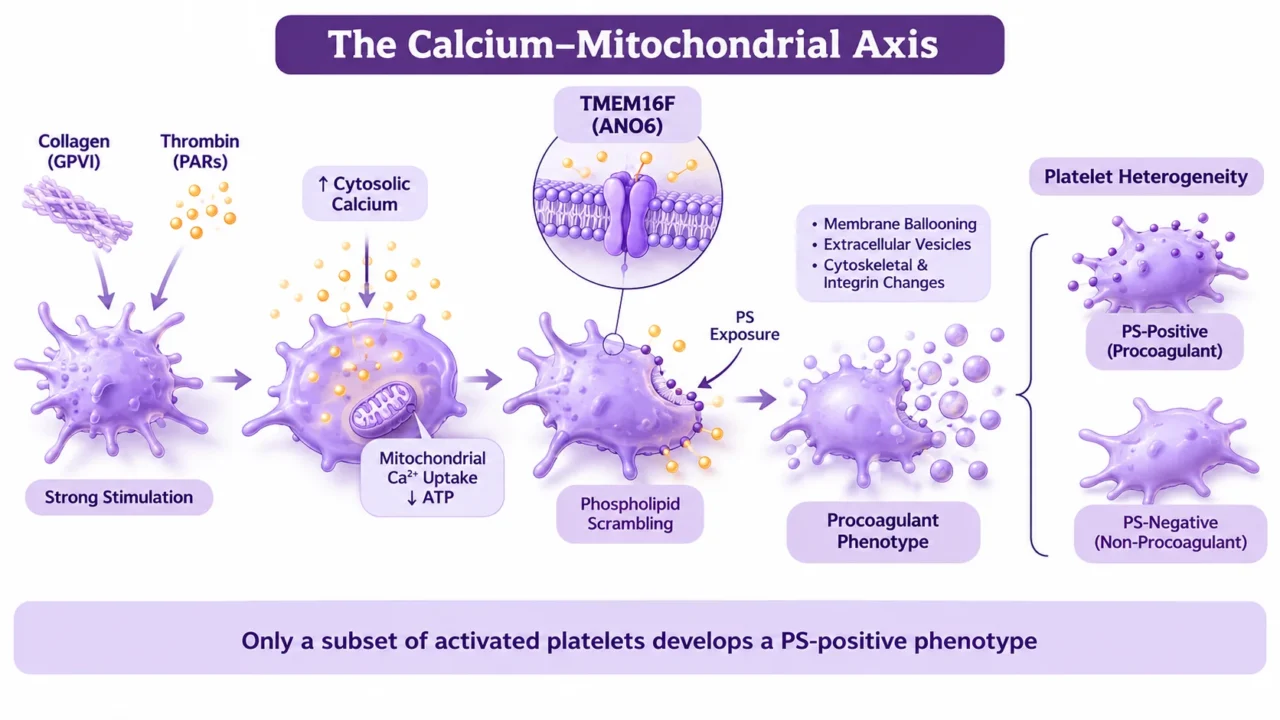
Strong stimulation through collagen-responsive glycoprotein VI and thrombin-responsive protease-activated receptors can produce sustained increases in cytosolic calcium.
Calcium uptake by mitochondria, changes in mitochondrial membrane potential, and depletion of cellular ATP contribute to the processes that permit membrane phospholipid scrambling.
A central mediator is TMEM16F, also known as anoctamin 6, a calcium-dependent phospholipid scramblase encoded by ANO6.
Under appropriate conditions, this protein facilitates the redistribution of phospholipids across the plasma membrane, allowing PS to become exposed externally. The process is accompanied by membrane ballooning, extracellular-vesicle formation, and changes in cytoskeletal and integrin function. Together, these changes establish a specialized procoagulant platelet phenotype.
Importantly, not every activated platelet undergoes this transformation.
Platelet populations are heterogeneous, and only a subset of platelets exposed to strong combined agonists develops the characteristic PS-positive phenotype under experimental conditions.
This heterogeneity offers a useful conceptual framework for understanding why conventional measurements of platelet number or aggregation may not fully describe the ability of a platelet population to support coagulation.
The Hidden Defect: when the Platelet Cannot Sustain Coagulation
Scott Syndrome and Defective Phospholipid Scrambling
Scott syndrome provides one of the clearest demonstrations that platelet procoagulant activity can be independently impaired. This rare inherited bleeding disorder is associated with defects in TMEM16F, which encodes a calcium-dependent phospholipid scramblase. Affected platelets have impaired exposure of PS-rich membrane regions and reduced release of certain procoagulant extracellular vesicles. The result is an inability to support some coagulation reactions as efficiently as normal platelets.
The clinical phenotype varies. Bleeding has been reported following surgical procedures, dental extractions, and childbirth, although the number of genetically characterized patients remains small. The rarity of the condition limits estimates of prevalence and makes it difficult to define the full range of clinical manifestations.
Importantly, Scott syndrome does not establish that every platelet function disorder is a disorder of thrombin generation. Instead, it demonstrates that a specific defect in platelet membrane remodeling can produce a bleeding phenotype through impaired procoagulant activity.
The distinction is mechanistically informative. A defect in platelet adhesion can prevent platelets from reaching or attaching to an injury site. A defect in aggregation can compromise the stability of the platelet plug. A defect in procoagulant membrane formation can impair the subsequent generation of thrombin and fibrin, even when some other platelet responses remain intact.
These pathways may coexist, but they should not be treated as equivalent.
Recent evidence also cautions against interpreting PS exposure as a simple binary property.
In a 2024 report examining a new family with a platelet PS-exposure defect, Gary E. Gilbert highlighted differences between extensive PS-rich membrane blebbing and lower-level PS exposure that may support coagulation without producing the same conspicuous membrane phenotype. The report raises important questions about how different degrees and patterns of PS exposure relate to physiological hemostasis.
This distinction matters for laboratory interpretation. A test designed to detect pronounced PS exposure may not capture every membrane-dependent contribution to coagulation. Conversely, a reduction in a particular PS-positive platelet population does not automatically establish a clinically significant deficiency in overall hemostatic capacity.
Beyond Scott Syndrome: Platelet Factor V and Granule-Associated Mechanisms
The platelet procoagulant phenotype is not determined by membrane phospholipids alone. Platelets contain α-granules and dense granules that release molecules capable of influencing coagulation and clot stability.
Platelet α-granules contain factor V, which can contribute to the formation of prothrombinase following activation. Dense granules release inorganic polyphosphate, which has been implicated in the modulation of several coagulation reactions and fibrinolysis.
These mechanisms create additional routes through which platelet abnormalities can influence thrombin generation.
A particularly informative example is Quebec platelet disorder, an inherited bleeding disorder associated with increased platelet urokinase-type plasminogen activator (uPA), accelerated degradation of platelet α-granule proteins, and enhanced platelet-associated fibrinolysis. Its pathophysiology illustrates that bleeding can result from overlapping abnormalities in coagulation support and clot stability.
A study using calibrated automated thrombin-generation assays examined seven patients with Quebec platelet disorder and 22 controls. Thrombin generation in platelet-poor plasma was normal, whereas platelet-rich plasma from affected patients showed reduced peak thrombin and endogenous thrombin potential. T
he abnormalities correlated with platelet factor V deficiency. Tranexamic acid improved thrombin-generation parameters but did not completely correct them. Importantly, the measured thrombin-generation abnormalities were not associated with bleeding scores in this small cohort.
This study illustrates two important principles.
First, plasma coagulation measurements may fail to reveal abnormalities that become apparent when platelets are included in the assay. Second, an abnormal laboratory measurement should not automatically be assumed to predict bleeding severity.
Quebec platelet disorder is not a pure defect of PS exposure, nor should it be classified as equivalent to Scott syndrome. Its value in this context lies in demonstrating that platelet-dependent thrombin generation can be affected by mechanisms other than defective phospholipid scrambling.
The broader implication is that the platelet’s contribution to hemostasis is distributed across multiple functions: membrane organization, coagulation-factor availability, granule secretion, and the regulation of fibrinolysis.
Why Routine Tests may not Tell the Whole Story
A normal platelet count is not proof of normal platelet function
The platelet count measures the number of circulating platelets, not their functional competence.
Inherited platelet-function disorders can occur with relatively normal platelet counts and morphology. Defects in receptors, intracellular signaling, granule contents, or membrane-associated processes may compromise hemostasis without producing an obvious numerical abnormality. [6]
This is well established in conventional platelet disorders. The more specific question is whether the same principle applies to platelet-dependent thrombin generation.
Mechanistically, it does. A normal number of platelets does not guarantee that an adequate proportion will undergo procoagulant transformation, expose sufficient PS, release relevant granule contents, or support efficient coagulation-complex assembly.
However, platelet-dependent thrombin generation is influenced by plasma coagulation factors as well as platelets. Therefore, a reduced result cannot automatically be attributed to an intrinsic platelet defect.
PT and aPTT Answer Different Questions
Prothrombin time (PT) and activated partial thromboplastin time (aPTT) remain important tests in the evaluation of bleeding disorders. They assess clot formation under defined laboratory conditions and can identify many abnormalities of the coagulation-factor pathways.
They do not, however, directly quantify every aspect of platelet-supported coagulation in a physiological hemostatic plug.
A patient may therefore have a clinical bleeding phenotype that is not explained by PT or aPTT alone. This observation is not specific to platelet procoagulant dysfunction: von Willebrand disease and many platelet-function disorders can also occur with normal routine coagulation results.
The appropriate conclusion is not that conventional coagulation tests are inadequate in general, but that different hemostatic tests measure different biological components.
When the clinical history remains unexplained, further evaluation should be guided by the bleeding phenotype, family history, medication exposure, platelet count and morphology, and the results of appropriate specialist investigations.
Aggregometry does not Directly Measure Thrombin-Generation Capacity
Light-transmission aggregometry and related platelet-function tests examine platelet responses to selected agonists. They are valuable for identifying abnormalities in aggregation pathways and remain important in the investigation of inherited platelet disorders.
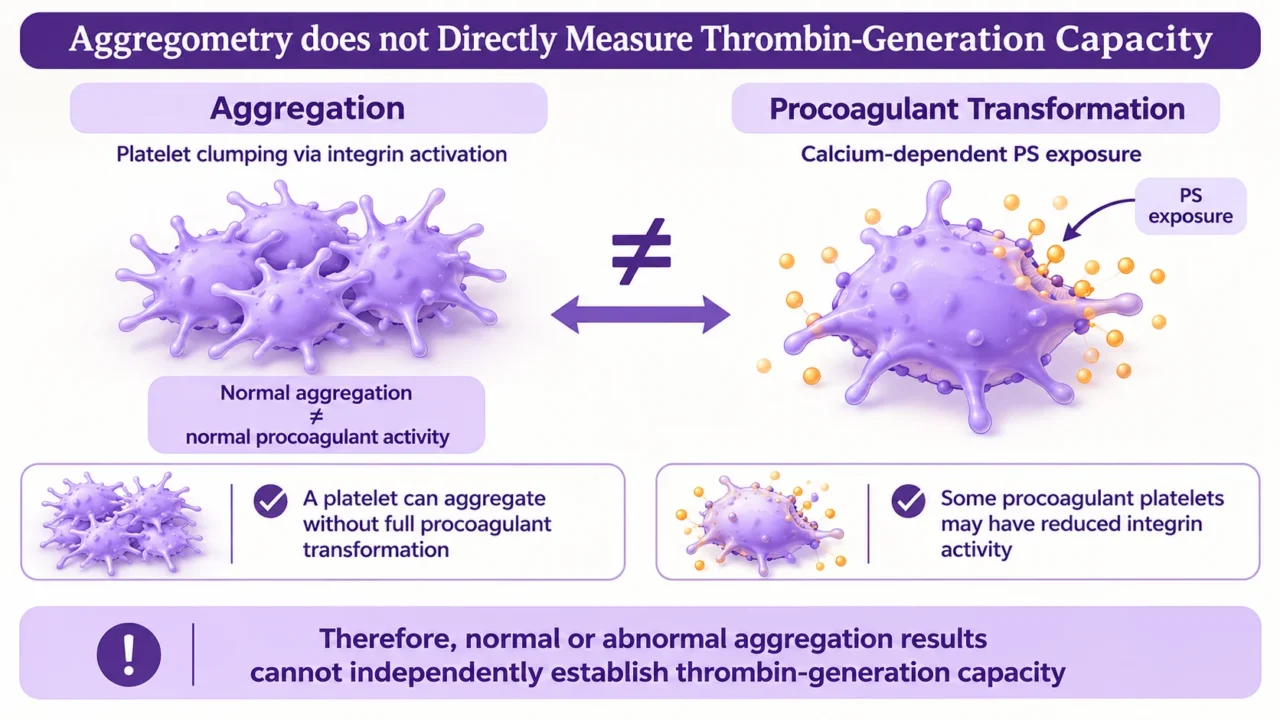
Nevertheless, aggregation and procoagulant transformation are distinct responses.
A platelet can participate in aggregation without undergoing the full calcium-dependent transformation associated with pronounced PS exposure. Conversely, some procoagulant platelets develop reduced integrin activity as part of their specialized phenotype.
Consequently, normal aggregation results cannot independently establish that platelet-dependent thrombin generation is normal.
The converse is equally important: an abnormal aggregation result does not establish that impaired procoagulant activity is the primary cause of bleeding.
A comprehensive assessment must preserve these distinctions rather than treating all platelet-function tests as interchangeable measures of a single property.
Measuring Platelet-Supported Thrombin Generation
Platelet-rich plasma and calibrated automated thrombinography
Thrombin-generation assays quantify the production of thrombin over time under defined laboratory conditions. When performed in platelet-rich plasma (PRP), they can assess the combined contribution of platelets and plasma coagulation components to thrombin formation.
Commonly reported parameters include:
- Lag time: the interval before measurable thrombin generation begins.
- Peak thrombin: the maximum thrombin concentration achieved.
- Time to peak: the time required to reach maximum thrombin concentration.
- Endogenous thrombin potential (ETP): the area under the thrombin-generation curve, reflecting total thrombin-generating potential under the assay conditions.
These parameters describe different features of the reaction. A prolonged lag time, reduced peak, and decreased ETP are not identical abnormalities and should not be interpreted as interchangeable indicators of bleeding risk.
Panova-Noeva, van der Meijden, and ten Cate reviewed the clinical applications and limitations of platelet-dependent thrombin-generation assays in 2020. Their review discussed potential applications in hemophilia, von Willebrand disease, Glanzmann thrombasthenia, and other bleeding conditions, while emphasizing the need for further standardization and clinical validation.
The attraction of PRP-based testing is that it incorporates platelets into the coagulation reaction rather than assessing plasma in isolation. However, this added biological complexity also creates analytical challenges.
Why Platelet-Poor Plasma Remains Useful
Comparing PRP with platelet-poor plasma (PPP) can help investigate whether a thrombin-generation abnormality is associated with the platelet-containing fraction.
The Quebec platelet disorder study provides a useful example: PPP thrombin generation was normal, while PRP thrombin generation was reduced.
Such a pattern supports a platelet-associated contribution to the observed defect. It does not, by itself, identify the precise mechanism, prove that the abnormality is the sole cause of bleeding, or establish its predictive value in other patients. The comparison is therefore most useful as part of a mechanistic investigation, alongside platelet-function testing and other appropriate laboratory assessments.
Flow Cytometry and Phosphatidylserine Exposure
Flow cytometry can quantify the proportion of platelets exposing PS after stimulation and characterize other activation-associated features. This approach is relevant when the clinical or laboratory findings raise suspicion of impaired procoagulant transformation. It can help distinguish a failure to develop a particular platelet phenotype from other abnormalities in platelet activation.
Nevertheless, interpretation depends on the agonist, stimulation conditions, sample handling, platelet gating, detection reagents, and the threshold used to define PS positivity. The choice of marker also matters because different reagents may detect different degrees or configurations of PS exposure.
A reduced PS-positive fraction should therefore be interpreted in the context of the complete assay and the patient’s clinical findings, not as an isolated diagnostic verdict.
The Problem of Standardization
Platelet-dependent thrombin generation remains primarily a specialized investigative tool rather than a universally standardized clinical test for bleeding disorders.
Pre-analytical variables, including blood collection, sample processing, platelet concentration, activation during handling, and the interval between collection and measurement, can influence results. Reagent concentrations and assay protocols also affect the thrombin-generation curve. Moreover, evidence that a test detects a biological abnormality is not equivalent to evidence that it predicts clinically important bleeding.
As emphasized by Panova-Noeva and colleagues, prospective studies linking platelet-dependent thrombin-generation parameters to clinical outcomes are necessary before the assay can be widely adopted for routine risk assessment.
The immediate priority is therefore not to replace established investigations with a single global assay. It is to determine which patients may benefit from complementary testing and whether the results improve diagnostic classification or clinical decisions.
Clinical Implications: Recognizing the Missing Dimension of Hemostasis
A more complete investigation of unexplained bleeding
The possibility of impaired platelet-supported thrombin generation is most relevant when the clinical bleeding phenotype cannot be adequately explained by initial investigations.
For example, a patient with recurrent mucosal bleeding or excessive bleeding after dental procedures may have a normal platelet count and normal PT and aPTT. These findings do not exclude a platelet-function disorder, but neither do they establish a defect in procoagulant platelet activity.
A rational diagnostic approach should proceed from the clinical phenotype toward increasingly specialized testing.
- Clinical bleeding phenotype
- Personal and family history, bleeding pattern, medication exposure and previous hemostatic challenges
- Initial laboratory assessment
- CBC and platelet count, blood film where indicated, PT, aPTT, fibrinogen and evaluation for von Willebrand disease as appropriate
- Specialist platelet investigation
- Selected platelet aggregation, secretion, flow-cytometry or genetic studies guided by the suspected disorder
- Selected assessment of procoagulant function
- PS exposure and platelet-dependent thrombin generation when clinically and scientifically justified
- Conceptual diagnostic framework for specialist evaluation; not a validated clinical algorithm or a substitute for established guidelines.
The central principle is that specialized procoagulant testing should complement, rather than replace, conventional investigations. Genetic testing may be particularly informative when a specific inherited disorder is suspected, but the interpretation of genetic findings requires correlation with the clinical and laboratory phenotype.
Could Platelet-Dependent Thrombin Generation Explain Bleeding Severity?
Patients with inherited bleeding disorders can exhibit variability in clinical severity that is not fully explained by a single laboratory measurement. Platelet-dependent thrombin generation offers one potential way to investigate this variability.
In severe coagulation-factor deficiencies, platelet surfaces provide the environment in which tenase and prothrombinase complexes operate.
The availability and properties of these surfaces may influence the overall reaction, although the extent to which platelet-specific differences independently determine bleeding severity remains incompletely established.
Similarly, patients with inherited platelet disorders may have defects involving several biological pathways simultaneously. A reduced thrombin-generation result may reflect impaired platelet factor V availability, defective membrane phospholipid exposure, abnormal secretion, a plasma coagulation abnormality, or a combination of these mechanisms.
This complexity limits the use of thrombin-generation measurements as standalone predictors. It also makes them potentially valuable research tools: they allow investigators to examine how distinct abnormalities interact within the same hemostatic system.
The next step is to determine whether particular assay patterns correspond reproducibly to clinically meaningful outcomes, such as bleeding after surgery, recurrent mucosal hemorrhage, or the need for hemostatic treatment.
Current Challenges and Controversies
The distinction between mechanism and diagnosis. Demonstrating impaired thrombin generation under laboratory conditions does not automatically establish a distinct bleeding disorder. The finding must be interpreted alongside clinical evidence and other investigations.
The meaning of PS exposure. Pronounced PS-rich membrane blebbing is a recognizable procoagulant phenotype, but it is not synonymous with every form of platelet-supported coagulation. Different activation conditions can produce different membrane responses. [3,4]
The relationship between laboratory results and clinical severity.
In the doi.org/10.1111/ijlh.13302, platelet-dependent thrombin generation was reduced, but the measured abnormalities were not associated with bleeding scores. Larger studies are needed to establish whether specific parameters predict clinically relevant outcomes.
The rarity of mechanistically defined disorders. Scott syndrome provides compelling evidence of the biological importance of phospholipid scrambling, but the small number of characterized patients limits conclusions about prevalence, phenotype variability, and the broader contribution of this mechanism to unexplained bleeding.
The absence of universal assay standards. Differences in sample processing, agonist selection, platelet concentration, reagents, and analytical protocols make comparisons across laboratories difficult. Standardized procedures and clinically validated reference intervals are needed before results can be interpreted consistently.
Future Directions: from Platelet Counts to Platelet Function in Context
The future of bleeding-disorder investigation may depend increasingly on combining complementary measures of hemostasis rather than relying on a single laboratory result. Several research priorities follow from the current evidence.
First, prospective studies should investigate whether platelet-dependent thrombin-generation parameters improve the diagnostic classification of patients with unexplained bleeding after conventional evaluation. These studies should use predefined clinical outcomes and include appropriate control groups.
Second, research should compare platelet-rich and platelet-poor plasma thrombin generation with flow-cytometric measurements of PS exposure, platelet aggregation, secretion, and relevant molecular findings. Such comparisons could help determine which patterns are associated with specific defects rather than treating reduced thrombin generation as a single biological entity.
Third, inherited disorders affecting membrane remodeling, platelet factor V, and granule function offer opportunities to investigate the relationship between molecular abnormalities and coagulation performance. Rare-disease registries and multicentre collaboration will be particularly important because individual centres may encounter very few affected patients.
Fourth, assay development should prioritize reproducibility and clinical relevance. A method that measures platelet procoagulant activity accurately in an experimental setting will have limited clinical value unless its results can be interpreted consistently and shown to improve patient assessment.
Finally, future studies should examine whether changes in platelet-dependent thrombin generation during treatment correspond to meaningful changes in bleeding outcomes. Such evidence would be necessary before the assay could be recommended for routine treatment monitoring.
These priorities do not imply that platelet-dependent thrombin generation should become a universal screening test. They identify a specific knowledge gap: the need to understand when measuring this additional component of hemostasis provides information beyond established diagnostic methods.
Conclusion: Looking beyond the Platelet Plug
Platelets are not merely the cellular building blocks of the primary hemostatic plug. They also provide a dynamic biochemical platform that supports thrombin generation, fibrin formation, and clot stabilization.
The study of procoagulant platelet activity reveals a dimension of hemostasis that conventional platelet counts, aggregation studies, and plasma coagulation tests do not fully characterize individually. Scott syndrome demonstrates that impaired phospholipid scrambling can cause bleeding, while Quebec platelet disorder illustrates how platelet-associated abnormalities can affect thrombin generation through additional mechanisms.
These disorders should not be considered interchangeable, nor should every unexplained bleeding phenotype be attributed to deficient platelet procoagulant activity. The strongest evidence supports the biological importance of platelet-dependent coagulation; the broader clinical utility of specialized thrombin-generation testing remains less certain.
The challenge for modern hematology is to establish when this additional information changes diagnosis, risk assessment, or treatment.
Ultimately, the question is not simply whether platelets are present, activated, or capable of aggregation. It is whether the entire hemostatic system can generate and sustain enough thrombin, at the appropriate location and time, to produce a stable clot.
That distinction may help explain selected bleeding phenotypes that remain incompletely characterized by conventional tests—and provides a focused direction for future research into platelet biology and clinical hemostasis.
Frequently Asked Questions (FAQs)
1. What is platelet procoagulant activity?
Platelet procoagulant activity is the ability of activated platelets to support coagulation reactions, particularly thrombin generation. This function depends partly on exposing phosphatidylserine (PS) on the outer platelet membrane, creating a surface on which coagulation-factor complexes can assemble efficiently.
2. Can a patient have normal platelet counts but impaired thrombin generation?
Yes. A normal platelet count does not guarantee normal platelet function. Defects in platelet membrane remodeling, granule contents, or other procoagulant mechanisms can impair platelet-supported coagulation despite an adequate number of circulating platelets. However, reduced thrombin generation can also result from plasma coagulation abnormalities and must be interpreted in context.
3. What is the difference between platelet aggregation and platelet procoagulant activity?
Platelet aggregation involves interactions between platelets that help form the initial hemostatic plug. Platelet procoagulant activity involves membrane and intracellular changes that support coagulation-factor reactions and thrombin generation. Although these processes cooperate during hemostasis, they are distinct functions and may be affected differently by disease.
4. What is Scott syndrome, and how does it cause bleeding?
Scott syndrome is a rare inherited bleeding disorder associated with defects in TMEM16F, a calcium-dependent phospholipid scramblase encoded by ANO6. Impaired phosphatidylserine exposure reduces the ability of affected platelets to provide a suitable surface for coagulation reactions, compromising efficient thrombin generation.
5. Can routine coagulation tests detect platelet procoagulant defects?
Not reliably. Prothrombin time (PT) and activated partial thromboplastin time (aPTT) primarily assess coagulation under defined laboratory conditions and do not directly measure all aspects of platelet-supported thrombin generation. Additional specialist investigations may be appropriate when the bleeding history remains unexplained.
6. How is platelet-dependent thrombin generation assessed?
Specialized assays, including calibrated automated thrombin generation in platelet-rich plasma, can measure parameters such as peak thrombin, lag time, time to peak, and endogenous thrombin potential. Flow cytometry can also assess platelet phosphatidylserine exposure. These tests have research and selected specialist applications, but standardization and clinical validation remain limitations.
7. Does reduced platelet-dependent thrombin generation always indicate a bleeding disorder?
No. An abnormal laboratory result does not independently establish a clinically significant bleeding disorder or predict its severity. Results must be interpreted alongside the patient’s bleeding history, other laboratory findings, medication exposure, and potential plasma coagulation abnormalities.
8. Which other platelet disorders can affect thrombin generation?
Quebec platelet disorder is an example of an inherited disorder in which platelet-associated abnormalities, including reduced platelet factor V availability and enhanced fibrinolysis, can affect hemostasis. Its mechanisms differ from those of Scott syndrome, illustrating that platelet-related bleeding can arise through multiple biological pathways.
9. Could platelet-dependent thrombin-generation testing improve the diagnosis of unexplained bleeding?
Potentially. It may provide additional information in selected patients whose bleeding phenotype is not adequately explained by routine investigations. However, further prospective studies are needed to establish its diagnostic accuracy, clinical utility, and ability to predict bleeding outcomes.
10. What are the most important unanswered questions in this field?
Key questions include how platelet procoagulant activity relates to clinical bleeding severity, which assay parameters are most informative, how results can be standardized between laboratories, and whether testing improves clinical decision-making beyond conventional platelet-function and coagulation studies.
11. Is phosphatidylserine exposure sufficient to explain platelet-supported thrombin generation?
No. Phosphatidylserine exposure is an important component, but thrombin generation also depends on coagulation-factor availability, platelet-associated proteins, calcium-dependent processes, and the experimental or physiological environment. It should be interpreted as one component of a broader hemostatic mechanism.
12. What is the main clinical message of platelet procoagulant research?
The principal message is that platelet number, platelet aggregation, and platelet-supported thrombin generation represent related but distinct aspects of hemostasis. Recognizing this distinction may help researchers and clinicians investigate selected bleeding phenotypes that remain incompletely characterized by conventional tests.
Written by Mane Kurghinyan.
Stay updated with Hemostasis Today.
-
Nov 5, 2026, 14:02Paulo Colimodio: Scientific Highlights from the XVII Argentine Congress of Hemostasis and Thrombosis
-
Nov 5, 2026, 13:52Emmanuel J Favaloro: STH Reports 2025 Impact Factor and Most Highly Cited Papers
-
Nov 5, 2026, 13:48David McIntosh: Plasma Progress – Reaching the 80% of Patients Still Left Behind
-
Nov 5, 2026, 13:42Hélène Gleitz-Broeders: How MPNs Reshape the Bone Marrow Microenvironment
-
Nov 5, 2026, 13:40Augustina Isioma Ikusemoro: The Role of Blood Conservation in PBM
-
Nov 5, 2026, 13:36Vera Ignjatović: Paediatric Thrombosis and Haemostasis Takes Centre Stage in Serbia
-
Nov 5, 2026, 13:31Mahinour Oraby: Hemophilia Awareness – The First Step Toward Better Care
-
Nov 5, 2026, 13:25Mukhtar Buhlaiga: Advancing Laboratory and Transfusion Medicine Through Innovation
-
Nov 5, 2026, 13:22Duane Day: A Novel Assay for Measuring Active Factor XIa