


Arun V J: Why Does Only 3% Donate Blood Even Though 95% Believe Donating Is Essential?
Arun V J, Consultant in the Department of Transfusion Medicine at Malabar Medical College, shared on LinkedIn:
”Why Does Only 3% Donate Blood Even Though 95% Believe Donating Is Essential? It’s not Laziness. It is “Intention-Behavior Gap.”
That is a massive gap.
As a doctor, I believed problem was logistics—people didn’t have time. But as a student of human behavior, I realized the problem is actually psychology.
You aren’t lazy. You aren’t uncaring. You are just running outdated software.
Your brain has three evolutionary “bugs” that talk you out of saving a life:
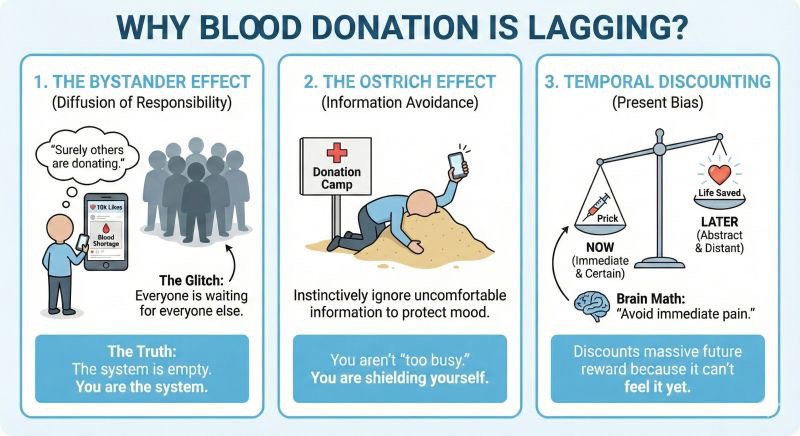
1. The Bystander Effect (Diffusion of Responsibility) You see a viral post about blood shortages with 10,000 likes. Your brain whispers: “With that much attention, surely thousands of people are donating. My pint won’t matter.” The Glitch: Everyone is waiting for everyone else. We assume the “System” will handle it. The Truth: The system is empty. You are the system.
2. The Ostrich Effect (Information Avoidance) Ever walk past a blood donation camp and purposely look at your phone? That is the Ostrich Effect. We instinctively ignore information that makes us feel uncomfortable or reminds us of hospitals. You aren’t “too busy.” You are psychologically shielding yourself from reality to protect your mood.
3. Temporal Discounting (Present Bias) Your primal brain prioritizes NOW over LATER.
The Cost: A needle prick (Immediate and Certain).
The Reward: Saving a life (Abstract and Distant).
Your brain does the math: “Avoid the immediate pain.” It discounts the massive future reward because it can’t feel it yet.
How to Hack the Glitch:
Stop trying to be a selfless saint. Behavioral science suggests we should embrace “Impure Altruism.”
It is okay to donate for the “Warm Glow.”
It is okay to donate for the ego boost.
It is okay to donate just to feel like a hero for the rest of the day.
The patient receiving the blood doesn’t care about your motives. They only care about your red blood cells.
The Fix: Don’t rely on willpower (“I might go”). Rely on identity (“I am a donor”).
Book the appointment. override the bugs. Be the glitch in the system.”
Read the full article here.
Stay updated with Hemostasis Today.
-
Sep 14, 2026, 04:43Christina (Tina) P.: Retinopathy Risk With Long-Term HCQ Treatment Detailed in Meta-Analysis
-
Sep 14, 2026, 04:38Aravind Palraj: Uncovering the Drivers of Occlusive Retinal Vasculitis in Young Patients
-
Sep 14, 2026, 04:33Mostafa Elshazly: ERS Has just Relesed 2026 Update on the Treatment of PAH
-
Sep 14, 2026, 04:24Sourabh Dwivedi: Important Hemoglobinopathies – High-Yield-Alert!
-
Sep 14, 2026, 04:14Leonard Valentino: Deeply Grateful to be Nominated for the 2026 Galien Patient First Award
-
Sep 13, 2026, 17:28Jim Hoffman: New Potential Predictive Biomarker for Lupus Nephritis
-
Sep 13, 2026, 17:08W. Alberto Sifuentes Giraldo: Urticarial Vasculitis Clinical Features, Systemic Involvement, and Treatment
-
Sep 13, 2026, 16:58Let’s Debunk Some Myths about Blood in SCD – ASCO
-
Sep 13, 2026, 16:56William Wallace: A Magnesium Ion Decides Whether Your Brain Learns or Not