


Abdul Mannan: When G6PD Testing Misleads During Acute Hemolysis
Abdul Mannan, Consultant Haematologist, Director Haemophilia Centre, Haematology Lab Lead at Betsi Cadwaladr University Health Board, shared a post on LinkedIn:
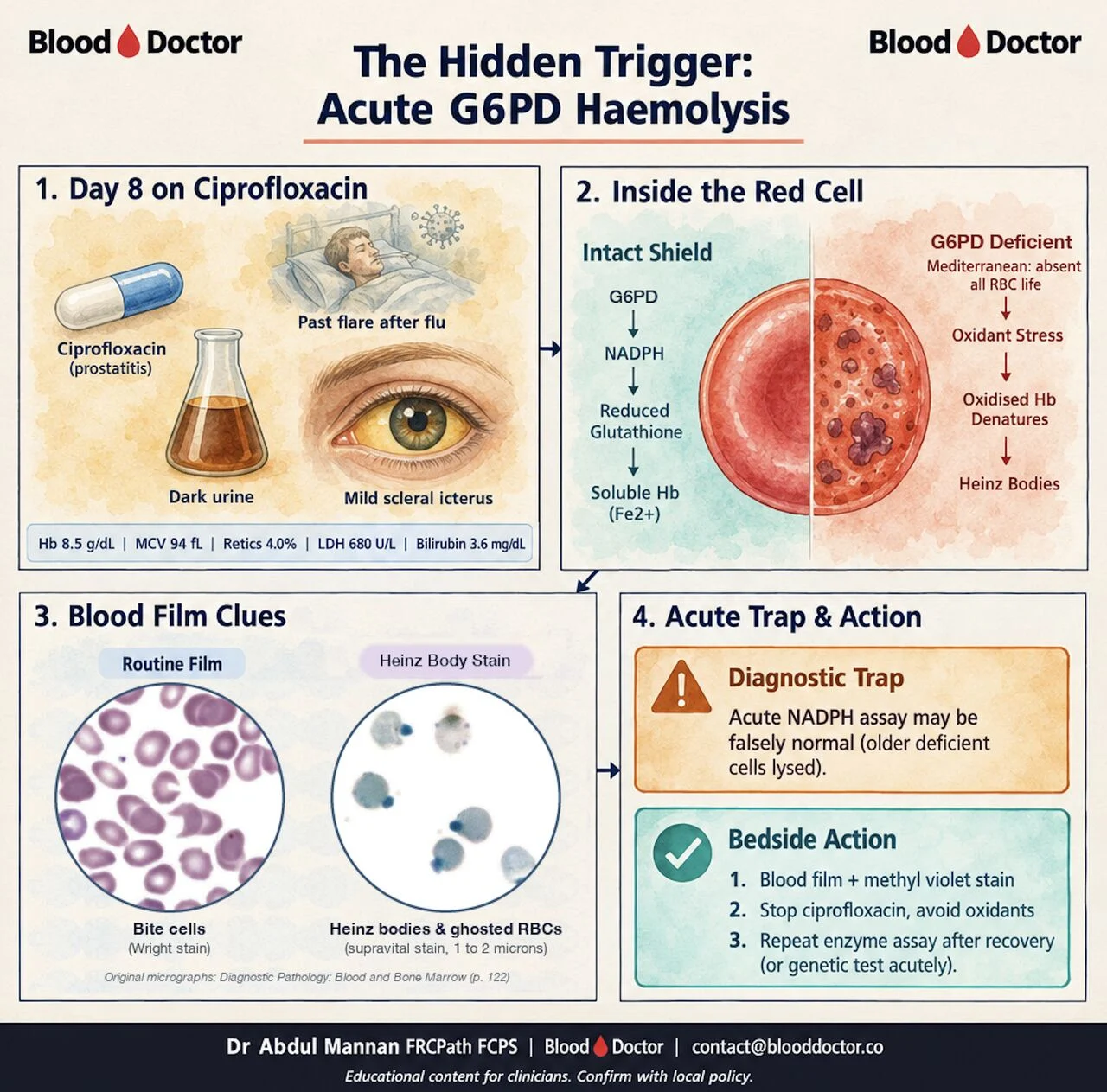
“Eight days into ciprofloxacin for acute prostatitis, a 67-year-old man noticed his urine turning the color of dark tea.
Years earlier, the same thing had happened after a bout of flu, and it settled on its own. With Italian ancestry and no living close relatives, no one had a family history to guide them.
On examination he had slight scleral icterus. His blood tests showed acute normocytic haemolysis: haemoglobin 85 g/L, MCV 94 fL, reticulocytes 4.0%, LDH 680 U/L, and total bilirubin 3.6 mg/dL (direct 0.8 mg/dL).
Many trainees request a G-6-PD enzyme assay straight away, and that test can miss the diagnosis during an acute crisis.
In G-6-PD deficiency, red cells lack the NADPH and reduced glutathione that protect haemoglobin from oxidant damage.
In the Mediterranean variant, enzyme activity is absent throughout the red cell lifespan, leaving patients sensitive to both infections and oxidant drugs (Luzzatto et al., Hematol Oncol Clin North Am, 2016). Oxidised haemoglobin denatures into Heinz bodies, and splenic macrophages bite them out.
Here is what helps at the bedside:
Check a peripheral blood film for bite cells and request a methyl violet stain to visualise Heinz bodies (1 to 2 microns) acutely.
Do not rely on an acute NADPH enzyme assay to exclude G-6-PD deficiency, because the oldest, most deficient red cells have already cleared, especially in the A- variant.
Stop ciprofloxacin, switch to a safe alternative, and advise the patient to avoid oxidant triggers (fluoroquinolones, dapsone, trimethoprim-sulfamethoxazole, primaquine, methylene blue, pegloticase, phenazopyridine).
Confirm the diagnosis with enzyme testing after recovery, or use molecular genetic testing acutely where available (Roper et al., BSH Guideline, Br J Haematol, 2020).
Have you seen a falsely normal acute G6PD assay delay a haemolysis diagnosis?”
Title: Laboratory diagnosis of G6PD deficiency. A British Society for Haematology Guideline
Authors: David Roper, Mark Layton, David Rees, Chris Lambert, Tom Vulliamy, Barbara De la Salle, Carol D’Souza
Read the Full Article on BJHaem
Title: Glucose-6-Phosphate Dehydrogenase Deficiency
Authors: Lucio Luzzatto, Caterina Nannelli, Rosario Notaro
Read the Full Article on Hematology/Oncology Clinics
More posts featuring Abdul Mannan on Hemostasis Today.
-
Nov 21, 2026, 11:36Emma Copperwaite: Transforming the Transfusion Pathway Through Digital Innovation
-
Nov 21, 2026, 11:28Nathan Connell: Rethinking the Role of Factor V in Hemostasis
-
Nov 21, 2026, 11:16Jecko Thachil: Optimizing Corticosteroid Therapy in ITP
-
Nov 21, 2026, 08:36Sangwan Sim: ASH 2026 to Highlight Research into PU.1-Related Neutrophil Dysfunction
-
Nov 21, 2026, 08:29Liz Tate: First Percutaneous LAAO Procedure Performed at The Park Hospital for Stroke Prevention
-
Nov 21, 2026, 08:26Robert Sidonio: WFH Webinar to Address Key Challenges in Rare Bleeding Disorders Care
-
Nov 21, 2026, 08:21Jenni Majumdar: What Changing Blood Transfusion Guidelines Mean for Patients and Surgical Teams
-
Nov 21, 2026, 08:17Doaa El Demerdash: The Bridge Meeting Fosters International Dialogue on Hemophilia Care
-
Nov 21, 2026, 08:16Emily Branchard: Uncoupling Anticancer and Antiplatelet Effects of Dipyridamole Analogs