


Factor XIa Inhibition Enters Clinical Practice With First FDA Approval
The U.S. Food and Drug Administration (FDA) has approved Sunharbo (asundexian) 50 mg, marking the first approval of a Factor XIa (FXIa) inhibitor in the United States.
The oral anticoagulant is indicated, in combination with antiplatelet therapy, to reduce the risk of recurrent stroke in adults following a recent non-cardioembolic ischemic stroke or high-risk transient ischemic attack (TIA).
The decision represents an important milestone in the development of anticoagulant therapies targeting Factor XIa, a component of the intrinsic coagulation pathway that has attracted considerable interest as a potential target for reducing thrombotic events while limiting bleeding complications.
Approved for secondary stroke prevention, asundexian introduces a new therapeutic approach for patients who remain at risk of recurrent ischemic events despite established antiplatelet treatment.

Why Factor XIa Has Become an Important Therapeutic Target
The rationale for targeting Factor XIa lies in the relationship between coagulation and hemostasis.
Factor XI participates in the intrinsic pathway and contributes to thrombin generation through activation of Factor IX. Its activated form, FXIa, amplifies coagulation and supports the formation of stable fibrin clots.
Unlike Factor Xa and thrombin, which occupy central positions in the common coagulation pathway, Factor XI is particularly relevant to thrombus propagation.
Evidence from individuals with congenital Factor XI deficiency has contributed to interest in this pathway: reduced Factor XI activity is associated with a lower risk of certain thrombotic events, although bleeding can still occur, particularly following surgery or trauma involving tissues with high fibrinolytic activity.
This has encouraged the development of Factor XI and FXIa inhibitors as a potential alternative to conventional anticoagulant strategies.
The therapeutic concept is to suppress pathological thrombus formation while preserving sufficient coagulation capacity for normal hemostasis. However, this does not mean that FXIa inhibition is free of bleeding risk. Clinical outcomes and individual patient characteristics remain essential when evaluating its safety.
From Early Promise to Clinical Evidence
Early studies of asundexian generated interest in its potential to reduce bleeding compared with conventional anticoagulation.
In the Phase II PACIFIC-AF trial, asundexian was associated with fewer bleeding events than apixaban in patients with atrial fibrillation. However, the study was not designed to establish equivalent stroke prevention.
The subsequent Phase III OCEANIC-AF trial, involving 14,810 patients with atrial fibrillation, was stopped early because asundexian was less effective than apixaban in preventing stroke or systemic embolism. The primary efficacy outcome occurred in approximately 1.3% of patients receiving asundexian compared with 0.4% receiving apixaban. Major bleeding was less frequent with asundexian (0.2% versus 0.7%).
These findings highlighted a critical limitation: reducing bleeding does not necessarily provide sufficient protection against thromboembolic events.
The results also demonstrated that the clinical value of FXIa inhibition cannot be generalized across different thrombotic conditions.
OCEANIC-STROKE: Establishing the Clinical Potential of FXIa Inhibition in Secondary Stroke Prevention
The Phase III OCEANIC-STROKE trial provided pivotal evidence for the clinical utility of Factor XIa inhibition in secondary stroke prevention.
In this multicenter, randomized, double-blind, placebo-controlled trial, 12,327 patients with recent non-cardioembolic ischemic stroke or high-risk TIA were randomized within 72 hours of symptom onset to receive asundexian 50 mg once daily or placebo, both in combination with antiplatelet therapy. Patients with ischemic stroke had a National Institutes of Health Stroke Scale (NIHSS) score of 15 or below.
Asundexian reduced recurrent ischemic stroke by 26% relative to placebo:
- Ischemic stroke: 6.2% with asundexian versus 8.4% with placebo.
- Cause-specific hazard ratio: 0.74 (95% CI, 0.65–0.84).
- P less than 0.001.
- Absolute risk reduction: 2.2 percentage points.
This corresponds to approximately 45 patients treated over the trial follow-up period to prevent one additional ischemic stroke, based on the observed absolute difference.
Importantly, the incidence of ISTH major bleeding was similar between the treatment groups (1.9% versus 1.7%; hazard ratio, 1.10; 95% CI, 0.85–1.44).
The trial followed patients for a median of 19 months, while the FDA reported a median treatment duration of 14.2 months.
These findings demonstrated that adjunctive FXIa inhibition can reduce recurrent ischemic stroke without a statistically significant increase in overall ISTH major bleeding in this population. The results formed the basis for FDA approval of asundexian.
However, the findings should be interpreted alongside OCEANIC-AF, where asundexian monotherapy was inferior to apixaban for stroke or systemic embolism prevention in patients with atrial fibrillation. This contrast underscores the importance of defining the appropriate clinical setting and therapeutic context for FXIa inhibition.
Comparing OCEANIC-AF and OCEANIC-STROKE
The contrasting outcomes of the two Phase III trials provide important insight into the clinical application of FXIa inhibition.
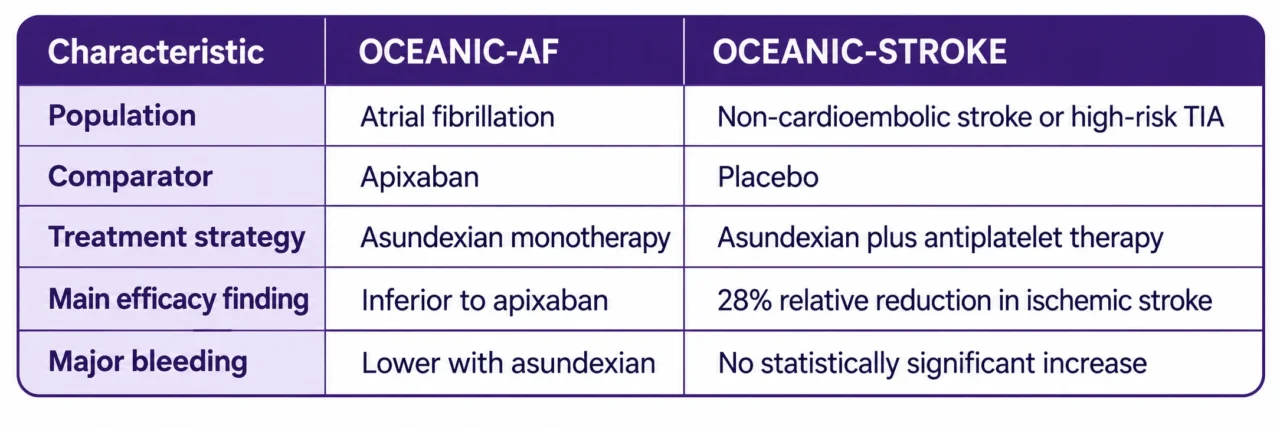
The difference between these trials is particularly important. In OCEANIC-AF, asundexian was investigated as an alternative to established oral anticoagulation, whereas OCEANIC-STROKE evaluated its addition to antiplatelet therapy.
Therefore, the findings should not be interpreted as evidence that FXIa inhibition is universally effective or ineffective. Instead, they highlight the importance of patient selection, the underlying thrombotic mechanism, and the overall antithrombotic treatment strategy.
Clinical Implications
The approval of asundexian introduces FXIa inhibition as a new therapeutic option for secondary stroke prevention in selected adults with a recent mild-to-moderate non-cardioembolic ischemic stroke or high-risk transient ischemic attack (TIA).
Its use requires careful patient selection and assessment of bleeding risk, renal and hepatic function, concomitant medications, potential drug–drug interactions, and planned surgical or invasive procedures.fda
Importantly, asundexian is not approved for stroke prevention in patients with atrial fibrillation.
The contrasting outcomes of OCEANIC-STROKE, in which adjunctive asundexian reduced recurrent ischemic stroke when added to antiplatelet therapy, and OCEANIC-AF, in which asundexian monotherapy was inferior to apixaban for prevention of stroke or systemic embolism, highlight a central principle in the development of FXIa inhibitors: antithrombotic efficacy and bleeding safety must be established for each specific clinical indication and treatment strategy rather than extrapolated across different thrombotic conditions.
Safety Considerations and Practical Prescribing
Although the overall incidence of ISTH major bleeding was similar between asundexian and placebo in OCEANIC-STROKE, the FDA highlighted important safety considerations in specific patient groups.
Major bleeding occurred more frequently among patients older than 75 years and during the first 90 days of treatment. Gastrointestinal bleeding was also more frequent in patients receiving asundexian. Diarrhea was the most commonly reported adverse reaction, occurring in at least 3% of treated patients.
Other important prescribing considerations include:
- Drug interactions: Concomitant use with combined P-glycoprotein (P-gp) and strong CYP3A4 inducers, such as carbamazepine, should be avoided because they may reduce asundexian exposure and effectiveness.
- Hepatic impairment: Asundexian is not recommended in patients with moderate or severe hepatic impairment (Child-Pugh B or C).
- Surgical procedures: Treatment should be withheld for at least 24 hours before elective surgery or invasive procedures.
- Thrombolysis: Asundexian should be withheld for at least 24 hours after thrombolysis for acute ischemic stroke.
- Pregnancy and breastfeeding: Treatment requires consideration of maternal and fetal bleeding risks. Breastfeeding is not recommended during treatment and for five days after the last dose.
These considerations emphasize that a favorable overall major bleeding result in a clinical trial does not eliminate the need for individualized bleeding-risk assessment and appropriate treatment monitoring.
Frequently Asked Questions
1. What is asundexian (Sunharbo)?
An oral, selective Factor XIa inhibitor used to reduce recurrent ischemic stroke risk in eligible adults.
2. How does Factor XIa inhibition work?
It reduces Factor IX activation, limiting thrombin generation and fibrin clot formation.
3. Why is Factor XIa a promising anticoagulant target?
It may reduce pathological thrombosis while having a more limited effect on normal hemostasis.
4. What is the FDA-approved indication?
Secondary prevention of ischemic stroke after a recent mild-to-moderate non-cardioembolic stroke or high-risk TIA.
5. What is the approved dose?
50 mg orally once daily, in combination with antiplatelet therapy.
6. What were the main OCEANIC-STROKE findings?
Asundexian reduced recurrent ischemic stroke by 26% compared with placebo, without a statistically significant increase in major bleeding.
7. Why was OCEANIC-AF stopped early?
Asundexian was less effective than apixaban in preventing stroke or systemic embolism in patients with atrial fibrillation.
8. Does asundexian carry a bleeding risk?
Yes. Bleeding remains an important safety concern despite the favorable major bleeding results in OCEANIC-STROKE.
9. Is asundexian approved for patients with atrial fibrillation?
No. It demonstrated inferior efficacy to apixaban in OCEANIC-AF.
10. Why is this approval clinically important?
It establishes Factor XIa inhibition as a new treatment strategy for secondary stroke prevention in selected patients.
Written by Elen Avetisyan, MD.
Stay updated with Hemostasis Today.
-
Nov 12, 2026, 09:30Roshni Kulkarni: A New Hope for Preventing Recurrent Stroke
-
Nov 12, 2026, 09:17Gashaw Arega Mekonnen: Jimma Moments – A Shared Mission for Childhood Cancer Care
-
Nov 11, 2026, 15:42Tareq Abadl: The Clinical Impact of Kell Alloimmunization
-
Nov 11, 2026, 15:30Alejandro González Veliz: Does PCI Change The Long-Term Outcome In Stable Coronary Artery Disease?
-
Nov 11, 2026, 15:25Preparing for the SoHO Regulation – EBA Board Convenes in Vienna – European Blood Alliance
-
Nov 11, 2026, 15:20Vaidehi Prasanth: IV Iron in Heart Failure – Exploring Hospitalisation Benefits vs. Infection Risk in Open Heart
-
Nov 11, 2026, 15:18Stefan Prendić: Can Algorithms Support Antibody Identification in Immunohematology?
-
Nov 11, 2026, 15:12Perioperative Challenges in Hemophilia Patients on Rebalancing Therapies
-
Nov 11, 2026, 15:03Maria Elisa Mancuso: World-Renowned Faculty and 33 Global Participants Unite at Hemophilia Academy 2026