

Long-Read Sequencing Is Closing Diagnostic Gaps in Inherited Bleeding Disorders
By resolving complex rearrangements and highly homologous genomic regions, long-read technologies are strengthening molecular investigations in hemophilia and von Willebrand disease.
Genetic testing is central to the investigation of inherited bleeding disorders, supporting diagnostic confirmation, carrier identification, family testing and reproductive counselling. Yet clinically convincing cases can remain unresolved when the underlying variant lies beyond the capabilities of conventional sequencing.
Long-read sequencing is helping address this gap by providing a more continuous view of genomic regions that are difficult to reconstruct from short DNA fragments.
Recent studies involving F8, F9 and VWF illustrate its potential – and underscore why greater sequencing resolution must be matched by careful clinical interpretation.
The Biological Diagnostic Challenge
The molecular architecture of bleeding-disorder genes can complicate variant detection: pathogenic changes range from single-nucleotide substitutions to deletions, duplications, insertions and complex rearrangements. Repetitive DNA and highly similar sequences elsewhere in the genome create additional challenges for accurate mapping and interpretation.
These difficulties are particularly relevant to F8 and F9, the genes associated with hemophilia A and B, and to VWF, which encodes von Willebrand factor. Conventional sequencing can identify many disease-associated variants, but structural changes and regions of high sequence similarity may require additional methods.
An important distinction is the difference between detecting an abnormality and resolving its structure: a copy-number assay may indicate that genetic material is missing or duplicated without establishing the precise breakpoints, orientation or arrangement of the affected sequence.
These details can be essential when interpreting complex findings and designing reliable family testing.
What Longer Reads Reveal
Short-read sequencing reconstructs genomic information from many small fragments, whereas long-read sequencing examines substantially longer stretches of DNA. The additional sequence context can help connect a variant to its surrounding genomic region, distinguish highly similar sequences and identify rearrangement junctions.agupubs.
Long reads can also link variants carried on the same DNA molecule – a process known as haplotype phasing – and provide breakpoint information that helps explain how structural variants arose. Some workflows additionally preserve methylation information, creating opportunities to investigate epigenetic features alongside DNA sequence.
These capabilities are complementary rather than interchangeable: targeted, amplification-based sequencing and whole-genome sequencing answer different questions and have different technical limitations.
Resolving Complex Hemophilia Variants
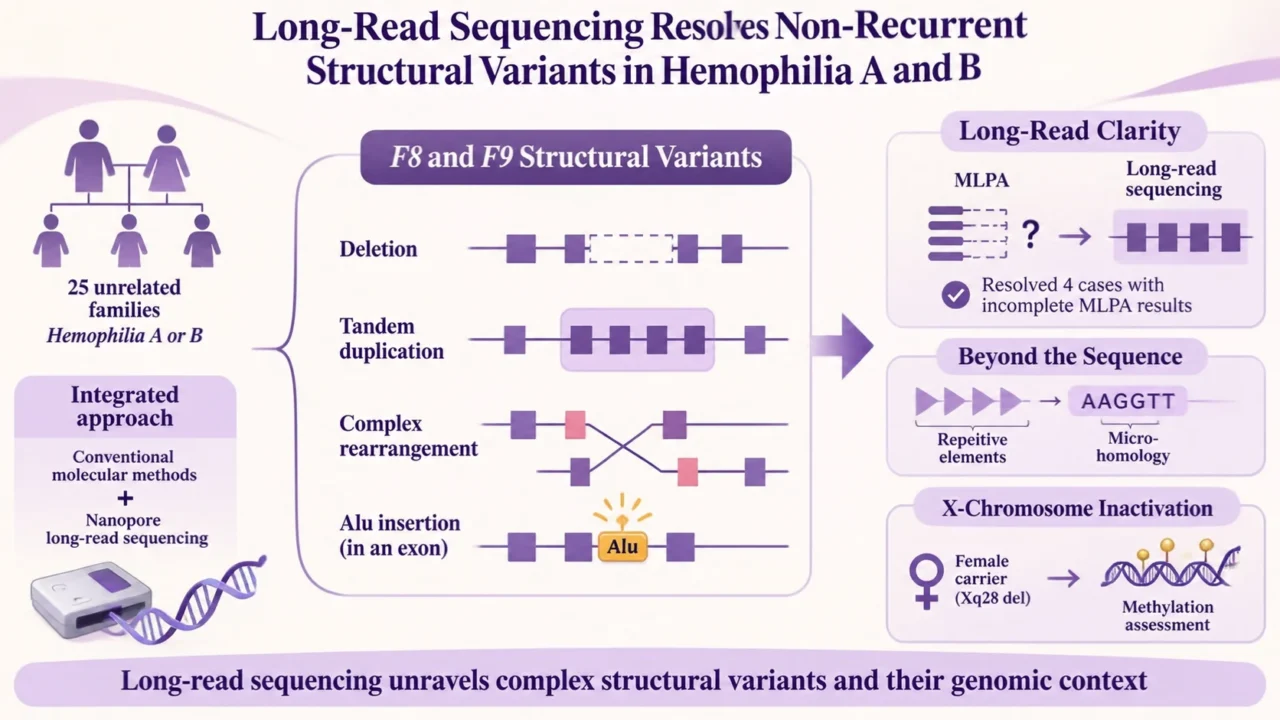
In their 2026 Blood Advances study, Nina Borràs Agustí and colleagues investigated non-recurrent structural variants in 25 unrelated families with hemophilia A or B. Their integrated approach combined conventional molecular methods with nanopore whole-genome long-read sequencing.
The investigation resolved a spectrum of F8 and F9 abnormalities, including deletions, a tandem duplication, complex rearrangements and exonic Alu insertions.
In four cases, long-read analysis clarified structural configurations that multiplex ligation-dependent probe amplification had incompletely or misleadingly characterized.
The significance extends beyond more detailed variant descriptions: a rearrangement’s architecture can determine which genomic regions are disrupted and whether a targeted assay will reliably identify the same variant in relatives.
Breakpoint analysis also revealed repetitive elements and microhomologies consistent with mechanisms involved in structural-variant formation.
The study further demonstrated methylation-based assessment of skewed X-chromosome inactivation in a female carrier with an Xq28 deletion, illustrating the potential to investigate sequence variation and epigenetic context within the same broader molecular assessment.
Navigating the VWF Locus
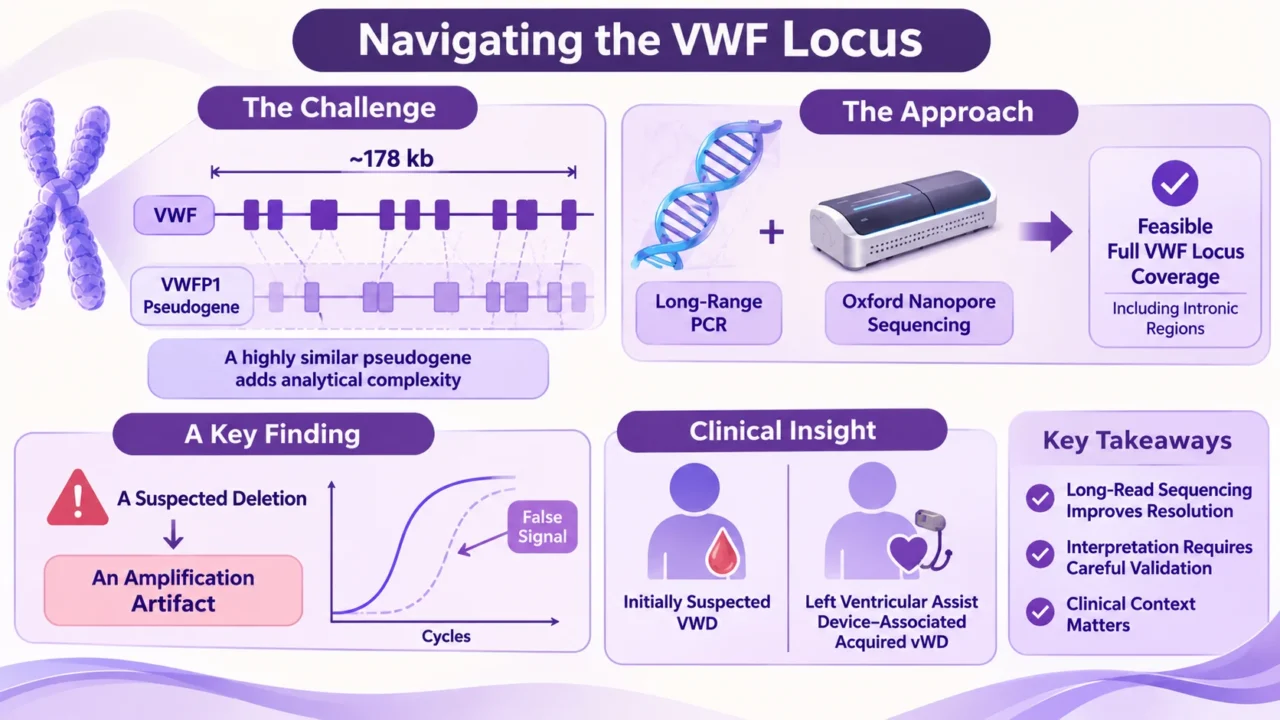
The VWF gene presents a different challenge: it spans approximately 178 kb and contains a region highly similar to the VWFP1 pseudogene. Distinguishing genuine VWF sequence from pseudogene-derived sequence is therefore an important analytical requirement.
In a 2025 study in Research and Practice in Thrombosis and Haemostasis, Sheng Ye and colleagues combined long-range PCR with Oxford Nanopore sequencing to investigate the entire VWF locus. Their work established the feasibility of broad gene coverage, including intronic and technically challenging regions.
However, the study also exposed an important vulnerability: a suspected deletion was ultimately interpreted as an amplification artifact. Long reads can improve resolution, but they do not eliminate errors introduced during sample preparation or amplification.
Clinical classification proved equally important: two samples initially associated with VWD came from individuals with left ventricular assist device-associated acquired von Willebrand syndrome. The distinction reinforces that sequencing performance and diagnostic utility are separate questions.
Resolution is not Diagnostic Yield
These studies support the analytical value of long-read sequencing, but they should not be interpreted as establishing its diagnostic yield across unselected bleeding-disorder populations. The hemophilia investigation focused on structural variants, while the VWF study was a small feasibility investigation with important phenotyping limitations.
Similarly, detecting additional variants does not establish their pathogenicity: interpretation still depends on clinical findings, inheritance, segregation and, where appropriate, functional evidence. Greater genomic coverage creates opportunities for diagnosis, but also increases the need to distinguish causal findings from incidental or uncertain variation.
Toward Integrated Molecular Diagnosis
The strongest current application is a complementary diagnostic role, particularly when conventional testing is unresolved, discordant with the phenotype or suggestive of a complex structural alteration. Candidate findings still require appropriate validation, and amplification-related artifacts must remain part of the differential interpretation.
Long-read sequencing therefore represents a move toward more complete molecular characterization—not an automatic replacement for established testing. Its clinical value will depend on whether improved resolution produces reliable diagnoses, more informative family testing and clearer explanations of patients’ bleeding phenotypes.
Frequently Asked Questions
1. What is long-read sequencing?
A technology that reads long DNA fragments, helping resolve variants missed by short-read methods.
2. How does it improve hemophilia testing?
It clarifies complex deletions, insertions and rearrangements in F8 and F9.
3. Can it resolve misleading MLPA results?
Yes. It clarified incomplete or misleading MLPA findings in four hemophilia cases.
4. Why is VWF difficult to sequence?
Its large size, repetitive DNA and similarity to the VWFP1 pseudogene complicate analysis.
5. Can it distinguish VWF from its pseudogene?
Longer sequence context and carefully designed targeted workflows improve discrimination.
6. What is haplotype phasing?
Determining which variants occur together on the same chromosome.
7. How can nanopore sequencing assess methylation?
It detects methylation patterns that can help investigate X-chromosome inactivation.
8. What artifacts can affect long-read sequencing?
PCR amplification can introduce false findings that require independent validation.
9. How is a variant’s clinical significance determined?
Through clinical findings, inheritance patterns and supporting laboratory evidence.
10. Which cases benefit most from long-read sequencing?
Cases with inconclusive results, phenotype–genotype discrepancies or suspected complex structural variants.
Written by Elen Avetisyan, MD.
Stay updated with Hemostasis Today.
-
Nov 19, 2026, 13:36Raja Prince: Protein S Silencing and the Future of Hemostatic Therapy
-
Nov 19, 2026, 13:26M. Sekip Altunkan: The Thrombotic Risk of Andexanet Alfa
-
Nov 19, 2026, 13:18Felice Gragnano: Personalizing Antiplatelet Therapy After PCI
-
Nov 19, 2026, 13:11When Postpartum Warning Signs Are Ignored – National Blood Clot Alliance
-
Nov 19, 2026, 12:56Batool Abuhalimeh: The Hidden Psychological Burden of Pulmonary Embolism
-
Nov 19, 2026, 12:45Pedro Perez: PE Recovery – From Acute Treatment to Long-Term Follow-Up
-
Nov 19, 2026, 12:34Edward Lee Carter: Are We Ready for FXIa Inhibitors?
-
Nov 19, 2026, 12:19Essama Telli: When a Bruise Doesn’t Heal – Recognising the Warning Signs
-
Nov 19, 2026, 11:51Wolfgang Miesbach: Beyond Episomal Gene Therapy in Haemophilia B