

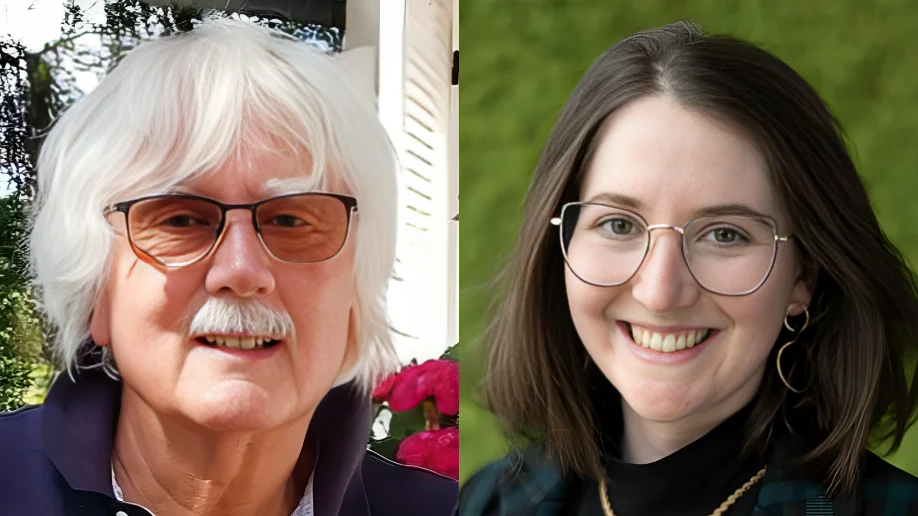
Alan Nurden: Disrupting Pathogenic Alleles in VWD Through Gene Editing
Alan Nurden, Emeritus Research Director at CNRS, Co-Founder of the French National Reference Centre for Inherited Platelet Disorders (CRPP), shared a post on LinkedIn about a recent article by Isabel Bär et al. published in Blood advances, adding:
“Like for most inherited platelet disorders, gene therapy has been slow in arriving for patients with von Willebrand disease (VWD).
While the heterogeneity of VWD adds to the complexity of treatment, the targeting of endothelial cells that extend throughout the vasculature is also a challenge.
In this study, Isabel Bär and her colleagues from the Netherlands, show proof of principle for a novel, approach for universal inactivation of dominant VWD variants by selectively disrupting the open reading frame of the mutated allelle.
CAS9 nuclease is used to introduce indels that transform the pathogenic allele into a null allele, the non-affected normal allele synthesizes enough VWF for it to assume normal hemostatic functions.
The question is whether this approach can be applied to other bleeding disorders including the megakaryocyte-derived autosomal dominant Glanzmann thrombasthenia-related disease or mono-allelic Bernard-Soulier syndrome where loss of platelet function is accompanied by macrothrombocytopenia.
As for endothelial cells, the key will be to adequately and specifically delete the disease-causing allele and in sufficient quantities to correct megakaryocytic maturation and increase platelet numbers.
Advances are being made to genetically correct the origins of blood disorders and this impressive manuscript is highly recommended.”
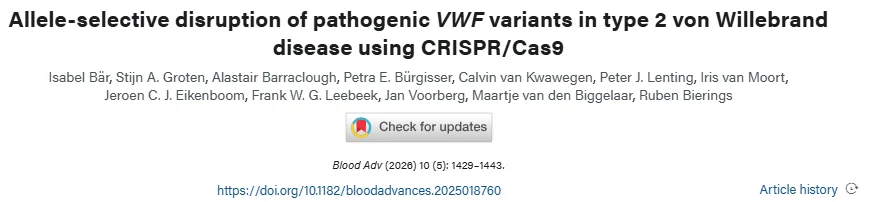
Title: Allele-selective disruption of pathogenic VWF variants in type 2 von Willebrand disease using CRISPR/Cas9
Authors: Isabel Bär, Stijn A. Groten, Alastair Barraclough, Petra E. Bürgisser, Calvin van Kwawegen, Peter J. Lenting, Iris van Moort, Jeroen C. J. Eikenboom, Frank W. G. Leebeek, Jan Voorberg, Maartje van den Biggelaar, Ruben Bierings
Read the Full Article on Blood advances
Other posts featuring Alan Nurden on Hemostasis Today.
-
Sep 30, 2026, 21:36Mark Murphy: Irish Heart Foundation Meets With Senator Teresa Costello on World Heart Day
-
Sep 30, 2026, 21:34Sadashiva Pai: How Pancreatic Cancer Uses Blood Clotting to Evade Immune Attack
-
Sep 30, 2026, 15:58Bernhard Merget: New Frontiers in Thrombosis and Stroke Research
-
Sep 30, 2026, 15:39Ifeanyichukwu Ifechidere: The Molecular Orchestra of Primary Hemostasis
-
Sep 30, 2026, 15:28Reassessing the Benefit–Risk Balance of Extended Anticoagulation in Cancer Patients – ESC Working Group on Cardiovascular Pharmacotherapy
-
Sep 30, 2026, 15:07Chiranjeev Sharma: Targeting Factor XIa with the Synthetic Inhibitor SB-01
-
Sep 30, 2026, 14:41Bruna Gigante: Balancing Thrombosis and Bleeding in Cardiovascular Care
-
Sep 30, 2026, 14:13Ashok Choudhury: Portal Vein Thrombosis and Outcomes in Cirrhosis
-
Sep 30, 2026, 13:57Leslye Conde Bazán: When Conventional Imaging Is Not Enough – The Role of IVUS