

From Prediction to Practice: Implementing Artificial Intelligence in Transfusion Medicine
Artificial intelligence (AI) is becoming increasingly visible across healthcare, and transfusion medicine is no exception.
Its potential extends across the vein-to-vein pathway, from donor recruitment and component production to inventory management, patient blood management (PBM), clinical decision support,and haemovigilance.
The key question is no longer whether AI can generate accurate predictions.
It is whether those predictions can be safely integrated into clinical workflows, understood by healthcare professionals, and translated into better patient care.
A recent systematic review by Maynard and colleagues illustrates the implementation gap.
Of 1,243 records screened, only three studies demonstrated prospective AI deployment with workflow integration, and none showed clear improvements in clinical outcomes or cost. This shifts the focus from model performance alone to clinical utility, safety, explainability, governance and sustainability.
This highlights an important shift in focus: AI in transfusion medicine must be evaluated not only by model performance, but also by its clinical utility, safety, explainability, governance and sustainability.
Where Can AI Help Across the Transfusion Pathway?
Transfusion medicine is highly data-rich, making it well suited to data-driven tools.
In donor and collection services, AI may support donor retention, appointment scheduling and identification of donors with rare blood group phenotypes.
In component production, machine learning could help detect process deviations and support quality assurance, while release decisions should remain based on validated laboratory criteria and professional oversight.
Inventory forecasting is one of the most practical near-term applications. AI models can combine historical demand, seasonal variation, surgical schedules, donor availability and component shelf life to help reduce shortages and wastage, particularly for platelets.
AI may also strengthen patient blood management (PBM) by identifying preoperative anaemia, flagging possible iron deficiency and estimating transfusion risk.
In clinical decision support, predictive models could help anticipate the need for crossmatching, additional blood components, or massive transfusion preparedness.
However, AI outputs should not function as automatic transfusion triggers. Hemodynamic status, bleeding, comorbidities, laboratory findings, and clinical judgement remain essential to transfusion decisions.
In haemovigilance, natural language processing may help identify possible transfusion reactions from electronic health records and free-text clinical notes.
AI can improve case finding, but final diagnosis remains a clinical and laboratory responsibility.
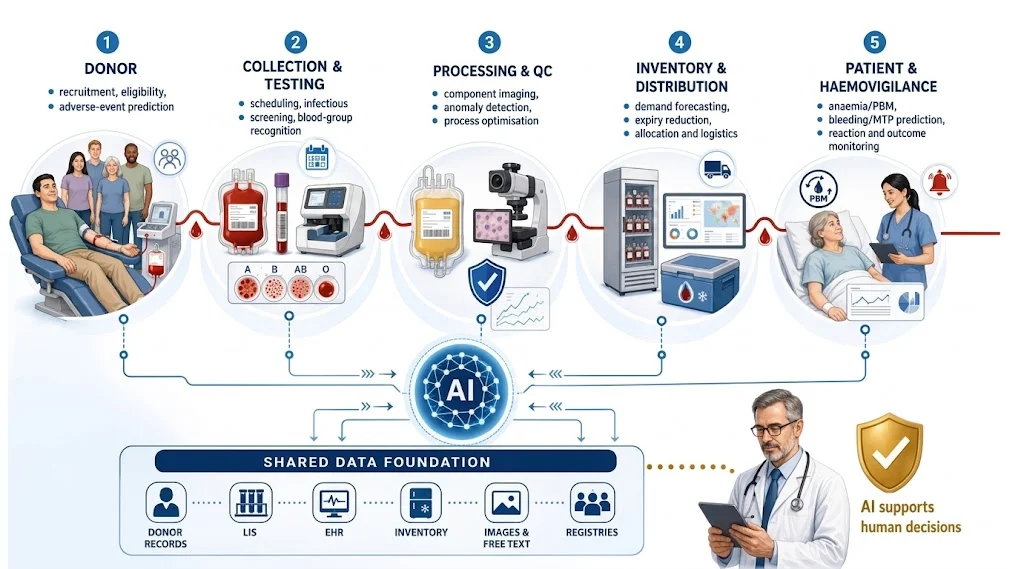
Figure 1. AI applications across the vein-to-vein transfusion pathway.
Why Is Clinical Adoption Still Limited?
The Maynard review identified only three prospective, workflow-integrated studies: prediction of low ferritin in anaemic patients, smartphone-based hemoglobin estimation from fingernail images, and prediction of resuscitation requirements in trauma patients.
These studies show that implementation is feasible, but they also demonstrate how early the field remains.
The central lesson is simple:
An accurate model is not automatically a useful clinical tool.
What Makes Implementation Difficult?
Several barriers can limit the transition of AI from research into routine clinical practice.
Data quality is fundamental. Blood-bank systems, laboratory information systems, electronic health records, and registries may use different terminology, coding systems, and timestamps. Missing or inconsistent data can reduce model performance.
Local practice also matters.
A model may learn the transfusion practices of a particular institution rather than underlying biological risk.
Differences in transfusion thresholds, surgical case mix, laboratory protocols, and component availability can limit its generalisability.
Workflow integration is equally important. Even an accurate alert has limited value if it appears too late, in the wrong system, or without a clear action for the healthcare professional.
Human factors must also be considered.
Automation bias may lead users to rely excessively on computer-generated recommendations.
In a 2026 survey of 218 transfusion professionals from 67 countries, 43.5% reported using AI tools, while 82.3% of users indicated that they were self-taught. These findings highlight gaps in formal training, expertise, and governance.
What Have Prospective Studies Taught Us?
Prospective evidence remains limited. A 2025 randomised trial evaluating AI-assisted erythropoiesis-stimulating agent dosing in patients receiving haemodialysis found that only one of four models met the predefined non-inferiority criteria.
Although the study was not specific to transfusion medicine, it reinforces an important principle: strong retrospective performance does not necessarily translate into safe and effective real-world clinical use.
How Do We Move From Prediction to Practice?
A practical implementation pathway can be simplified into five steps:
- Define the problem.
- Prepare data and governance.
- Validate locally.
- Pilot before deployment.
- Monitor continuously.
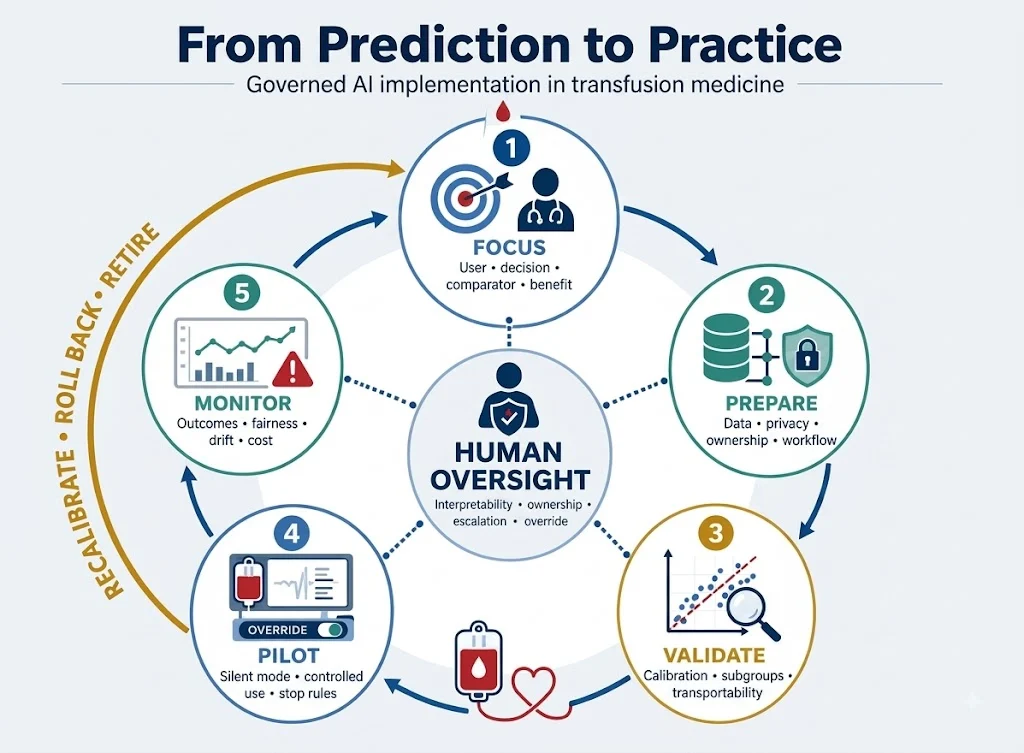
Figure 2. Five-stage pathway from problem definition to continuous monitoring of AI in transfusion medicine.
AI implementation should be treated as a lifecycle, not as a one-time software installation.
Are Regulation and Standards Keeping Pace?
Recent frameworks are helping organisations evaluate AI more systematically.
FUTURE-AI emphasises fairness, universality, traceability, usability, robustness and explainability.
TRIPOD+AI supports transparent reporting of prediction models, while PROBAST+AI helps assess study quality, risk of bias, and applicability.
Regulators are also moving towards lifecycle-based oversight, including guidance on changes to AI-enabled medical devices.
For clinicians, the practical questions are straightforward:
- Was the model validated in a population like ours?
- Is it calibrated?
- Can its outputs be explained and overridden?
- Are important subgroups represented?
- How will performance be monitored after implementation?
What Does the Future Look Like?
The most plausible near-term role of AI in transfusion medicine is not autonomous decision-making, but carefully governed clinical decision support.
AI may help identify patterns, prioritise cases, forecast demand and inform clinical decisions, while trained healthcare professionals retain responsibility for interpreting outputs and taking action.
This approach is consistent with current implementation evidence, which emphasises the importance of workflow integration, safety monitoring, regulatory oversight, data governance, and clear accountability.
To date, prospective transfusion studies have not demonstrated improvements in clinical outcomes or cost.
Accordingly, the success of AI should be assessed not only by algorithmic accuracy, but also by its impact on patient and donor safety, avoidable transfusions, blood availability, component wastage, equity, workload and cost.
Until these benefits are demonstrated prospectively, AI should remain a monitored clinical support system rather than an autonomous transfusion decision-maker.
Meaningful human oversight is essential to ensure that healthcare professionals can review, interpret, and appropriately challenge AI-generated recommendations.
FAQ
1. Can AI decide whether a patient should receive a transfusion?
No. AI can support prediction and preparation, but transfusion decisions must remain based on clinical context, laboratory findings, and professional judgement.
2. Where is AI most likely to have an early practical impact?
Inventory forecasting, patient blood management, transfusion-demand prediction, workflow prioritisation, and haemovigilance are among the most practical near-term applications.
3. Why is local validation necessary?
Models may learn local patient populations, transfusion practices, and data structures. Performance in another hospital cannot therefore be assumed to be equivalent.
4. What is automation bias?
Automation bias is the tendency to accept automated recommendations too readily. Human review remains particularly important in unusual, complex, or high-risk cases.
5. Does AI need monitoring after implementation?
Yes. Changes in patient populations, workflows, software, and clinical practice can cause performance drift and may require recalibration, suspension, or withdrawal of the model.
6. Will AI replace transfusion medicine specialists?
Current evidence supports AI as a tool for clinical augmentation rather than professional replacement. Its greatest value is likely to come from combining computational pattern recognition with clinical and laboratory expertise.
7. How should patient data be protected?
By using secure systems, restricted access, anonymisation where appropriate, and clear data-governance policies.
8. What if an AI recommendation is wrong?
Clinicians must be able to review, override, and report unsafe recommendations.
9. How can AI fairness be assessed?
Performance should be tested across relevant patient and donor groups to identify unequal error rates.
10. Who is responsible for an AI-supported decision?
AI can provide recommendations, but responsibility remains with the healthcare professionals and institutions overseeing its use.
Written by Yama Sirly Putri, MD
Clinical Pathologist
Stay updated with Hemostasis Today.
-
Oct 8, 2026, 04:28Jeff Molter: Electrophysiological PIEZO1 Analysis Advances Diagnosis in Hereditary Xerocytosis
-
Oct 8, 2026, 04:23Barbara Adams Krolak: Women and Blood Clots Are We Missing the Warning Signs
-
Oct 8, 2026, 04:10Rutendo Muzambi: Hospital Admission Patterns and Care Disparities in Sickle Cell Disease
-
Oct 8, 2026, 03:50Olfat Berro: Redefining the Future of Haemophilia A
-
Oct 8, 2026, 03:35Tasnia Tarana: Heavy Menstrual Bleeding When the Cause Is Not in the Uterus
-
Oct 8, 2026, 03:28Kian Haseli: Electrophysiological PIEZO1 Analysis Advances Diagnosis in Hereditary Xerocytosis
-
Oct 8, 2026, 03:20Sthanu Subramanian: Leukopenia in Sepsis A Marker of Severe Disease
-
Oct 7, 2026, 16:44Amor Salah: 2026 NCS/SCCM Guidelines for Managing Antithrombotic-Associated ICH
-
Oct 7, 2026, 16:04NETs in Thrombosis: From Mechanism to Therapeutic Target