

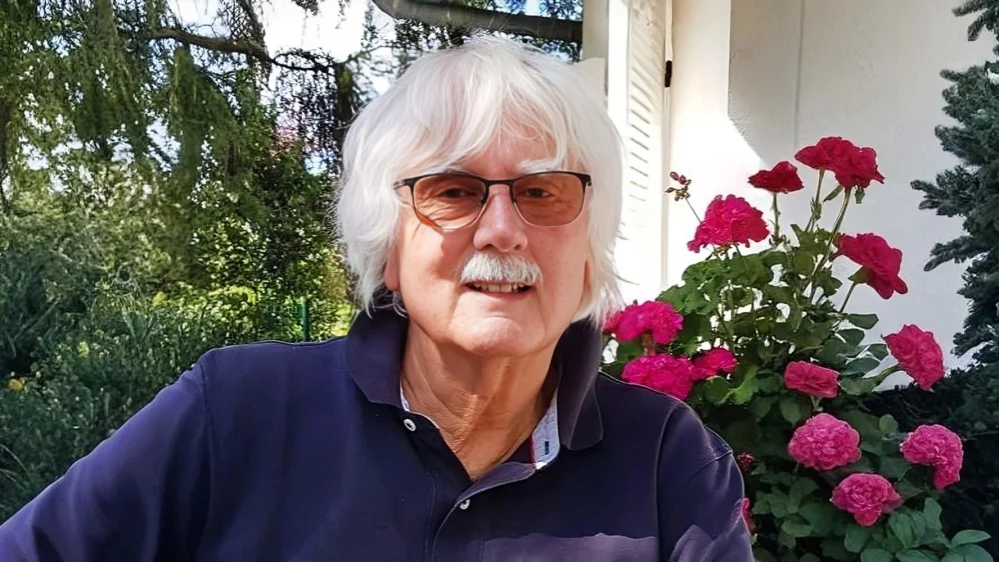
Alan Nurden: Translating Advances into Access in Rare Platelet Disorder Management
Alan Nurden, Emeritus Research Director at CNRS, Co-Founder of the French National Reference Centre for Inherited Platelet Disorders (CRPP), shared a post on LinkedIn about a recent article by Shruti Vilas Kharat et al., published in IJMR, adding:
“This is exactly the kind of article that I have been calling for: a careful survey of the demographics, bleeding severity and quality of life of a large group of patients from a hospital center in India with the rare platelet-based bleeding disorders Glanzmann thrombasthenia (GT) and the Bernard-Soulier syndrome.
The authors led by Shrimati Shetty bring some important facts to our attention.
First is that in remote regions people are still dying from these syndromes because basic treatments such as transfusion of platelet concentrates or the use of recombinant FVIIa are not available. Neither are modern technologies such as next-generation sequencing to ensure a full molecular diagnosis.
Please note that the annualized bleeding rate for the patients works out at about one per month. Contrast this with the much higher rate given in the recent publication on GT by Khair et al based on an online survey, where the bulk of the patients had received rFVIIa whereas None of the Indian patients had received it.
Kate Khair’s careful work highlighted the needs of a mostly severe bleeding Western cohort.
But worldwide, the high prevalence of these disorders in ethnic groups in remote regions means that much still needs to be done to improve their basic care and to make modern advances available to them.
This will also apply to the novel prophylaxis proposals for GT such as the upgrading of fibrin-generation at bleeding sites (bivalent antibodies such as HMB-001 (sutacimig) from Hemab, or silencing protein S, a thrombin inhibitor) or, hopefully in the future, gene therapy, all of which will require substantial patient care and it is unfortunately difficult to see them being used in geographical regions with low economic resources. These patients must not be left behind.”
1.Title: Natural history & quality of life in Glanzmann thrombasthenia & Bernard Soulier syndrome: An observational study from India
Autors: Shruti Vilas Kharat, Shrinath Kshirsagar, Kranti Patil, Gurpreet Kaur Saini, Fiza Jivani, Aniket Kamble, Savita Rangarajan, Samir Vinayak Joshi, Shrimati Shetty

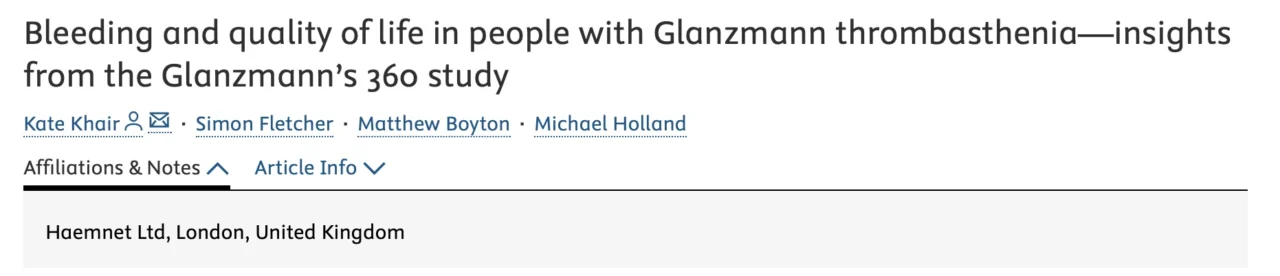
2.Title: Bleeding and quality of life in people with Glanzmann thrombasthenia-insights from the Glanzmann’s 360 study
Autors: Kate Khair, Simon Fletcher, Matthew Boyton, Michael Holland
Read the Full Article on RPTH.
Find more posts featuring Alan Nurden on Hemostasis Today.
-
Sep 28, 2026, 10:18Neha Rastogi Panda: Empowering Young Women Through Health Awareness
-
Sep 28, 2026, 10:16S.0 MIKAYE – Hypertension in Pregnancy From Diagnosis to Management
-
Sep 28, 2026, 09:45Emma Groarke: The 3rd International VEXAS Conference in Milan
-
Sep 28, 2026, 09:36Iman Alshamsi: Thrombophilia Workup and PNH Screening When Testing Matters
-
Sep 28, 2026, 09:25Emadullah Raidullah: Thrombophilia Workup and PNH Screening When Testing Matters
-
Sep 28, 2026, 03:59Rahul Saha: JAMA The 49th Human Blood Group System
-
Sep 28, 2026, 01:51Ann Mullally: Expect to See Lots More Gene Therapy in Medicine in the Years Ahead
-
Sep 27, 2026, 15:49Rana Al-Hrout: Iron Deficency – Is Ferritin 15ng/mL or Less Still the Cutoff?
-
Sep 27, 2026, 15:49Ayushi Sharma: What I Thought Transfusion Medicine Would Be vs What It Actually Is