

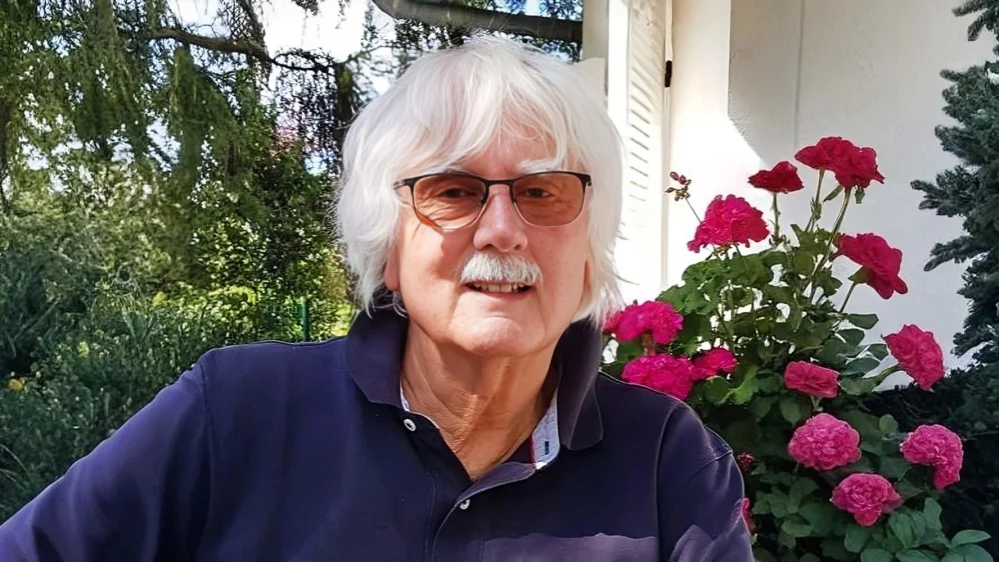
Alan Nurden։ How Platelets Amplify Thromboinflammation and NET Formation
Alan Nurden, Emeritus Research Director at CNRS, Co-Founder of the French National Reference Centre for Inherited Platelet Disorders (CRPP), shared a post on LinkedIn about recent article by Astride Perrot et al, published in Blood Vessels, Thrombosis and Hemostasis, adding:
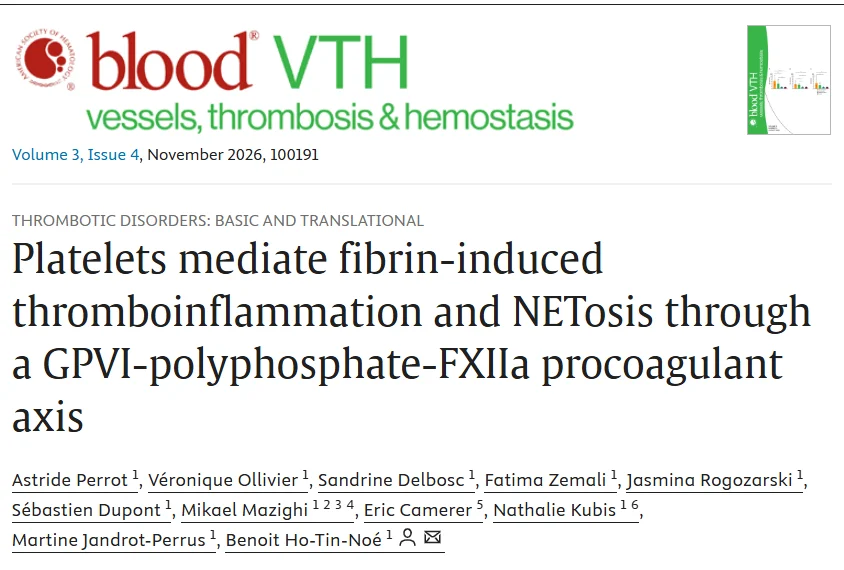
”Astride Perrot, Véronique Ollivier, Sandrine Delbosc, Fatima Zemali, Jasmina Rogozarski, Sébastien Dupont, Mikael Mazighi, Eric Camerer, Nathalie Kubis, Martine Jandrot-Perrus, Benoit Ho-Tin-Noé; Platelets mediate fibrin-induced thromboinflammation and NETosis through a GPVI-polyphosphate-FXIIa procoagulant axis. Blood Vessels, Thrombosis and Hemostasis 2026.
How platelets react at sites of thrombo-inflammation is the subject of much current interest.
Here, the authors have used a microfluid model of microvascular inflammation where whole blood was perfused over a surface coated with fibrin monomers.
They defined a thrombo-inflammatory cascade in which a layer of activated platelets uses a key GPVI-polyphosphate-FXIIa procoagulant axis to interact with second responders that promote thrombin-dependent fibrin formation and neutrophil extracellular trap formation (NETosis). Significantly, neutrophil recruitment and NETosis were exacerbated in blood with induced hyperglycemia and from subjects with diabetes.
Significantly, while the initial steps of platelet activation on fibrin were in part alphaIIbbeta3 dependent, blocking neither the integrin nor GPVI failed to prevent platelet secretion as assessed by P-selectin expression.
So, the whole process is complex and involves multiple interactions. It would now be of much interest to use a similar model to investigate the action of platelet first and second responders using blood from patients with inherited platelet disorders beginning with Glanzmann thrombasthenia (GT) where platelets lack functional alphaIIbbeta3 receptors.
The question as to how GT patients deal with sepsis or viral infections such as Covid-19 needs asking. Expanding the project to other IPDs such as the Bernard-Soulier syndrome (platelets lacking GPIb), the gray platelet syndrome (lacking alpha-granules) or to the Hermansky-Pudlak syndrome (dense granule deficiency) would also be in order.”
Title: Platelets mediate fibrin-induced thromboinflammation and NETosis through a GPVI-polyphosphate-FXIIa procoagulant axis
Authors: Astride Perrot, Véronique Ollivier, Sandrine Delbosc, Fatima Zemali, Jasmina Rogozarski, Sébastien Dupont, Mikael Mazighi, Eric Camerer, Nathalie Kubis, Martine Jandrot-Perrus, Benoit Ho-Tin-Noé
Stay updated on all scientific advances with Hemostasis Today.
-
Sep 13, 2026, 16:29Priya Prasad: How Frequent Blood Donors Can Prevent Hidden Iron Deficiency
-
Sep 13, 2026, 16:22Tiffany Hall: Why Standard Pre-Op Labs Miss High-Risk Patients?
-
Sep 13, 2026, 16:09Dimitrios Syrengelas: Haemophilia Care Begins With Safe Movement
-
Sep 13, 2026, 15:33Christina (Tina) P.: Antiphospholipid Syndrome After Unprovoked VTE
-
Sep 13, 2026, 15:22Ioana Alexandra Voda: The Story Gets More Time at IFOS Istanbul
-
Sep 13, 2026, 14:52Omar Al Hammadi: Integrating Diabetes and Dyslipidemia in Modern Clinical Care
-
Sep 13, 2026, 14:37Mohammad Zamrood Khan: Hereditary Spherocytosis and Protein C/S Deficiency Case Report Submitted
-
Sep 13, 2026, 14:33Heghine Khachatryan: A Resource-Adapted Approach to Hemophilia Joint Care
-
Sep 13, 2026, 14:23Simon Fletcher: The Unmet Burden of Factor VII Deficiency