

Clusterin Regulates von Willebrand Factor Multimer Stability Through ADAMTS13 Inhibition
A 2026 study published in Blood identifies clusterin as an endothelial-derived regulator of von Willebrand factor (VWF) multimer stability.
By binding to a defined region of VWF and limiting its cleavage by ADAMTS13, clusterin helps preserve high-molecular-weight multimers essential for effective platelet adhesion. The findings introduce a new dimension to hemostatic regulation: the preservation of VWF functional structure, rather than the regulation of circulating protein concentration alone.
The discovery raises questions about why patients with similar VWF levels can experience different bleeding phenotypes and whether proteins outside the VWF gene contribute to this variability.
Although the findings remain at an early stage of translation, they identify a potential biomarker pathway and a new direction for research into von Willebrand disease (VWD).
Key Points
- Clusterin is stored in endothelial Weibel–Palade bodies and is released alongside VWF following endothelial stimulation.
- Clusterin binds the D4N region of VWF and competitively limits ADAMTS13-mediated proteolysis, helping preserve high-molecular-weight multimers.
- Clusterin-deficient mice exhibit impaired hemostasis, while recombinant clusterin improves hemostatic outcomes in preclinical models.
- Reduced plasma clusterin in a small cohort of patients with type 2A VWD provides an initial clinical association, not a validated diagnostic finding.
- The immediate research priorities are biomarker validation, characterization of the clusterin–VWF interaction, and assessment of the safety of multimer stabilization.
The Clinical Problem Behind VWF Multimer Stability
VWD is the most common inherited bleeding disorder, yet its recognition and characterization remain uneven across healthcare systems.
The World Federation of Hemophilia’s 2023 Annual Global Survey identified 101,128 people with VWD among 390,630 people reported with inherited bleeding disorders. The reported prevalence of VWD varied substantially between high-income and low-income countries, reflecting differences in diagnostic access and disease ascertainment as well as the limitations of reported data.
Diagnosis relies on a combination of clinical history and laboratory testing, including VWF antigen (VWF:Ag), VWF activity, and factor VIII measurements. Specialized laboratories can also assess VWF multimer distribution, which provides information about the structural organization of the protein.
This distinction matters because VWF concentration does not fully describe its hemostatic capacity. High-molecular-weight (HMW) multimers are particularly effective at supporting platelet adhesion and collagen binding under conditions of high shear stress.
Their loss can compromise hemostasis even when other laboratory measurements provide an incomplete picture of the underlying functional defect.
The clusterin findings offer a possible explanation for part of this variation.
They suggest that an extracellular modifier, independent of the VWF gene itself, may influence how long the most functionally active VWF multimers persist in circulation.
VWF Multimers and the ADAMTS13 Regulatory Pathway
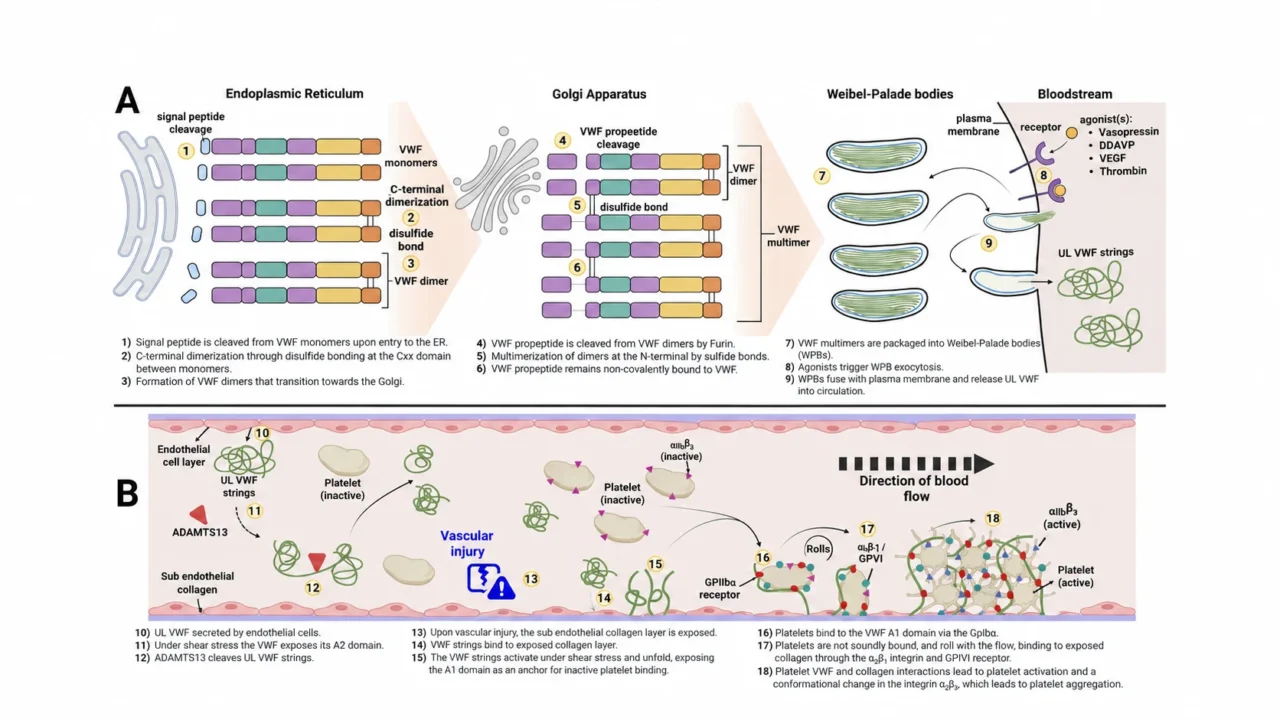
VWF is a large multimeric glycoprotein synthesized primarily by endothelial cells and megakaryocytes.
Endothelial VWF is stored in Weibel–Palade bodies and released following vascular stimulation. Its functions include mediating platelet adhesion at sites of vascular injury and carrying coagulation factor VIII in the circulation.
Following secretion, ultralarge VWF multimers are subject to cleavage by ADAMTS13, a plasma metalloprotease. Under appropriate shear conditions, the VWF A2 domain unfolds, exposing the Tyr1605–Met1606 cleavage site to ADAMTS13. This process limits the accumulation of excessively adhesive VWF multimers.
The balance between VWF release and proteolytic processing is clinically important. Severe ADAMTS13 deficiency is associated with thrombotic thrombocytopenic purpura (TTP), in which ultralarge VWF promotes platelet-rich microvascular thrombosis. Conversely, loss of HMW multimers is characteristic of type 2A VWD and contributes to impaired primary hemostasis.
The newly described role of clusterin adds another potential regulatory input. Rather than changing VWF production or directly replacing ADAMTS13, clusterin appears to influence the accessibility of VWF to proteolytic cleavage.
www.frontiersin.org
How Clusterin Was Identified as a VWF Regulator
In their 2026 study, Qiao and colleagues investigated proteins released by endothelial cells following vascular endothelial growth factor stimulation and mechanical stretch. Proteomic analysis identified clusterin, also known as apolipoprotein J, among the proteins associated with endothelial activation.
Further experiments demonstrated clusterin localization within Weibel–Palade bodies and its release alongside VWF through regulated endothelial secretion. This places clusterin at a biologically relevant site: the endothelial secretory pathway, where newly released VWF multimers enter the circulation and encounter the mechanisms responsible for their processing.
Clusterin is a multifunctional secreted glycoprotein previously investigated in cellular stress responses and other biological processes. Its identification as a regulator of VWF multimer stability expands its potential relevance to vascular biology.
The principal mechanistic finding was that clusterin binds the D4N region of VWF and competitively reduces ADAMTS13 binding. This interaction limits VWF cleavage under shear conditions and helps preserve HMW multimers.
Importantly, clusterin deficiency did not substantially alter VWF expression or secretion in the reported experimental models. The observed effect was primarily related to multimer integrity rather than the amount of VWF produced.
This distinction is central to the study: two biological systems may contain comparable quantities of VWF while differing in the structural integrity and functional persistence of its most adhesive multimers.
Experimental Evidence and Clinical Relevance
The investigators examined plasma samples from 10 patients with type 2A VWD and found significantly lower clusterin levels than in healthy controls, with an approximately 50% reduction reported by ELISA. This finding is consistent with a potential relationship between clusterin and VWF multimer integrity, although the small cohort cannot establish whether reduced clusterin contributes to the disease or reflects associated biological changes.
The experimental findings provide additional support for the proposed mechanism. Clusterin-deficient mice exhibited prolonged bleeding, impaired thrombus formation, and reduced HMW VWF multimers. Administration of recombinant clusterin improved hemostatic and thrombotic readouts, while clusterin-directed messenger RNA delivery also demonstrated preclinical activity.
Together, these results support a functional relationship between clusterin and VWF multimer stability. However, the animal experiments do not establish therapeutic efficacy in humans, and the clinical observations do not demonstrate that clusterin deficiency is an independent cause of VWD.
The most important next step is to determine whether clusterin levels explain clinically meaningful differences in VWF multimer distribution among patients with comparable VWF concentrations and genetic variants.
The 2026–2029 VWD Treatment Landscape
The clusterin discovery comes at a time when VWD treatment research is expanding beyond replacement therapy and on-demand management. Several investigational approaches target different components of the hemostatic process, including natural anticoagulation, factor VIII activity, fibrinolysis, and VWF replacement.
The following programs provide context for the potential future relevance of multimer stabilization. Trial status and recruitment should be confirmed against the live registries before publication.
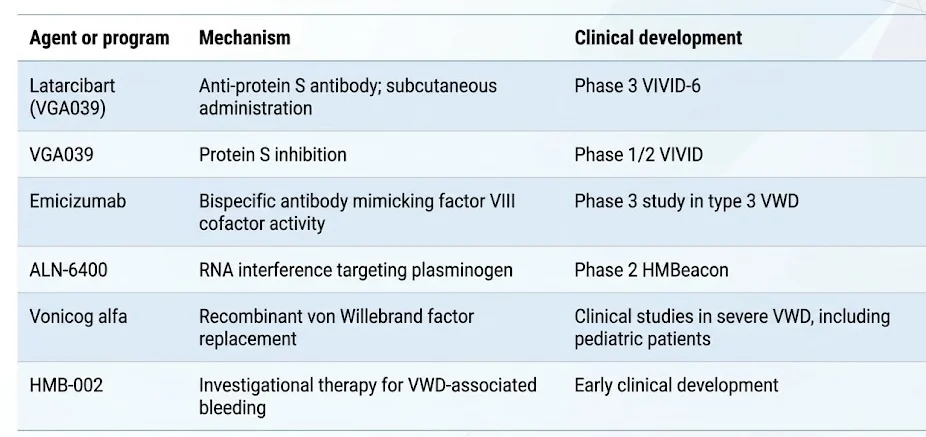
These approaches address different limitations in hemostasis. Protein S inhibition reduces natural anticoagulant activity, emicizumab provides factor VIII-mimetic activity, plasminogen knockdown targets fibrinolysis, and recombinant VWF replaces the deficient or dysfunctional protein.
Clusterin-mediated multimer stabilization would address a different biological question: whether preserving the functional structure of endogenous VWF could improve platelet capture and hemostatic performance.
This distinction is potentially important for future combination strategies. However, no clusterin-directed VWD therapy is established, and the current evidence does not demonstrate that clusterin supplementation would provide additional clinical benefit over existing treatments.
Building the Evidence Base for a Clusterin Biomarker
The most defensible near-term application of clusterin is as a candidate biomarker of VWF multimer regulation rather than a stand-alone diagnostic test.
Prospective studies could measure plasma clusterin alongside VWF:Ag, VWF activity, VWF collagen-binding activity, multimer distribution, and ADAMTS13 activity. Including inflammatory markers and relevant clinical variables would help distinguish a specific relationship with VWF processing from the broader effects of clusterin’s multifunctional biology.
Patient cohorts should include multiple VWD subtypes, particularly types 1, 2A, 2B, 2M, and 3, alongside appropriate healthy controls. Studies involving TTP could also help determine whether clusterin levels or activity vary in conditions characterized by impaired ADAMTS13 function.
An important design would compare patients with similar VWF variants but different multimer profiles or bleeding severity. If clusterin explains some of this variability independently of established laboratory measurements, it could become a useful modifier for clinical phenotyping and research stratification.
Existing resources, including the WFH Annual Global Survey, the EAHAD Coagulation Factor Variant Databases, and ClinVar, could support patient characterization and genotype–phenotype studies. Nevertheless, genetic databases alone cannot establish the contribution of a circulating modifier. Prospective laboratory phenotyping will be essential.
Therapeutic Potential and Safety Considerations
The possibility of preserving HMW VWF multimers presents an intriguing therapeutic concept for selected bleeding disorders associated with their loss. Unlike VWF replacement, which increases the availability of functional protein, a multimer-stabilizing approach would seek to prolong the persistence of the most adhesive forms of endogenous VWF.
However, the same mechanism creates a safety concern. Excessive stabilization of highly adhesive VWF multimers could theoretically increase platelet-rich thrombus formation, particularly if ADAMTS13-mediated regulation were inhibited too strongly or for too long.
Any future therapeutic program would therefore need to define an appropriate balance between hemostatic benefit and thrombotic risk. Relevant endpoints could include VWF multimer distribution, VWF functional activity, ADAMTS13 activity, platelet activation markers, bleeding outcomes, and thrombotic events.
The rescue experiments in mice provide proof of concept, not evidence that chronic clusterin administration is safe. The duration of effect, optimal exposure, pharmacological properties, and consequences of sustained multimer stabilization remain to be established.
Limitations and Research Priorities
Several limitations currently restrict the clinical interpretation of the findings.
First, the human data come from a small cohort of patients with type 2A VWD. Whether reduced clusterin occurs in other VWD subtypes or in unrelated hemostatic disorders is unknown. Second, clusterin is responsive to cellular stress and has multiple biological functions, making inflammation, renal function, and metabolic status potential confounders. Third, the preclinical treatment findings require validation before translation into clinical practice.
Future research should prioritize:
Clinical validation: Measure clusterin across VWD subtypes and relevant control populations, adjusting for ADAMTS13 activity and inflammatory markers.
Genotype–phenotype analysis: Determine whether clusterin explains differences in multimer distribution or bleeding severity among patients with comparable VWF variants.
Mechanistic characterization: Map the clusterin–VWF interaction to establish how binding alters ADAMTS13 access and whether the effect can be reproduced selectively.
Therapeutic safety: Investigate the consequences of sustained multimer stabilization, including thrombotic and microangiopathic outcomes.Clinical trial integration: Consider VWF multimer distribution and functional activity as exploratory endpoints in studies of VWD therapies.
The central finding is not that clusterin has already become a diagnostic marker or treatment target. Rather, it establishes a previously underappreciated mechanism through which an endothelial secretory protein can influence VWF proteolysis without substantially altering VWF abundance.
Frequently Asked Questions
1. What is clusterin, and why is it relevant to hemostasis?
Clusterin, also known as apolipoprotein J, is a multifunctional secreted glycoprotein. The 2026 study identifies it as a regulator of VWF multimer stability through its interaction with ADAMTS13-mediated proteolysis.
2. How does clusterin affect von Willebrand factor?
Clusterin binds the D4N region of VWF and competitively limits ADAMTS13 binding, helping preserve HMW multimers under shear conditions.
3. Does clusterin deficiency cause von Willebrand disease?
This has not been established in humans. Clusterin-deficient mice exhibited impaired hemostasis, but the clinical association observed in patients with type 2A VWD does not prove causation.
4. Why are high-molecular-weight VWF multimers important?
HMW multimers are particularly effective at mediating platelet adhesion and collagen binding. Their loss can impair primary hemostasis and is characteristic of type 2A VWD.
5. Could clusterin become a diagnostic biomarker?
Potentially, but additional research is required. Clusterin must demonstrate reproducible associations with VWF function and clinically meaningful information beyond established laboratory tests.
6. Is clusterin being tested as a treatment for VWD?
The study provides preclinical evidence of therapeutic potential, but clusterin is not an established VWD treatment. Human efficacy and safety have not been demonstrated.
7. How does clusterin-mediated stabilization differ from VWF replacement?
VWF replacement supplies functional protein, whereas clusterin-mediated stabilization aims to preserve the integrity of existing VWF multimers. Whether these approaches could complement one another remains unknown.
8. Could clusterin increase the risk of thrombosis?
Potentially. Because HMW VWF supports platelet adhesion, excessive or prolonged stabilization could theoretically promote thrombosis. This risk requires direct investigation.
9. Which patients should be studied next?
Prospective cohorts should include multiple VWD subtypes, patients with different multimer profiles, and relevant controls. Comparisons of patients with similar VWF variants but different bleeding phenotypes may be particularly informative.
10. What is the main clinical significance of the discovery?
The study introduces a potential mechanism linking endothelial secretion, VWF multimer integrity, and hemostatic function. Its clinical value will depend on independent validation and demonstration of relevance to patient outcomes.
Written by Elen Avetisyan, MD.
Stay updated with Hemostasis Today.
-
Oct 28, 2026, 14:14Mina Jarrahi: Platelet-Rich Fibrin for Periodontal Regeneration
-
Oct 28, 2026, 14:06Mohammed Alo: A Stent Treats the Blockage, Not the Underlying Disease
-
Oct 28, 2026, 13:58Vladimir Lemaire: When Blood Clots Affect Elite Athletes
-
Oct 28, 2026, 13:27M. Alejandro Mosso-Pani: Dengue in Florida – Why Platelet Function Matters
-
Oct 28, 2026, 13:13Michael Cahillane: Three-Buffy-Coat Platelets – Strengthening Blood Supply Resilience
-
Oct 28, 2026, 13:05N. Mariana S. Vasquez: Antiplatelets vs Anticoagulants – Key Clinical Differences
-
Oct 28, 2026, 12:45Panithaya Chareonthaitawee: A Podcast Walk Through Anticoagulation
-
Oct 28, 2026, 11:55Natalia C. Badillo: Anticoagulation in AF – A Decision Beyond the Score
-
Oct 28, 2026, 08:40Simon Fletcher: The Hidden Burden of Non-Severe Haemophilia