

Choosing the Right VTE Risk Assessment Model for Clinical Practice
Venous thromboembolism (VTE) remains an important, potentially preventable cause of morbidity and mortality among patients with cancer, surgical patients and acutely ill medical inpatients.
Risk assessment models (RAMs) support targeted thromboprophylaxis, but their predictive performance and the clinical benefit of score-guided anticoagulation must be considered separately.
The Khorana, Caprini and Padua scores were developed for distinct clinical populations, with different levels of validation and evidence supporting their use.
Randomized trials support selected thromboprophylaxis strategies in ambulatory patients with cancer identified as being at increased risk by the Khorana score, whereas the Caprini and Padua models support more context-dependent risk assessment in surgical and hospitalized medical populations. Recent validation studies also highlight limitations in discrimination and generalizability across clinical settings.
This review examines the scoring criteria, predictive performance and clinical evidence underpinning these three models, with a focus on their application to thromboprophylaxis decisions.
Risk assessment scores should inform, rather than dictate, clinical management. Appropriate model selection, independent bleeding-risk assessment, clinical reassessment and adherence to procedure-specific and population-specific guidance remain essential to preventing VTE while minimizing bleeding complications.
Why VTE Risk Stratification Matters
Venous thromboembolism (VTE) is a major cause of preventable morbidity and mortality among hospitalized patients, surgical patients and individuals with cancer.
The risk of VTE varies according to clinical context and is influenced by factors such as active malignancy, surgery, reduced mobility, systemic inflammation and previous thromboembolic events. Pharmacological thromboprophylaxis can reduce VTE risk but must be balanced against bleeding risk.
Risk assessment models (RAMs) provide a structured approach to identifying patients who may benefit from preventive measures, although their performance and clinical applicability vary across populations.
The clinical value of a RAM extends beyond its ability to classify patients by risk.
Three distinct questions must be considered:
- How accurately does the model predict VTE?
- Does thromboprophylaxis improve outcomes in the patients it identifies as high risk?
- Does implementing a score-guided strategy improve outcomes in clinical practice?
These questions address predictive performance, treatment benefit and implementation effectiveness, respectively. A model’s ability to stratify risk does not, by itself, establish that anticoagulation is beneficial for every patient above a particular threshold. Its use should therefore be guided by the relevant clinical evidence, an individualized assessment of bleeding risk and the recommendations applicable to the patient’s clinical setting.
The Khorana Score for Ambulatory Patients With Cancer
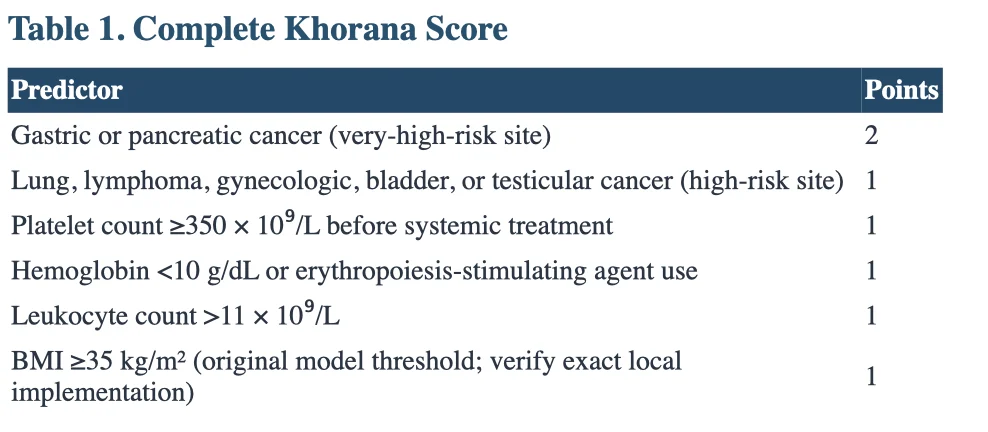
The Khorana score was developed to estimate the risk of chemotherapy-associated venous thromboembolism (VTE) in ambulatory patients with cancer initiating systemic treatment.
It incorporates five clinical and laboratory parameters: primary tumor site, platelet count, hemoglobin level or erythropoiesis-stimulating agent use, leukocyte count and body mass index (BMI).
These variables provide a practical approach to identifying patients who may benefit from further assessment for thromboprophylaxis.
The score assigns 2 points for gastric or pancreatic cancer and 1 point for lung, lymphoma, gynecologic, bladder or testicular cancer. The remaining criteria each contribute 1 point: a baseline platelet count of ≥350 × 10⁹/L, hemoglobin level below 10 g/dL or use of an erythropoiesis-stimulating agent, leukocyte count above 11 × 10⁹/L, and BMI of ≥35 kg/m².
Tumor-site categories are mutually exclusive, and only the applicable category should be scored.
Under the original classification, a total score of 0 indicates
- low risk
- 1–2 intermediate risk
- ≥3 high risk
However, a threshold of ≥2 is commonly used in clinical trials and recommendations to identify patients for consideration of primary thromboprophylaxis. This threshold should not be confused with the original high-risk category.
The Khorana score supports risk assessment but does not, by itself, establish an indication for anticoagulation. Decisions about thromboprophylaxis should also consider bleeding risk, cancer type, treatment regimen, comorbidities, potential drug interactions and patient preferences.
Does Khorana-Guided Thromboprophylaxis Improve Outcomes?
The clinical utility of the Khorana score has been evaluated in randomized trials of primary thromboprophylaxis in ambulatory patients with cancer.
In AVERT, apixaban (2.5 mg twice daily) reduced VTE incidence over 180 days from 10.2% with placebo to 4.2% (hazard ratio [HR], 0.41). Major bleeding occurred in 3.5% of patients receiving apixaban and 1.8% receiving placebo in the modified intention-to-treat population.
In CASSINI, rivaroxaban (10 mg once daily) did not significantly reduce the primary composite endpoint over the full study period: events occurred in 6.0% of patients receiving rivaroxaban and 8.8% receiving placebo. The on-treatment analysis showed a greater reduction, with event rates of 2.6% and 6.4%, respectively. These findings highlight the importance of distinguishing the primary intention-to-treat analysis from analyses restricted to the treatment period.
Together, these trials support consideration of thromboprophylaxis in selected ambulatory patients with cancer who have an elevated VTE risk.
However, they do not establish that the Khorana score has strong individual-level predictive accuracy or that every patient meeting a specified threshold will benefit from anticoagulation.
Clinical guidelines support individualized consideration of apixaban, rivaroxaban or low-molecular-weight heparin in appropriately selected patients, particularly when VTE risk is elevated and bleeding risk is acceptable.
Decisions should account for tumor type, renal function, platelet count, potential drug interactions, gastrointestinal or genitourinary bleeding risk and patient preferences. Pancreatic cancer warrants particular attention because of its substantial thrombotic risk. Recommendations and eligibility criteria vary among professional guidelines, including those from ASH, ITAC, ESMO, ASCO and BSH.
Predictive Limitations and Recent Validation
Although the Khorana score is widely used in ambulatory oncology, it does not incorporate several factors that may influence VTE risk, including tumor stage, metastatic burden, previous VTE, specific treatment regimens and changes in inflammatory or hemostatic biomarkers. Its predictive performance therefore varies across cancer populations and clinical settings.
A 2026 prospective external validation involving 803 patients in Brazil reported an area under the receiver operating characteristic curve (AUC) of 0.567 (95% confidence interval [CI], 0.462–0.672), indicating limited discrimination in that cohort. These findings underscore the limitations of relying on the score alone and should not be generalized to all cancer populations without further evidence.
The Caprini Risk Assessment Model for Surgical Patients
The Caprini risk assessment model (RAM) estimates perioperative VTE risk by assigning weighted points to patient-specific characteristics, comorbidities and procedure-related factors. It is widely used in surgical risk assessment, although its predictive performance and the thresholds used to guide prophylaxis vary across specialties and patient populations.
The 2013 version expanded the original criteria to include additional factors informed by epidemiological evidence. However, the inclusion of a risk factor in the model does not necessarily mean that its individual contribution has been independently validated across all surgical settings. Accurate scoring requires adherence to the original completion instructions, particularly when applying supplementary criteria or accounting for overlapping risk factors.
The following table reproduces the principal and supplementary criteria of the 2013 Caprini model. The original scoring instructions should be consulted when interpreting individual items and calculating the total score.
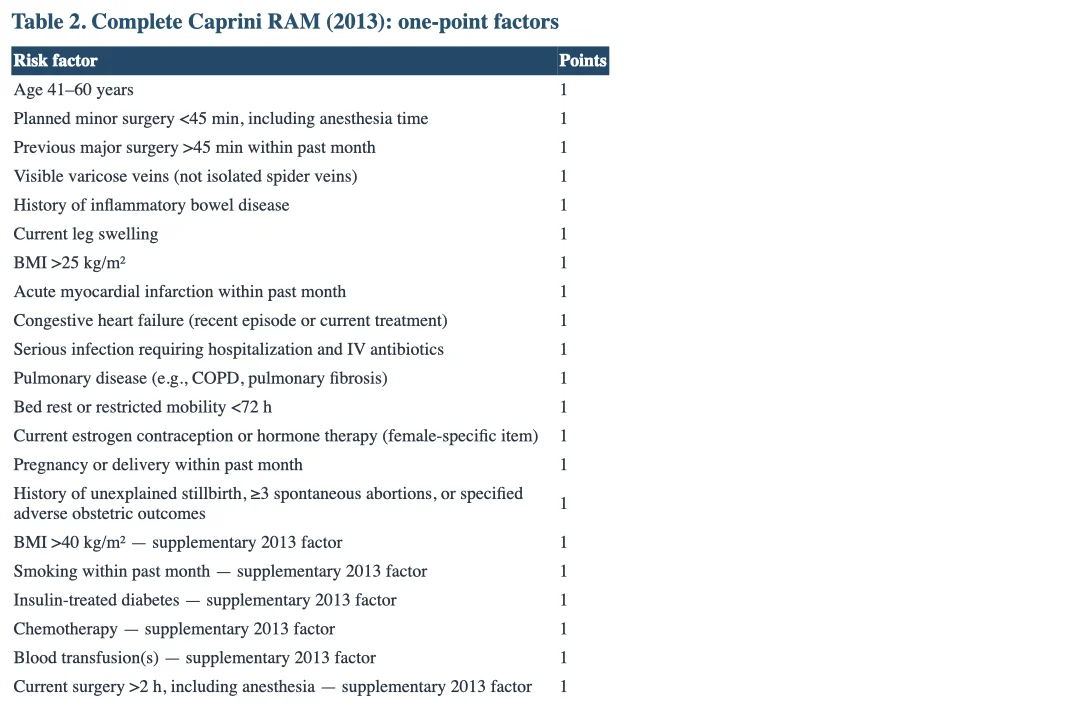
The supplementary BMI >40 criterion may add to the general BMI >25 item in the 2013 scoring framework. The surgery-duration supplement must not be added to the five-point elective hip/knee arthroplasty category. Additional rules govern multiple pulmonary diagnoses and recurrent events; see the original completion guidance.
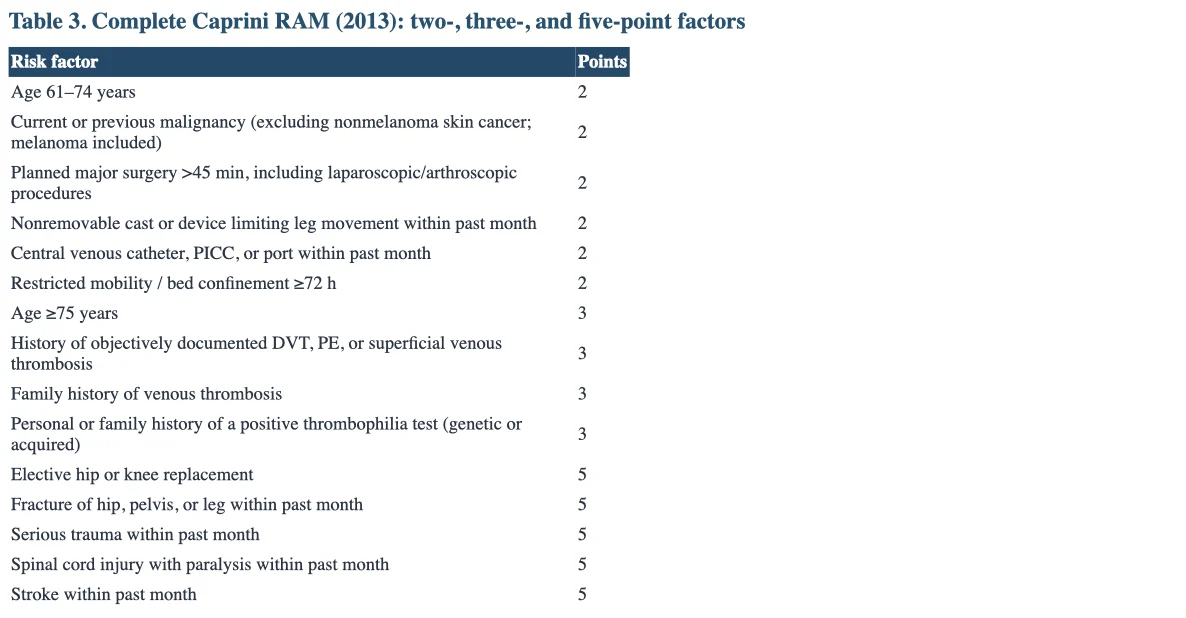
Scoring caveats: only one age band applies; separate objectively documented VTE episodes may contribute separately, but simultaneous DVT and PE constitute one episode under the published instructions.
The original guidance includes superficial venous thrombosis in the three-point history category.
Multiple established thrombophilia markers may be counted according to the published instructions, but low-evidence polymorphisms must not be treated as clinically meaningful thrombophilia without specialist interpretation. For major arthroplasty, avoid double counting the ordinary two-point surgical category.
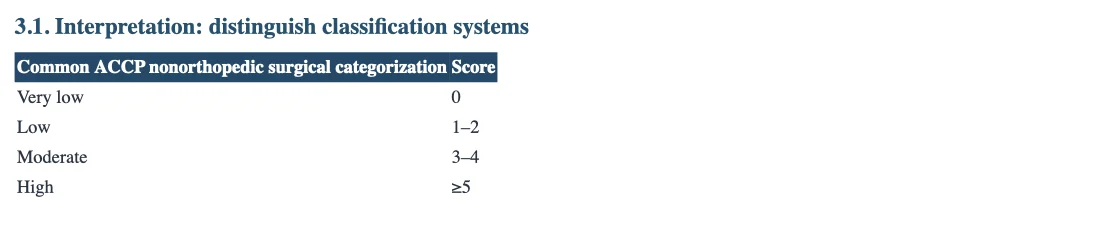
Other Caprini publications and clinical tools use alternative labels (e.g., 0–1 low, 2 moderate, 3–4 high, ≥5 very high). Such terminology should not be mixed without identifying the underlying source.
Higher thresholds (e.g., ≥7, ≥8, ≥10, or ≥12) have been investigated in particular surgical specialties; none should be assumed universally applicable.
Predictive Performance and Recent Evidence
Evidence published in recent years highlights variation in the predictive performance of the Caprini model across clinical settings. A 2026 scoping review of 275 studies published between 2021 and 2025 reported a mean area under the receiver operating characteristic curve (AUC) of 0.702 (standard deviation [SD], 0.104) for the Caprini score across 52 paired comparisons, compared with 0.832 (SD, 0.080) for modified or newly developed models.
These descriptive averages should not be interpreted as pooled estimates from a uniform population or as proof that modified models consistently improve clinical outcomes. The review identified substantial variation between specialties and increasing interest in specialty-specific models, biomarkers and machine-learning approaches.
In a nationwide Veterans Affairs cohort comprising 1,252,460 hospital admissions, the Caprini and Padua scores demonstrated limited discrimination for 90-day VTE, with AUCs of 0.56 and 0.59, respectively.
These findings raise concerns about applying either model indiscriminately to unselected hospitalized populations. However, they do not negate the potential value of the Caprini model in surgical populations for which its use has been evaluated.
Implications for Thromboprophylaxis
The Caprini score can support decisions regarding early mobilization, mechanical prophylaxis, pharmacological thromboprophylaxis and, where supported by procedure-specific evidence, extended prophylaxis after discharge. However, the total score does not independently determine the appropriate anticoagulant, dose, initiation time or duration. These decisions require consideration of the procedure, individual bleeding risk, comorbidities and relevant clinical guidelines.
The effectiveness of a Caprini-based prevention programme also depends on how the score is implemented. Standardized orders, clinician education, reassessment and audit may improve adherence to prophylaxis protocols. Any improvement in clinical outcomes should therefore be evaluated in the context of the overall prevention strategy rather than attributed to the risk score alone.
Padua Prediction Score for Hospitalized Medical Patients
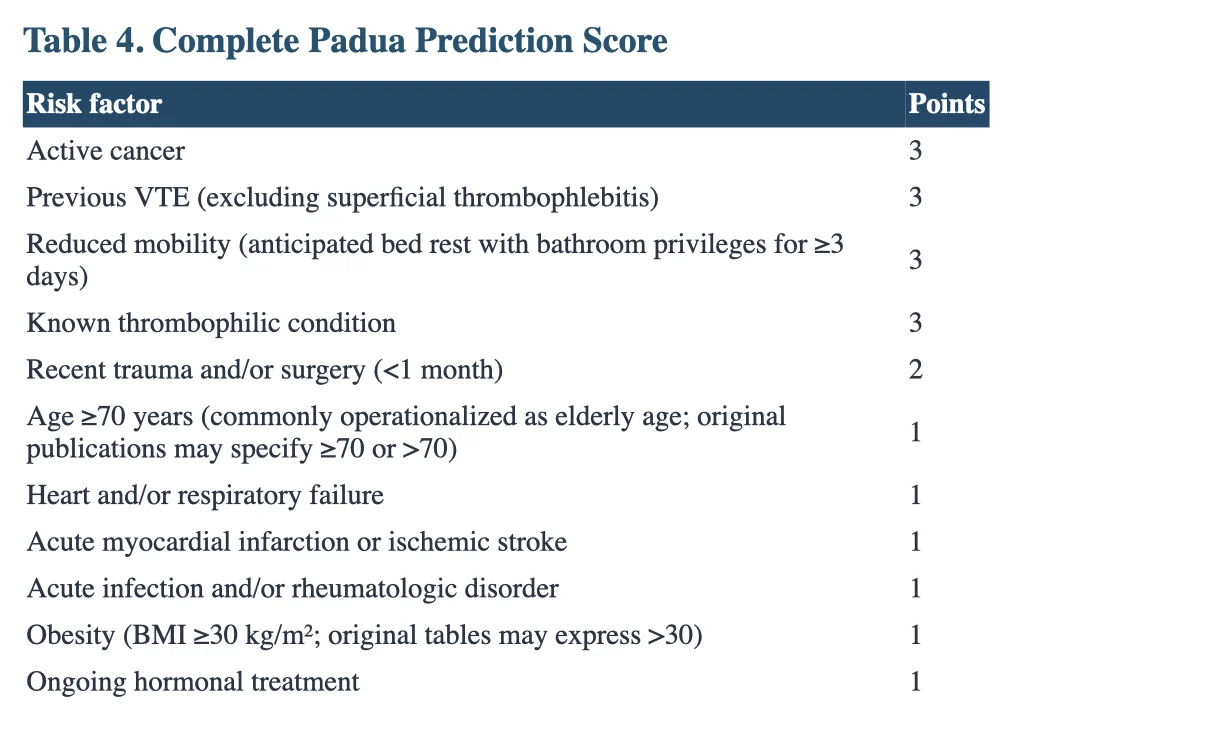
The Padua Prediction Score was developed to assess venous thromboembolism (VTE) risk in acutely ill hospitalized medical patients. Reduced mobility, active cancer, previous VTE, and known thrombophilia are among its highest-weighted risk factors. A total score of ≥4 indicates high VTE risk and supports consideration of pharmacological prophylaxis after an independent assessment of bleeding risk.
Risk factors and points: Active cancer (3 points); previous VTE, excluding superficial vein thrombosis (3 points); reduced mobility, defined as anticipated bed rest with bathroom privileges for ≥3 days (3 points); known thrombophilic condition (3 points); recent trauma and/or surgery within 1 month (2 points); age ≥70 years (1 point); heart and/or respiratory failure (1 point); acute myocardial infarction or ischemic stroke (1 point); acute infection and/or rheumatologic disorder (1 point); obesity (BMI ≥30 kg/m²) (1 point); and ongoing hormonal treatment (1 point).
A total score of ≥4 indicates high VTE risk, whereas a score of 0–3 indicates lower risk. In the original cohort, VTE occurred in approximately 11% of high-risk patients who did not receive prophylaxis, compared with 2.2% of those who received prophylaxis. These findings arose from an observational comparison and should not be interpreted as a randomized estimate of treatment efficacy.
Concurrent Bleeding-Risk Assessment
The Padua Prediction Score assesses VTE risk but does not quantify bleeding risk. Before initiating pharmacological prophylaxis, clinicians should consider active bleeding, recent hemorrhage, thrombocytopenia (particularly a platelet count below 50 × 10⁹/L), severe renal or hepatic impairment, active gastroduodenal ulcer, and planned invasive procedures.
The IMPROVE Bleeding Risk Assessment Model (RAM), for which a score of ≥7 is commonly used to identify high bleeding risk, may complement clinical judgment. When bleeding risk contraindicates pharmacological prophylaxis, mechanical prophylaxis may be considered when appropriate, with regular reassessment and transition to pharmacological prophylaxis when the bleeding risk becomes acceptable.
Head-to-Head Comparison and Evidence Hierarchy
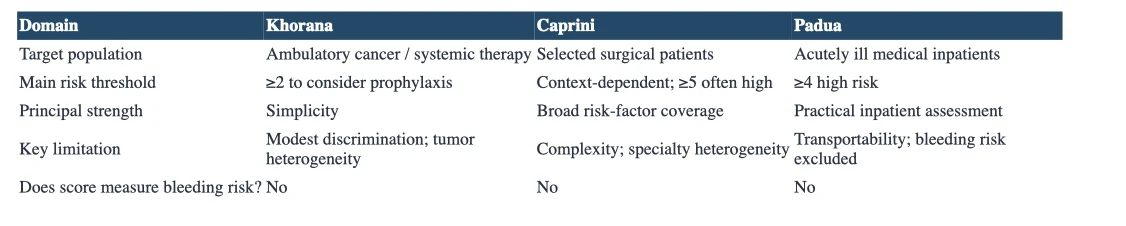
The Khorana, Caprini, and Padua risk assessment models (RAMs) were developed for different clinical populations and should be selected according to the patient’s clinical setting.
The Khorana score estimates VTE risk in ambulatory patients with cancer receiving systemic therapy, with a score of ≥2 commonly used to identify patients for consideration of thromboprophylaxis.
The Caprini score covers a broad range of surgical risk factors, with thresholds varying by surgical population and clinical protocol; a score of ≥5 often indicates high risk. The Padua score is intended for acutely ill medical inpatients, with a score of ≥4 indicating high VTE risk.
The principal strength of the Khorana score is its simplicity, although its predictive performance may vary across cancer types and treatment settings.
The Caprini score incorporates a broad range of risk factors but can be more complex to apply, and its validation varies across surgical specialties.
The Padua score offers a practical approach to inpatient medical risk assessment, although its performance may vary across populations and healthcare settings. None of these scores directly measures bleeding risk, so prophylaxis decisions require a separate assessment of bleeding risk and clinical contraindications.
When comparing RAMs, discrimination, calibration, and clinical utility should be evaluated separately. Discrimination, commonly measured by the area under the receiver operating characteristic curve (AUC) or c-statistic, reflects a model’s ability to distinguish patients who develop VTE from those who do not.
Calibration assesses agreement between predicted and observed risks, while decision-curve analysis evaluates net clinical benefit across relevant treatment thresholds. A high AUC alone does not establish that score-guided intervention reduces VTE, and AUC values derived from different populations should not be ranked as though they were directly comparable.
Translating Risk Scores Into Clinical Decisions
A VTE risk score is the starting point for a clinical decision, not the decision itself.
Effective risk assessment requires selecting the appropriate model, calculating the score correctly, and integrating the result with bleeding risk, contraindications, and current clinical guidance. Risk should be reassessed as the patient’s condition, mobility, or treatment changes.
Documentation should capture the score, the model used, and the rationale for the prophylaxis strategy.
Illustrative case A: Pancreatic cancer
A 62-year-old patient with pancreatic adenocarcinoma starting systemic therapy receives at least 2 points on the Khorana score based on tumor site alone. This places the patient in a group for whom primary thromboprophylaxis may be considered, but the decision requires more than a numerical threshold. Gastrointestinal bleeding risk, thrombocytopenia, renal function, drug interactions, and patient preferences must also inform treatment selection.
Illustrative case B: Major abdominal surgery
A 68-year-old patient undergoing major abdominal surgery with a history of deep vein thrombosis has a Caprini score of at least 7: 2 points for age, 2 for surgery lasting more than 45 minutes, and 3 for previous VTE. This identifies substantial thrombotic risk, but the final prophylaxis plan must account for bleeding risk, procedure-specific recommendations, and postoperative mobility.
Illustrative case C: Acute medical admission
A 76-year-old patient admitted with pneumonia and respiratory failure, with restricted mobility expected to last at least 3 days, has a Padua score of 6. Reduced mobility contributes 3 points, while age, respiratory failure, and acute infection contribute 1 point each. Pharmacological prophylaxis should be considered after evaluating bleeding risk and contraindications.
Emerging Evidence and Unresolved Questions
VTE risk changes over time, but many risk scores capture only a snapshot. During hospitalization or systemic cancer therapy, evolving clinical conditions, treatment exposures, and mobility may alter thrombotic risk. Dynamic models incorporating these variables, D-dimer, and electronic health record data could support more individualized assessment. Their complexity, however, must be justified by external validation, reliable calibration, prospective evidence of clinical benefit, and feasibility in routine practice.
The central question is not whether a model can identify patients at higher risk, but whether using it changes clinical decisions for the better. A useful risk assessment strategy should improve prevention of symptomatic VTE without causing disproportionate major bleeding. Differences in event rates between risk groups alone do not establish that a score-guided approach improves outcomes.
Conclusions
The right VTE risk score is the one validated for the clinical setting in which it is used. Khorana supports thromboprophylaxis decisions in selected ambulatory patients with cancer, Caprini informs perioperative risk assessment, and Padua helps identify acutely ill medical inpatients who may benefit from prophylaxis. Their value depends on appropriate patient selection, independent assessment of bleeding risk, and integration with clinical guidelines.
Recent validation studies reinforce an important distinction: predicting risk is not the same as preventing events. The ultimate measure of a risk assessment model is whether it helps clinicians make better-informed decisions, prevent clinically significant thrombosis, and minimize bleeding harm.
FAQ
1. What are the Khorana, Caprini and Padua scores used for?
They assess VTE risk in ambulatory patients with cancer, surgical patients and acutely ill medical inpatients, respectively.
2. What Khorana score supports consideration of thromboprophylaxis?
A score of ≥2 commonly identifies ambulatory patients with cancer for consideration of primary thromboprophylaxis.
3. What evidence supports Khorana-guided thromboprophylaxis?
The AVERT and CASSINI trials evaluated apixaban and rivaroxaban, respectively, demonstrating the potential benefits and bleeding risks of prophylaxis in selected patients.
4. What Caprini score indicates high VTE risk?
A score of ≥5 commonly indicates high risk in certain surgical populations, although thresholds vary by specialty and protocol.
5. What Padua score indicates high VTE risk?
A score of ≥4 indicates high risk in acutely ill medical inpatients.
6. How accurately do these scores predict VTE?
Performance varies by population, with limited discrimination reported in some validation studies.
7. How should bleeding risk be assessed?
Consider active bleeding, thrombocytopenia, renal impairment, recent hemorrhage and planned invasive procedures; the IMPROVE model may assist in medical inpatients.
8. What if both VTE and bleeding risks are high?
Individualize prophylaxis according to contraindications, clinical guidelines and the balance between thrombosis and bleeding risks.
9. What are discrimination and calibration?
Discrimination measures how well a model separates patients who develop VTE from those who do not; calibration compares predicted with observed risk.
10. How should clinicians select a VTE risk score?
Match the model to the clinical setting, assess bleeding risk independently and integrate the result with current guidelines and clinical judgment.
Written by Heghine Khachatryan, Editor-in-Chief of Hemostasis Today.
Stay updated with Hemostasis Today.
-
Oct 26, 2026, 14:29Ilenia Calcaterra: HEMOPLATE Explores Biological Factors Behind Bleeding Variability in Haemophilia A
-
Oct 26, 2026, 14:28Giovanni Solimeno: An Advanced Thrombin Injection Technique for Complex Femoral Pseudoaneurysms
-
Oct 26, 2026, 14:20Abdul Mannan: Are We Teaching Doctors to Think or Just Trust AI?
-
Oct 26, 2026, 14:18Shadi Yaghi: Evidence Supports DOACs as an Alternative to VKAs for Cerebral Venous Thrombosis
-
Oct 26, 2026, 14:15Kale Gubae: Comparing the Effectiveness and Safety of Warfarin and Rivaroxaban in Atrial Fibrillation
-
Oct 26, 2026, 14:06Mokhtar Tazik: Evidence-Based Regulation to Strengthen Plasma Supply and Patient Safety
-
Oct 26, 2026, 13:57Gladys Delancey: Spotting the Warning Signs of Vein Disease
-
Oct 26, 2026, 13:36Kefah Mokbel: Targeted Breast Cancer Therapies Linked to Increased Thrombotic Risk
-
Oct 26, 2026, 13:32Jorge Enrique: Beyond Fibrin Targeting New Strategies for Thrombolysis