


Andreas Calatzis: Can Protein C and Plasma Overcome Fibrinolysis Resistance in Sepsis?
Andreas Calatzis, Managing Director of Eonis GmbH and Dynabyte GmbH, shared a post on LinkedIn about recent articles, adding:
“How can we fix fibrinolysis resistance in sepsis?
We know today that a poor response to a t-PA challenge in viscoelastic testing is associated with adverse outcomes in sepsis and other critical conditions.
Studies by Fazakas János, Mirjam Bachler, Lucy Coupland and Anders Aneman-SSWAHS on the ClotPro system, and work on other platforms, have shown this convincingly.
But a diagnostic test does not cure a patient. Only treatment does.
That is why I found the new study by Andrea Meli and colleagues from Mauro Panigada‘s group so interesting (open access).
They report nine consecutive patients with sepsis-associated purpura fulminans treated with protein C concentrate and plasma.
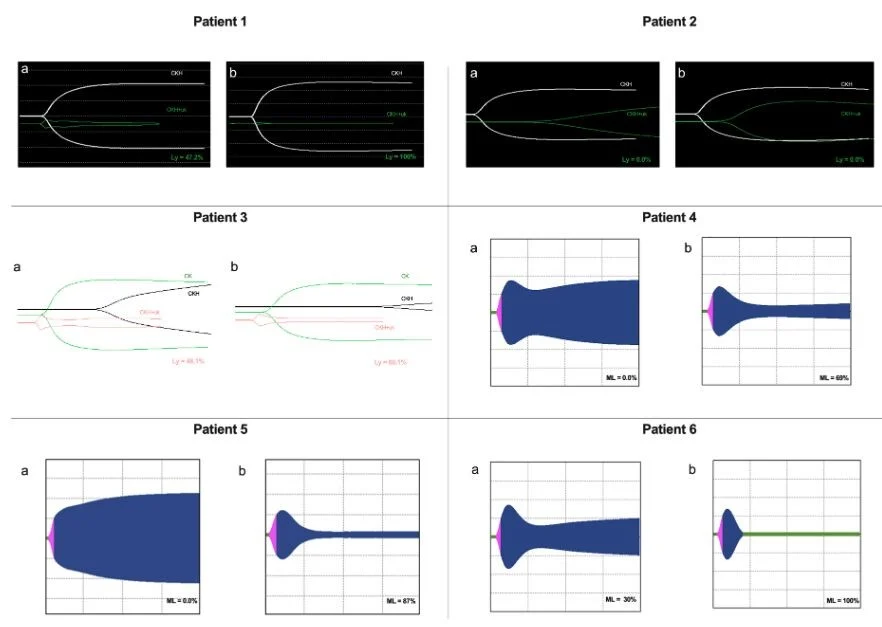
Six adults had activator-modified viscoelastic testing. All six were fibrinolysis-resistant before treatment, and in five the lytic response increased afterwards.
The figure shows the tracings (a: before, b: after protein C and plasma; patients 1–3 urokinase-modified TEG, patients 4–6 ClotPro TPA-test).
While this is a small retrospective series without a control group, it shows that fibrinolysis resistance can move in the right direction under therapy, and that we can follow this using viscoelastometry.
I really hope we will find an effective treatment for fibrinolysis resistance in the coming years, as it could contribute to a better recovery of these critically ill patients.”
Title 1: Fibrinolytic Response to Protein C Zymogen and Plasma in Sepsis-Associated Purpura Fulminans: A Case Series of Nine Consecutive Patients
Authors: Andrea Melihttps, Tiziana Marchesi, Ivan Silvestri, Alessio Caccioppola, Cristina Novembrino, Giacomo Grasselli, Mauro Panigada
Read the Full Article on Clinical and Applied Thrombosis/Hemostasis
Title 2: A grading system of dynamic fibrinolysis resistance in sepsis associates with ICU outcomes
Authors: Lucy A. Coupland, Steven A. Frost, Jessica Lin, Nguyen Pham, Matthew Self, Philip J. Crispin, David J. Rabbolini, Charithani B. Keragala, Robert L. Medcalf, Anders Aneman
Read the Full Article on American Journal of Respiratory and Critical Care Medicine
Title 3: Point‑of‑care diagnosis and monitoring of fibrinolysis resistance in the critically ill:results from a feasibility study
Authors: Lucy A. Coupland1, David J. Rabbolini, Jonathan G. Schoenecker, Philip J. Crispin, Jennene J. Miller, Tony Ghent, Robert L. Medcal, Anders, E. Aneman
Read the Full Article on Coupland et al. Critical Care
Find more posts featuring Andreas Calatzis on Hemostasis Today.
-
Nov 15, 2026, 15:25Hussnain Javaid: Thalassaemia 2026 New Therapies Transforming UK Practice
-
Nov 15, 2026, 15:03Francesco Antonio Veneziano: Rethinking Coronary Artery Disease Through Precision Cardiology
-
Nov 15, 2026, 14:37Denise Rezende: 100 Years of von Willebrand Disease and Advances in Diagnosis
-
Nov 15, 2026, 14:22Ahmed Alotaibi: Does Donor Sex Influence Platelet Storage Quality
-
Nov 15, 2026, 14:09Stephen Alerhand: Acute Pulmonary Embolism vs Chronic Pulmonary Hypertension
-
Nov 15, 2026, 10:32Ibrahim Gwarzo: Identifying Care Gaps and Emergency Pain Delays in Sickle Cell Disease at APHA 2026
-
Nov 15, 2026, 10:17Ify Osunkwo: How the Sickle Cell Community Can Influence FDA Drug Development Priorities
-
Nov 15, 2026, 10:11Ahmed Abdelsalam: Why Matching ABO and RhD Groups Does Not Guarantee Crossmatch Compatibility
-
Nov 15, 2026, 10:06Asma Khalil: New British Society for Haematology Guidance on Paediatric and Neonatal Transfusion