


NEJM Study: Aspirin with Oral Anticoagulation Raises Risks in Chronic Coronary Syndrome
Ahmed Bennis, Professor of Cardiology at Ibn Rochd University Hospital, shared a post on X:
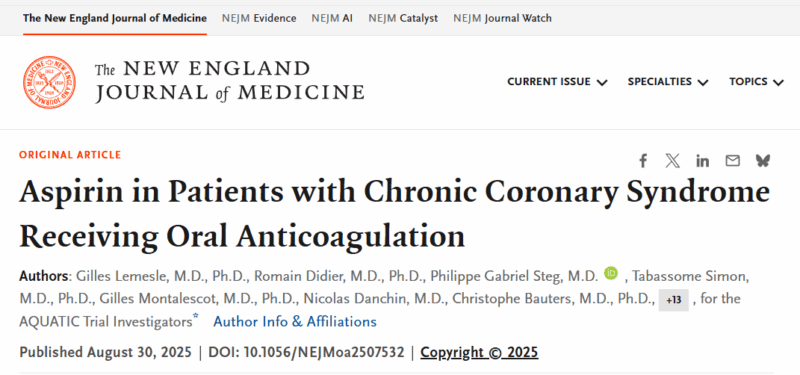
”Aspirin in Patients with Chronic Coronary Syndrome Receiving Oral Anticoagulation
Among patients with chronic coronary syndrome at high atherothrombotic risk who were receiving an oral anticoagulant, the addition of aspirin led to a higher risk of cardiovascular death, myocardial infarction, stroke, systemic embolism, coronary revascularization, or acute limb ischemia than placebo, as well as higher risks.”
Read the full article here.
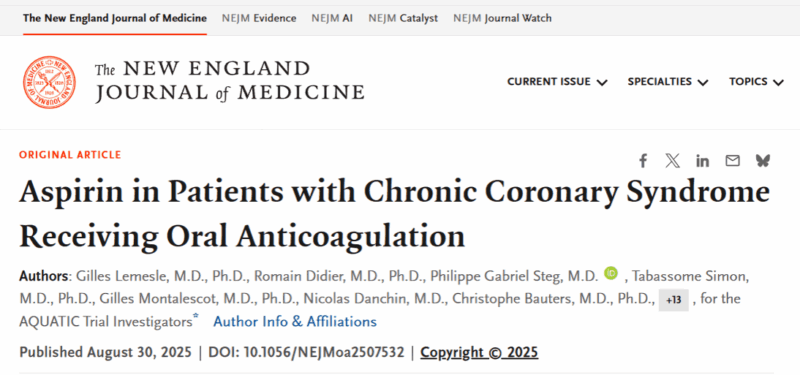
Title: Aspirin in Patients with Chronic Coronary Syndrome Receiving Oral Anticoagulation
Authors: Gilles Lemesle, Romain Didier, Philippe Gabriel Steg, Tabassome Simon, Gilles Montalescot, Nicolas Danchin, Christophe Bauters, Didier Blanchard, Claire Bouleti, Denis Angoulvant, Stéphane Andrieu, Gérald Vanzetto, Mathieu Kerneis, Véronique Decalf, Etienne Puymirat, Dominique Mottier, Abdourahmane Diallo, Eric Vicaut, Martine Gilard, Guillaume Cayla
Stay updated on the latest scientific advancements with Hemostasis Today.
-
Oct 21, 2026, 17:55Gayatri Kotwal։ New Review on Anemia, Pain, and Nutritional Deficiencies in Cancer Patients
-
Oct 21, 2026, 17:40Tetsuzan Ron: Iron Deficiency Without Anemia Clinical Impact and Management
-
Oct 21, 2026, 17:29Amir Hossien Esfandiari։ The Association Between Viral Infections and Aplastic Anemia
-
Oct 21, 2026, 17:16Melissa Hollo: A Meaningful Step Forward for Women’s Health
-
Oct 21, 2026, 17:09Chipili Ng’onga: Have You Ever Seen a Result That Just Didn’t Make Sense?
-
Oct 21, 2026, 16:57Fabrice Cognasse: Celebrating the Next Generation of Platelet Research and Transfusion Medicine
-
Oct 21, 2026, 16:47Christabel Odeta: Treating Pediatric Cancer in Children With Sickle Cell Disease
-
Oct 21, 2026, 16:36Sharlene Haywood: Bringing Multidisciplinary Learning Into Nursing Practice
-
Oct 21, 2026, 16:19Vanessa Carvalho: New Research on Platelet-Derived Extracellular Vesicles in Preeclampsia