


Why TXA and rFVIIa Are Not Equivalent in Trauma Bleeding Control – RPTH Journal
RPTH Journal shared on LinkedIn about a recent article by Bilgimol Chumappumkal Joseph et al, adding:
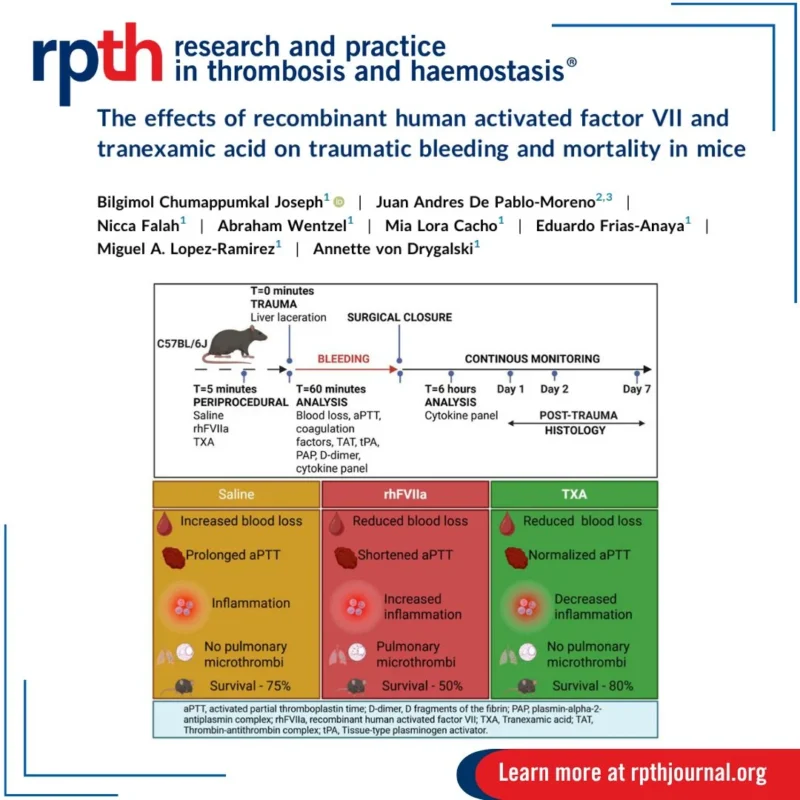
”Tranexamic acid vs recombinant FVIIa in severe trauma: same goal, very different outcomes
Both tranexamic acid (TxA) and recombinant activated factor VII (rhFVIIa) can reduce bleeding in severe trauma.
But do they carry the same risks?
A new study in RPTH Journal puts them head-to-head in a murine liver laceration model.
Key findings:
- Both rhFVIIa and TxA reduced blood loss compared with controls
- TXA normalised coagulation parameters and suppressed fibrinolysis effectively
- Survival at 7 days: ~80% with TxA vs ~50% with rhFVIIa
- rhFVIIa overcorrected coagulation, failed to suppress D-dimer, and exacerbated IL-6 formation
- Pulmonary fibrin deposition and microthrombi were observed exclusively in rhFVIIa-treated mice.”
Title: The effects of recombinant human activated factor VII and tranexamic acid on traumatic bleeding and mortality in mice
Authors: Bilgimol Chumappumkal Joseph, Juan Andres De Pablo-Moreno, Nicca Falah, Abraham Wentzel, Mia Lora Cacho, Eduardo Frias-Anaya, Miguel Lopez-Ramirez, Annette von Drygalski
Stay updated on all scientific advances with Hemostasis Today.
-
Sep 29, 2026, 03:53Nahrwan Masaoodi: Iron Deficiency Can Exist Without Anemia
-
Sep 29, 2026, 03:38Muhammad Yousaf: Iron Deficiency Beyond Diet
-
Sep 29, 2026, 03:21Parvez Ahmed Chowdhury: Synthesizing Aspirin in the Organic Chemistry Lab
-
Sep 29, 2026, 03:12Ahmed Hamandi: Building the Future of Hematopoietic Transplantation in Iraq
-
Sep 29, 2026, 03:09M V Chandrakanth: Aspirin in CRC – Old Drug, New Precision Oncology?
-
Sep 29, 2026, 03:07Caroline Pothet: Advancing Treatment Development in Sickle Cell Disease and Thalassaemia
-
Sep 29, 2026, 02:53Astha Jain: Thalassemia Care Through a Public Health Lens
-
Sep 29, 2026, 02:50Emma Groarke: Starting a New Career Path in Homeland
-
Sep 28, 2026, 19:14Aditya Sharma: An Outstanding Start to the Final Day of VSS 2026!