

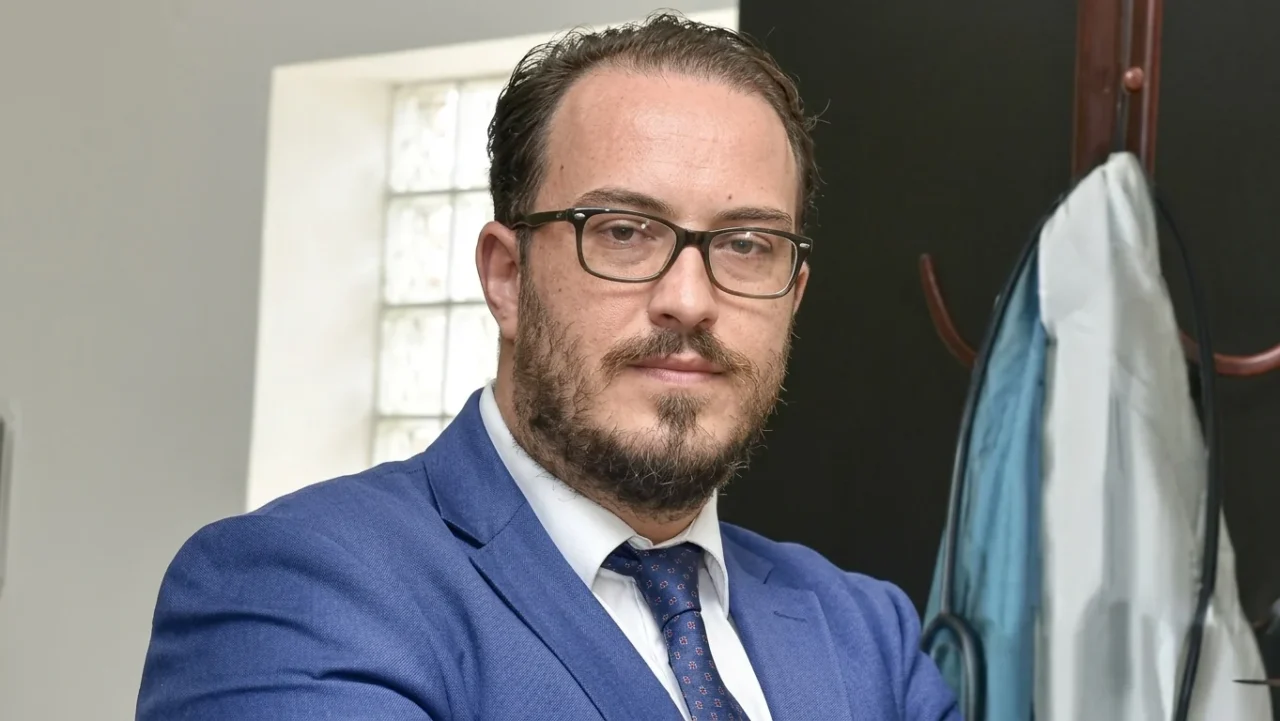
Can Özlü: Can the HALP Score Help Identify Thrombotic Risk in Myeloproliferative Neoplasms?
Can Özlü, General Manager at CAS Industrial Health Products Trading Ltd. Co., Associate Professor at Kütahya Health Sciences University, Special Education Specialist at KSBÜ Society for Computational Sciences and Innovative Technology in Healthcare, shared a post on LinkedIn about a recent article he and his colleagues co-authored, published in Medical Records, adding:
“Can routine laboratory data help us recognize thrombotic risk in myeloproliferative neoplasms more clearly?
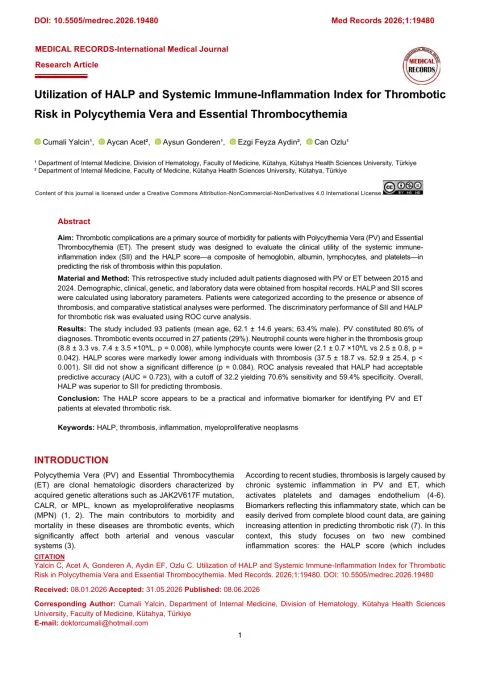
Our new study, now available in the official Medical Records archive, evaluated the HALP score and systemic immune-inflammation index (SII) in 93 patients with polycythemia vera or essential thrombocythemia.
Thrombosis occurred in 27 patients. HALP scores were lower in patients with thrombosis, and HALP showed moderate discrimination in ROC analysis (AUC 0.723). At a cutoff of 32.2, sensitivity was 70.6% and specificity 59.4%. SII, by contrast, did not reach statistical significance.
The clinically important message is one of possibility, not proof. This was a retrospective, single-center study with a limited sample, so HALP should not replace established risk models or guide treatment on its own. It is a practical, inexpensive candidate marker that deserves prospective and external validation.
I thank my co-authors Cumali Yalçın, Aycan Acet, Aysun Gönderen and Ezgi Feyza Aydın for this collaboration.
What validation would you consider essential before a composite laboratory score could influence clinical decisions?”
Title: Utilization of HALP and Systemic Immune-Inflammation Index for Thrombotic Risk in Polycythemia Vera and Essential Thrombocythemia
Authors: Cumali Yalcin, Aycan Acet, Aysun Gonderen, Ezgi Feyza Aydin, Can Ozlu
Stay updated on all scientific advances with Hemostasis Today.
-
Oct 24, 2026, 16:08Paula Alonso-Frías: Human Umbilical Cord Blood Platelet-Rich Plasma for Endometrial Regeneration
-
Oct 24, 2026, 16:00Fatma Ebeid: Ain Shams University Hosts TIF Experts for Collaborating Center Evaluation
-
Oct 24, 2026, 15:52Mazen A. Juratli: Platelet-Derived Extracellular Vesicles as Potential Predictors of Survival in Liver Cancer
-
Oct 24, 2026, 14:28Satyam Arora: Umbilical Cord Blood for Neonatal Transfusions
-
Oct 24, 2026, 13:24Amelia Carro Hevia: Ischaemic Stroke Risk in Atrial Flutter vs Atrial Fibrillation
-
Oct 24, 2026, 12:27Emeka Patrick Chukwuka: Ferritin Falls First – Iron Deficiency Before Anaemia
-
Oct 24, 2026, 11:57Priyanka Kandalgaokar: Sharing India’s Patient Advocacy Journey at MPN Horizon 2026
-
Oct 24, 2026, 11:40Uli Schotten: Coagulation Factors May Influence Cardiac Remodelling
-
Oct 24, 2026, 11:20Edward Lee Carter: Anticoagulation After Intracranial Hemorrhage – Encouraging Data, but an Unresolved Tradeoff