


Daniel Messiha: AI-Integrated PERT Workflow Improves Pulmonary Embolism Care and Speeds Up Intervention
Daniel Messiha, Attending Physician at Department of Cardiology and Vascular Medicine at The West German Heart and Vascular Center, Junior Reviewer at European Heart Journal, shared a post on LinkedIn about a recent article he and his colleagues co-authored, published in European Heart Journal, adding:
“I am excited to share our latest research, now published in the European Heart Journal – Digital Health, investigating the real-world impact of integrating artificial intelligence into a Pulmonary Embolism Response Team (PERT) workflow at Department of Cardiology and Angiology, University Hospital Essen.
What did we find?
When AI was implemented into a full clinical workflow – bringing the various PERT specialists to one digital table – it markedly improved clinical care of PE patients:
- PERT activation increasing from 9.2 percent to 84.5 percent
- Faster PE diagnosis, reducing the time from CT completion to diagnosis from 2.1 to 1.3 hours
- 50 percent shorter time from diagnosis to interventional treatment
- Potential economic benefits, with our exploratory analysis suggesting reduced healthcare costs
These findings highlight the potential of AI to improve not just diagnostics, but the entire clinical pathway if integrated into a complete clinical PE workflow and not only used as an add-on for radiology reporting.
At the West German Heart and Vascular Centre, University Hospital Essen, we are committed to advancing pulmonary embolism care by combining interventional expertise, interdisciplinary collaboration, and innovative technologies.
This study represents another step in our ongoing efforts to translate these advances into faster, more coordinated, and ultimately better care for our patients.
A big thank you to all my co-authors and colleagues across cardiology and radiology whose dedication and collaboration made this work possible.”
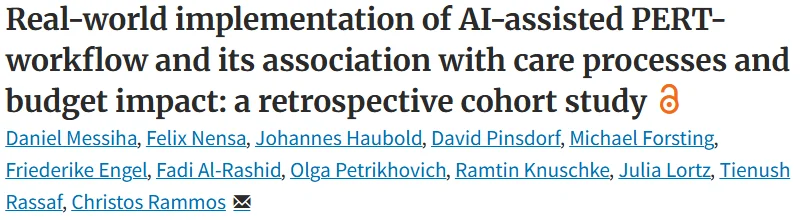
Title: Real-world implementation of AI-assisted PERT-workflow and its association with care processes and budget impact: a retrospective cohort study
Authors: Daniel Messiha, Felix Nensa, Johannes Haubold, David Pinsdorf, Michael Forsting, Friederike Engel, Fadi Al-Rashid, Olga Petrikhovich, Ramtin Knuschke, Julia Lortz, Tienush Rassaf, Christos Rammos
Stay updated on all scientific advances with Hemostasis Today.
-
Oct 29, 2026, 15:36Brigitta Nicorici: Pregnancy and Laboratory Medicine
-
Oct 29, 2026, 15:22Ugo Clinton։ Tranexamic Acid From Discovery to a Life-Saving Treatment
-
Oct 29, 2026, 15:01Owen McCarty: Targeting FXI and FXII to Reduce Device-Associated Thrombosis and Inflammation
-
Oct 29, 2026, 14:47Ingeborg Hers: Exploring New Frontiers in Platelet Biology and Thrombosis Research
-
Oct 29, 2026, 14:36Theodore Iwashyna: Could Hemoglobin Thresholds Lead to Unnecessary Blood Transfusions in ICU Patients?
-
Oct 29, 2026, 14:24Aryabhatta Sadhu: Contributing to Nepal’s First CAR-T Cell Therapy Case
-
Oct 29, 2026, 13:50Lainie Kazan’s Story and the Clinical Risks of Post-Injury Immobilization
-
Oct 29, 2026, 12:17Bridget King: IBM Employees Support Blood Donation Efforts
-
Oct 29, 2026, 12:08Georgina Pearson: A Promising Blood Donation Partnership With Missed Potential