


David Ferreira: Standardizing Thrombin Generation Testing in Portugal and Spain
David Ferreira, President of the General Assembly of APIH, shared a post on LinkedIn about a recent article he and his colleagues co-authored, published in International Journal of Laboratory Hematology, adding:
”As one of the Portuguese investigators in this multicentre Iberian study, I am delighted to see this work published today.
A laboratory result is only clinically useful if it means the same thing in Madrid, Porto, Gaia, Barcelona or Coimbra.
Today, I am pleased to share a new publication developed through a collaboration between experts from Portugal and Spain, coordinated within the Spanish Society of Thrombosis and Hemostasis.
Together with Dr.a Sara Lopes and colleagues from 12 Iberian centres, we evaluated thrombin generation testing using the fully automated ST Genesia platform.
The key finding was not simply the establishment of reference intervals for healthy adults.
More importantly, we demonstrated that when a harmonized methodology is applied, thrombin generation testing can achieve high reproducibility and comparability between laboratories.
Why does this matter?
Because one of the major barriers to wider clinical implementation of global coagulation assays has always been standardization.
Reliable and reproducible results are essential before any laboratory test can move from research settings towards broader clinical use.
This work represents another step towards that goal and highlights the value of international collaboration in laboratory medicine, hemostasis and quality assurance.
Proud to have contributed to this project alongside an outstanding Iberian team of investigators.
Grateful to all co-authors and collaborators, particularly Diego Velasco Rodríguez, Joan Carles Reverter and Pilar Llamas-Seller for their leadership of this project.”
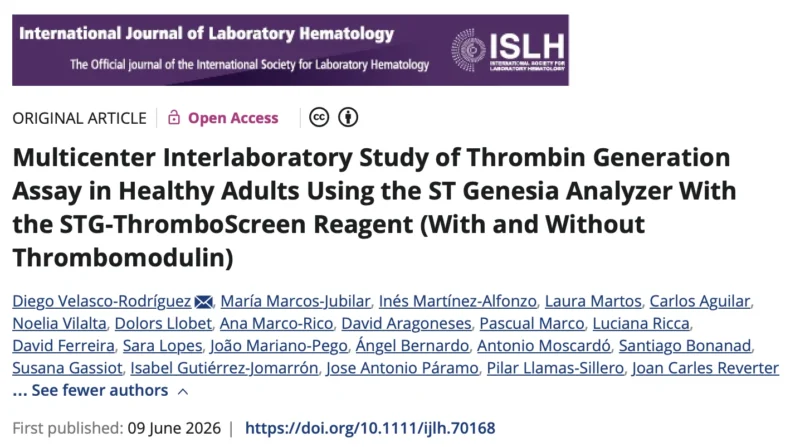
Title: Multicenter Interlaboratory Study of Thrombin Generation Assay in Healthy Adults Using the ST Genesia Analyzer With the STG-ThromboScreen Reagent (With and Without Thrombomodulin)
Authors: Diego Velasco-Rodríguez, María Marcos-Jubilar, Inés Martínez-Alfonzo, Laura Martos, Carlos Aguilar, Noelia Vilalta, Dolors Llobet, Ana Marco-Rico, David Aragoneses, Pascual Marco, Luciana Ricca, David Ferreira, Sara Lopes, João Mariano-Pego, Ángel Bernardo, Antonio Moscardó, Santiago Bonanad, Susana Gassiot, Isabel Gutiérrez-Jomarrón, Jose Antonio Páramo, Pilar Llamas-Sillero, Joan Carles Reverter
Stay updated on all scientific advances with Hemostasis Today.
-
Oct 31, 2026, 08:52Julianna Argueta: ATHN Data Summit – Advancing Collaboration in Blood Disorders
-
Oct 31, 2026, 08:11Paul Kariuki: Expanding Access to Plasma-Derived Medicines Across Africa
-
Oct 31, 2026, 07:09Akshay Sharma: Gene therapy for sickle cell disease
-
Oct 31, 2026, 07:00Owen McCarty: The Hidden Immune Mechanism Behind Chemotherapy-Associated Platelet Loss
-
Oct 31, 2026, 06:51Thijn Brummelkamp: SMIM1 Reveals a Novel Pathway for Cellular Iron Uptake Through Haemoglobin
-
Oct 31, 2026, 01:26Bringing the Voices of People With Bleeding Disorders to WHO Regional Discussions – World Federation of Hemophilia
-
Oct 31, 2026, 01:18A Clear Overview of Haemophilia A Treatments at SISET Congress – CRH French Reference Center for Hemophilia Lyon
-
Oct 31, 2026, 01:11Alexander Misono: Venous Ultrasound and Early Intervention in Deep Vein Thrombosis
-
Oct 31, 2026, 00:54How Has Human Evolution Shaped the Delicate Balance between Bleeding and Clotting? – Seminars in Thrombosis and Hemostasis