


Edward Lee Carter: Beyond CHA₂DS₂-VASc – Are We Measuring the Patient—or Just Scoring the Risk Factors?
Edward Lee Carter, Clinical Pharmacist Practitioner at U.S. Department of Veterans Affairs, shared a post on LinkedIn about a recent article by et at al., published in American Journal of Cardiovascular Drugs, adding:
“Beyond CHA₂DS₂-VASc: Are We Measuring the Patient—or Just Scoring the Risk Factors?
Two patients with atrial fibrillation can have identical CHA₂DS₂-VASc scores yet different underlying atrial pathology and thromboembolic risk.
A 2026 review in the American Journal of Cardiovascular Drugs explores how multimodal risk assessment might refine anticoagulation decisions.
Emerging approaches incorporate:
- AF burden and episode duration
- Left atrial volume index
- Left atrial reservoir strain
- Left atrial appendage morphology and function
- NT-proBNP and high-sensitivity troponin
- The biological rationale is compelling. But randomized evidence underscores the complexity of treatment decisions.
ARTESIA: Apixaban reduced stroke/systemic embolism in subclinical AF but increased major bleeding.
NOAH-AFNET 6: Edoxaban did not significantly reduce the primary efficacy composite in patients with atrial high-rate episodes and increased the composite of death or major bleeding.
ALONE-AF: In selected post-ablation patients, anticoagulation discontinuation reduced the composite of stroke, systemic embolism, or major bleeding, primarily through fewer bleeding events.
SINGLE-AF: In intermediate-risk clinical AF, DOAC therapy favored the primary composite outcome over no anticoagulation (0.5% vs 1.5% at 24 months).
ABC-AF: Among 3,933 randomized patients, biomarker-guided management did not significantly improve stroke or death compared with guideline-based care (HR 1.19; 95% CI 0.96–1.48).
Enrollment stopped prematurely because of safety concerns, leaving the trial underpowered.
Better risk prediction does not necessarily translate into better clinical outcomes.
Precision anticoagulation should not become synonymous with deprescribing. Improved assessment may identify patients who benefit from initiating treatment as well as those with limited net benefit.
Emerging imaging and biomarker strategies require prospective validation before replacing established treatment pathways.
From an anticoagulation stewardship perspective, our responsibility is to:
- Assess stroke risk comprehensively.
- Address modifiable bleeding risks.
- Individualize treatment through shared decision-making.
- Reassess as patients and clinical circumstances change.
CHA₂DS₂-VASc remains an important starting point. It should not be the end of our clinical assessment.”
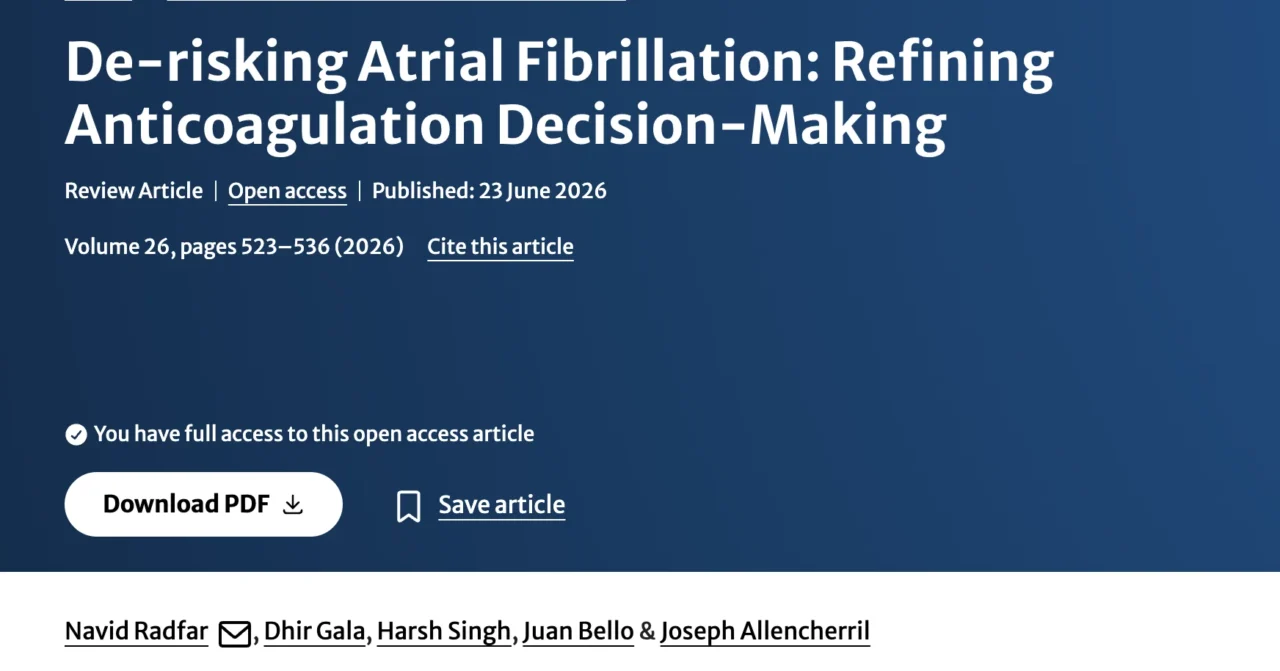
Title: De-risking Atrial Fibrillation: Refining Anticoagulation Decision-Making
Authors: Navid Radfar, Dhir Gala, Harsh Singh, Juan Bello, Joseph Allencherril
More posts featuring Edward Lee Carter on Hemostasis Today.
-
Nov 25, 2026, 12:26Anne Trezise: The Blood Sample Pathway in Laboratory Diagnostics
-
Nov 25, 2026, 12:18Research Can’t Move Forward Without Funding – American Society of Hematology
-
Nov 25, 2026, 12:14Nicolaus Kröger: Mapping Bone Marrow Recovery After Allogeneic Transplantation for Myelofibrosis
-
Nov 25, 2026, 12:09Melissa McGue: Strengthening Advocacy for Hematology
-
Nov 25, 2026, 11:53Michael Praktiknjo: Early Portal Decompression Associated with Reduced Cirrhosis Decompensation
-
Nov 25, 2026, 11:29Streptococcus oralis Links Platelet Adhesion to Antibody-Dependent Activation – Platelets Journal
-
Nov 25, 2026, 11:08Limb Fat Distribution Linked to Increased Venous Thromboembolism Risk – JTH
-
Nov 25, 2026, 08:57Ndembe Djeni Erwan: Sickle Cell Disease Awareness and Stigma Among Medical Students in Cameroon
-
Nov 25, 2026, 08:27Rana Zareef: Early Right Ventricular Remodeling in Pediatric Sickle Cell Disease