


Edward Lee Carter: AI vs FDA Anticoagulant Education – The Most Important Finding Wasn’t Who Scored Highest
Edward Lee Carter, Clinical Pharmacist Practitioner at U.S. Department of Veterans Affairs, shared a post on LinkedIn about a recent article by Mohammed Amer Khan et at al., published in International Journal of Clinical Pharmacy, adding:
“AI vs FDA Anticoagulant Education: The Most Important Finding Wasn’t Who Scored Highest.
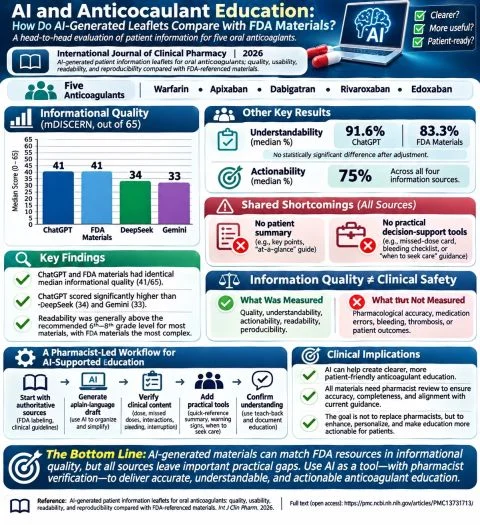
A new study in the International Journal of Clinical Pharmacy compared patient information leaflets generated by ChatGPT, Gemini, and DeepSeek with FDA-referenced materials for five oral anticoagulants:
Warfarin, apixaban, dabigatran, rivaroxaban, and edoxaban.
Three clinical pharmacists independently evaluated informational quality, understandability, and actionability.
The results were interesting.
Median informational quality (modified DISCERN, maximum 65):
- ChatGPT: 41
- FDA materials: 41
- DeepSeek: 34
- Gemini: 33
ChatGPT scored significantly higher than DeepSeek and Gemini, while its score did not differ significantly from FDA-referenced materials.
But that wasn’t the most important finding.
Every source—including FDA materials—had limitations in practical actionability.
None provided a patient summary or a practical decision-support tool, such as a missed-dose card or bleeding recognition guide.
And all sources generally exceeded recommended patient education reading levels.
For anticoagulation pharmacists, that raises a more important question:
Are we giving patients information, or are we preparing them to make safe decisions?
A patient may understand why they take apixaban but still be uncertain about a missed dose, a new medication, or an upcoming procedure.
Those are not minor educational gaps.
Importantly, this study evaluated information quality and usability—not pharmacological accuracy, clinical safety, or patient outcomes. It does not establish that AI-generated education is clinically equivalent to FDA materials.
My takeaway:
AI may become a valuable tool for developing clearer, more personalized anticoagulation education. But the opportunity isn’t simply to reproduce existing medication guides.
It’s to make education more understandable, actionable, and responsive to the decisions patients actually face. That requires pharmacist verification, patient-specific guidance, and continued clinical oversight.
The future of anticoagulation education shouldn’t be AI replacing pharmacists. It should be AI helping pharmacists deliver better education.”
Title: AI-generated patient information leaflets for oral anticoagulants: quality, usability, readability, and reproducibility compared with FDA-referenced materials
Authors: Mohammed Amer Khan, Mohammed Maazuddin, Ammar Al Abdullah, Ihtisham Sultan, Hakam Abdallah Alzaeem, Mohammed Qintar, Krishana Kumar Sharma, Biplab Pal
More posts featuring Edward Lee Carter on Hemostasis Today.
-
Nov 23, 2026, 16:04Gamunu Wijetunge: Stop Leaving TRICARE Transfusion Reimbursement on the Table
-
Nov 23, 2026, 15:58Mohsin Raza: Why is Anemia so Common in Patients with Chronic Kidney Disease?
-
Nov 23, 2026, 15:39Thirunavukkarasu Angappan: From Donated Plasma to Life – Saving Medicines
-
Nov 23, 2026, 15:06Giuseppe Biondi Zoccai: Hemoglobin-to-Creatinine Ratio Linked to Early Markers of Anthracycline-Induced Cardiac Injury
-
Nov 23, 2026, 14:54Mina Mokaram: New Research Examines MDS Progression and Transplant Outcomes in Pediatric CAMT
-
Nov 23, 2026, 14:41Danyel Chermon: Study Reveals Independent Effects of BMI and Genetic Risk on B12 and Folate Status
-
Nov 23, 2026, 14:25Ayomide Juliana: Promoting Informed Reproductive Decisions Through Sickle Cell Genotype Awareness
-
Nov 23, 2026, 14:15Disseminated Intravascular Coagulation: From Diagnostic Scores to Molecular Phenotyping
-
Nov 23, 2026, 14:13Mariam AlEissa: AI and Pharmacogenomics Drive WarfaRisk’s Personalized Warfarin Dosing Initiative