


Giulia Alagna: Managing Coronary Aneurysmal and Ectatic Disease
Giulia Alagna, Interventional Cardiologist at ASL VCO, shared a post on LinkedIn about a recent article she and her colleagues co-authored, published in The American Journal of Cardiology, adding:
“New publication in The American Journal of Cardiology.
This work focuses on coronary aneurysmal and ectatic disease (CAA/CAE), an increasingly recognized condition in contemporary catheterization laboratory practice that still represents a significant diagnostic and therapeutic challenge.
A sincere thank you to my co-authors Francesca Campanella, Lucio Giuseppe Granata, Pierre F. Sabouret, Alessandro Lupi, Giuseppe Andò for their valuable contributions and for sharing this project with me.
What did we focus on?
We aimed to provide a practical framework for the management of these patients, from pathophysiology to treatment, with particular emphasis on the aspects most relevant to everyday Cath Lab practice.
A central role is played by intravascular imaging (IVUS and OCT). Angiography alone may not adequately characterize vessel dimensions, aneurysm morphology, or intraluminal thrombus.
Intravascular imaging can also help distinguish true aneurysms from pseudoaneurysms and guide procedural planning when PCI is required.
What about antithrombotic therapy?
This remains one of the most controversial aspects of management.
Our systematic appraisal of the available literature shows that current evidence does not support routine oral anticoagulation in unselected patients with coronary aneurysmal disease.
Antiplatelet-based therapy therefore remains the cornerstone of treatment, while oral anticoagulation may be considered, off-label, in selected high-risk scenarios, such as documented intraluminal thrombus, recurrent ischemic events despite adequate antiplatelet therapy, or very large/diffuse aneurysmal disease.
Revascularization also cannot follow a ‘one-size-fits-all’ strategy.
PCI should primarily target flow-limiting or culprit lesions, preferably with intravascular imaging guidance, while giant aneurysms and particularly complex anatomies may require surgical evaluation and multidisciplinary Heart Team discussion.
The key message of our work is therefore straightforward: There is no single treatment strategy that fits every patient.
Clinical presentation, coronary anatomy, thrombus burden, ischemic risk, and bleeding risk should all be integrated into an individualized, phenotype-driven approach.”
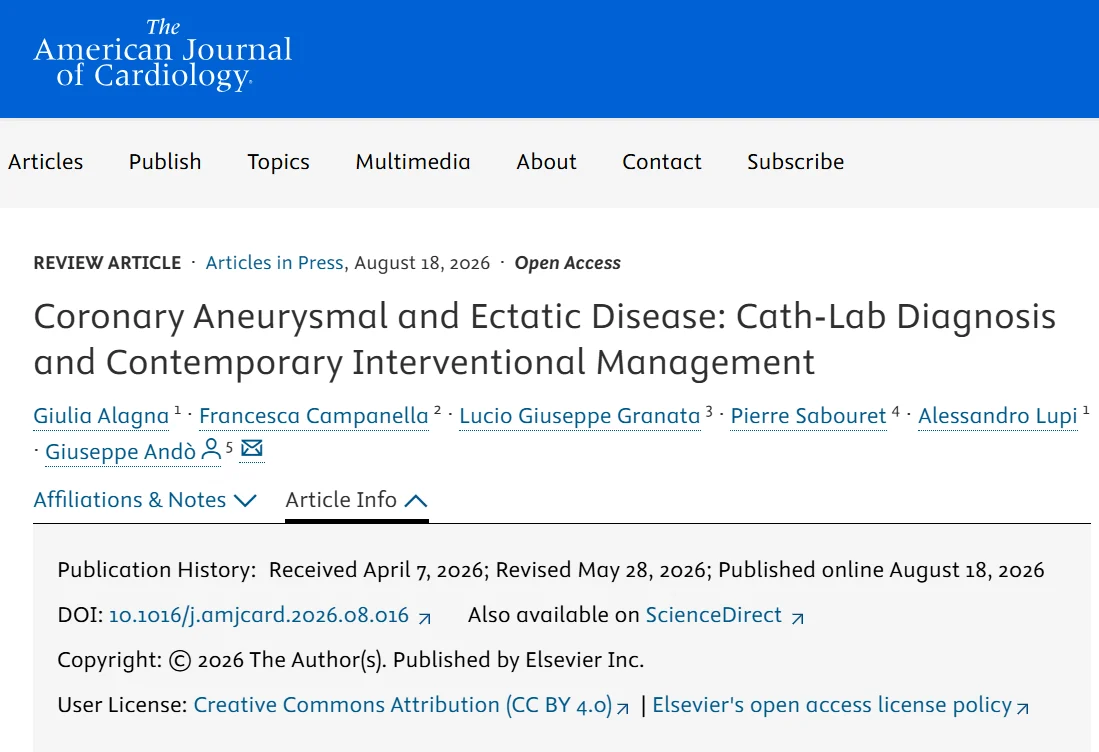
Title: Coronary Aneurysmal and Ectatic Disease: Cath-Lab Diagnosis and Contemporary Interventional Management
Authors: Giulia Alagna, Francesca Campanella, Lucio Giuseppe Granata, Pierre Sabouret, Alessandro Lupi, Giuseppe Andò
Stay updated with Hemostasis Today.
-
Oct 1, 2026, 07:52Marc Carrier: TRIM-Line Trial Evaluates VTE Prevention in Cancer
-
Oct 1, 2026, 07:29Ariela Marshall: New Guidelines Provide Updated Recommendations for Iron Deficiency Diagnosis
-
Sep 30, 2026, 22:28Recent Mechanical Risk Factors and Young-Onset Cryptogenic Ischemic Stroke – American Heart Association International
-
Sep 30, 2026, 22:22Expert Consensus on Inferior Vena Cava Thrombosis – Thrombosis and Haemostasis Journal
-
Sep 30, 2026, 22:21Markus Abeln: How Platelets and Complement Shape Placental Blood Flow
-
Sep 30, 2026, 22:19Fatma Al Arbawi: Studying Blood Clot Mechanics to Understand Aspirin Resistance and Thrombosis
-
Sep 30, 2026, 22:17Sudhir Kumar: Stroke is a Medical Emergency – and Every Minute Matters
-
Sep 30, 2026, 22:15Luisa Medeiros Visentini: Our Research on Cognitive Impairment After CVT Cited in the International Journal of Stroke
-
Sep 30, 2026, 21:50Jagat Narula: Connecting Cardiovascular Health and Sickle Cell Disease on World Heart Day 2026