

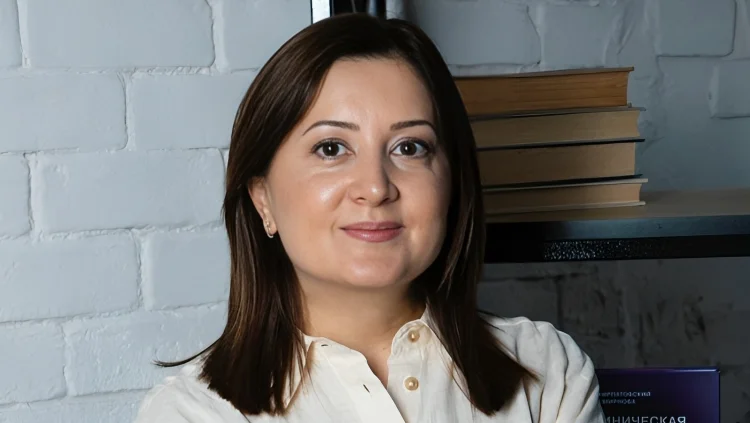
Heghine Khachatryan on Anticoagulation After AFib Ablation: New Evidence from NEJM
Heghine Khachatryan, Editor-in-Chief of Hemostasis Today, Head of Hemophilia and Thrombosis Center at Yeolyan Hematology and Oncology Center, reposted from NEJM Group on LinkedIn:
”Anticoagulation after Successful Atrial Fibrillation Ablation: New Evidence from NEJM
A recently published NEJM OCEAN trial addresses a long-standing clinical dilemma: should anticoagulation be continued after successful catheter ablation for non-valvular atrial fibrillation?
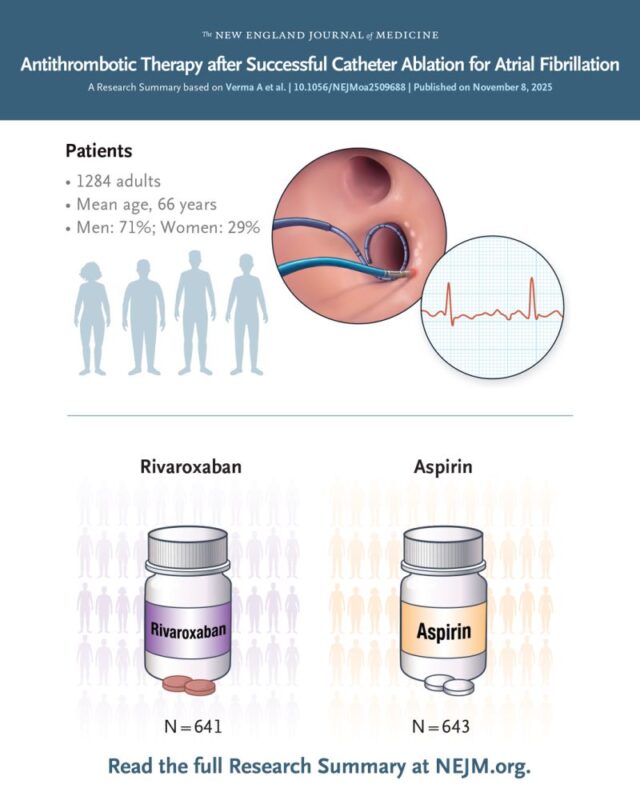
In this randomized study, patients ≥1 year post-successful AF ablation with a CHA₂DS₂-VASc score indicating stroke risk were assigned to either rivaroxaban (15 mg daily) or aspirin (70–120 mg daily).
Key findings at 3 years:
• Rivaroxaban did not significantly reduce the composite endpoint of stroke, systemic embolism, or covert embolic stroke compared with aspirin
• No clear net clinical benefit was demonstrated despite guideline-driven assumptions favoring indefinite anticoagulation
Clinical implication:
These results challenge the routine continuation of anticoagulation after successful AF ablation and underscore the need for individualized, risk-based decision-making, rather than a one-size-fits-all approach.
As hematologists and cardiologists, this trial reminds us that thromboembolic risk assessment must remain dynamic, integrating procedural success, patient-specific risk factors, and bleeding risk.
Full trial results: NEJM – OCEAN Trial”
Quoting NEJM Group‘s post:
”In patients with atrial fibrillation after successful ablation, could rivaroxaban therapy lead to a significantly lower incidence of a composite of stroke, systemic embolism, or new covert embolic stroke than aspirin therapy?
For patients who undergo catheter ablation for atrial fibrillation, guidelines recommend that anticoagulation be continued indefinitely after the procedure on the basis of a patient’s stroke risk profile, but this guidance is based on small, nonrandomized studies.
The risks and benefits of ongoing anticoagulation after successful ablation remain unclear.
In the OCEAN trial, patients who had undergone successful catheter ablation for nonvalvular atrial fibrillation at least 1 year earlier and had a CHA₂DS₂-VASc score (range, 0 to 9, with higher scores indicating a higher risk of stroke) of 1 or more, or 2 or more for women or for patients in whom vascular disease was a risk factor, were randomly assigned to receive either rivaroxaban (at a dose of 15 mg daily) or aspirin (at a dose of 70 to 120 mg daily).
The primary outcome was a composite of stroke, systemic embolism, or new covert embolic stroke (defined by ≥1 new infarct measuring ≥15 mm on MRI) at 3 years.
The primary safety outcome was a composite of fatal or major bleeding.
Among patients who had undergone successful catheter ablation for atrial fibrillation and were at risk for stroke, subsequent daily use of rivaroxaban did not result in a significantly lower incidence of stroke, systemic embolism, or new covert embolic stroke (the composite primary outcome) than aspirin.
Read the full OCEAN trial results and Research Summary.”
Read the full article here.
Article: Antithrombotic Therapy after Successful Catheter Ablation for Atrial Fibrillation
Authors: Atul Verma, David H. Birnie, Chenyang Jiang, Hein Heidbüchel, Gerhard Hindricks, Paulus Kirchhof, Jeff S. Healey et al., for the OCEAN Investigators
Stay updated on all scientific advances with Hemostasis Today.
-
Sep 30, 2026, 01:52Javed Anees: DADA2 – When a Young Stroke Is More Than a Stroke
-
Sep 30, 2026, 01:51How a Venous Thrombus Becomes Revascularized – ISTH
-
Sep 29, 2026, 22:45Victor Agunyego: Paracetamol – The Most Common Drug We Underestimate
-
Sep 29, 2026, 22:42Nova Sinclair: Advancing the Future of Hematology – Meet Our 2027 Organizing Committee
-
Sep 29, 2026, 22:41Lorenz Räber: Intracoronary Imaging in PCI – Why, When, How, and Which Modality?
-
Sep 29, 2026, 22:31Selma Turkovic: Pleased to Deliver the Opening Presentation at Kingston Hospital
-
Sep 29, 2026, 22:31Miguel Teran: Ultrasound and Simulation in Arterial Blood Sampling
-
Sep 29, 2026, 22:28Mohammad Refaei: Navigating Your Career in Hematology From Training to Practice
-
Sep 29, 2026, 22:27Matteo Foschi: 10 Clinical Pearls for Antithrombotic Therapy in Secondary Stroke Prevention