


Heghine Khachatryan: Intracranial Hemorrhage in Leukemia – Beyond Thrombocytopenia
Heghine Khachatryan, Editor-in-Chief of Hemostasis Today, Head of Hemophilia and Thrombosis Center at Yeolyan Hematology and Oncology Center, shared RPTH Journal’s post on LinkedIn:
“Intracranial hemorrhage in leukemia – beyond thrombocytopenia
Emerging pathology data highlight a critical mechanism: leukemic cell infiltration of cerebral vessels leading to direct vascular injury.
Key mediators such as cathepsin G and VEGF appear to drive endothelial damage, meningeal invasion, and ultimately bleeding.
Takeaway:
Intracranial hemorrhage in leukemia is not purely a coagulation defect – it is also a vascular disease driven by leukemic biology.”
RPTH Journal shared a post on LinkedIn about a recent article by Toshihiro Gi et al., published in RPTH Journal, adding:
“Intracranial hemorrhage in leukemia: what do autopsy findings reveal about the underlying mechanisms?
Intracranial haemorrhage (ICH) is one of the most devastating complications of leukemia, yet the mechanisms driving cerebral vascular injury and CNS involvement remain poorly understood.
A new autopsy-based study in RPTH Journal sheds light on this critical question.
Key findings from 37 leukemia cases and 20 matched controls:
- ICH was identified in 68% of leukemia cases, with fatal brain herniation in 40%
- CNS involvement was observed in 54% of cases, often without a prior clinical diagnosis
- Leukemic cell infiltration of meninges and vascular walls was frequently associated with structural changes in smooth muscle cells and adventitial collagen
- VEGF was highly expressed in leukemia cells and linked to meningeal invasion
- Cathepsin G, predominantly expressed in myeloid leukemia, was associated with cerebral vascular damage
The identification of VEGF and cathepsin G as potential markers of CNS invasion and vascular injury opens promising avenues for earlier detection and targeted intervention in leukemia-associated ICH.”
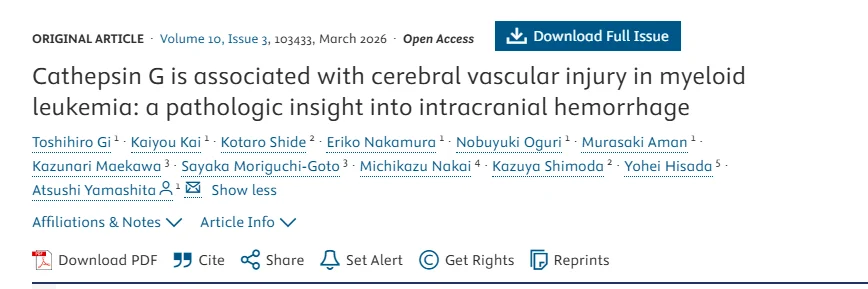
Title: Cathepsin G is associated with cerebral vascular injury in myeloid leukemia: a pathologic insight into intracranial hemorrhage
Authors: Toshihiro Gi, Kaiyou Kai, Kotaro Shide, Eriko Nakamura, Nobuyuki Oguri, Murasaki Aman, Kazunari Maekawa, Sayaka Moriguchi-Goto, Michikazu Nakai, Kazuya Shimoda, Yohei Hisada, Atsushi Yamashita
Other posts featuring Heghine Khachatryan and RPTH Journal on Hemostasis Today.

-
Jul 28, 2026, 09:06Payal Desai: Highlights from the NASCC 2026 Sickle Cell Workshop
-
Jul 28, 2026, 08:43Flora Peyvandi։ Acquired Hemophilia A – An Illustrated Review Based on French Guidelines
-
Jul 28, 2026, 08:28Ujjal Didar Singh Sekhon: Exploring SynthoPlate Under P2Y12 Blockade
-
Jul 28, 2026, 08:27Sujeet Katiyar: You Share Patient Data with Your TPA. Where Is the Contract?
-
Jul 28, 2026, 07:50Mihail Celeski: Personalizing Anticoagulant Therapy for Frail Patients With Atrial Fibrillation
-
Jul 28, 2026, 07:36Ifeanyichukwu Ifechidere: What If the Test We’ve Trusted for Decades Has Been Telling Us Half the Story?
-
Jul 28, 2026, 07:10Wolfgang Miesbach: How Safe Is AAV Gene Therapy?
-
Jul 28, 2026, 06:59Fiona Robinson: New MASAC Recommendations for Iron Deficiency – Live Webinar
-
Jul 28, 2026, 06:49Vera Ghali: What Else Do Platelets Do Besides Clotting?