

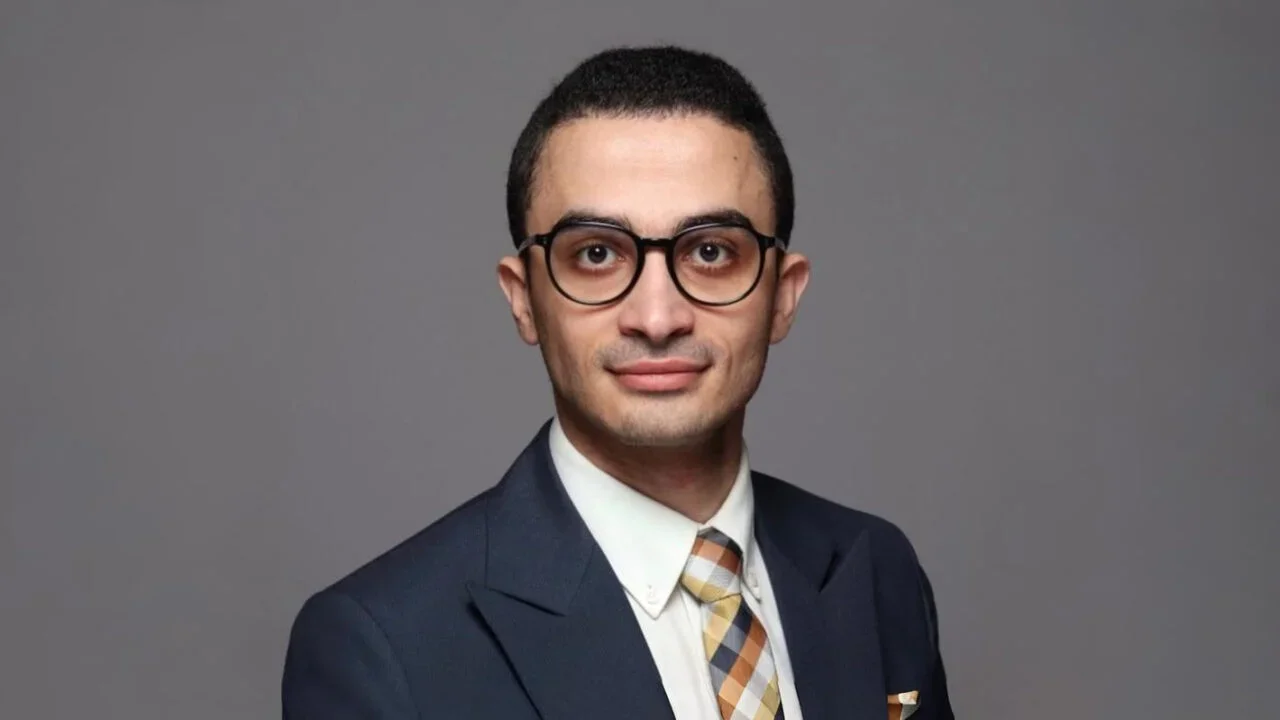
Hossam El Benawi: Who Can Safely Stop Anticoagulation after LVT Resolution?
Hossam El Benawi, Senior Clinical Research Fellow of Cardiovascular Medicine at Mayo Clinic, shared on LinkedIn about a recent article he and his colleagues co-authored, published in JACC: Advances, adding:
”Who Might Need Long-Term Anticoagulation After Left Ventricular Thrombus (LVT) Resolution
Much on the optimal anticoagulant for LVT resolution.
However, less is known about management after LVT resolution:
Clinical factors associated with LVT recurrence?
Echo findings predict recurrence?
Should predictors be assessed at the time of LVT diagnosis or resolution?
Most importantly?!!!!: Who can safely STOP AC after LVT resolution?
Our Mayo Clinic multi-site study (Part 2) showed that:
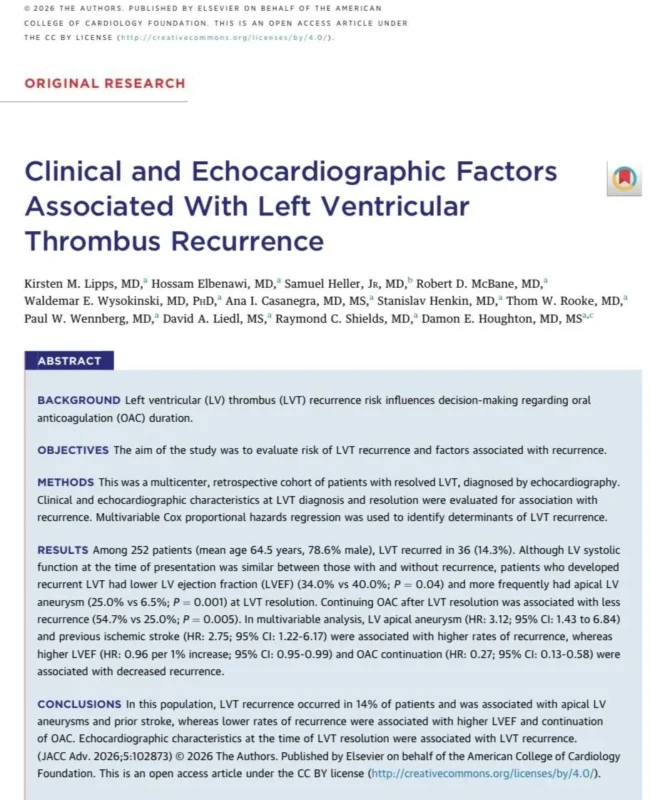
Among 252 patients with LVT resolution, recurrence occurred in (14.3%).
Patients with recurrent LVT were likely to have:
- Ischemic cardiomyopathy (83.3% vs 61.1%, p=0.01)
- Lower LVEF at time of LVT resolution (34.0% ± 12.4 vs 40.0% ± 15.3, p=0.04)
- LV apical aneurysm (25.0% vs 6.5%, p=0.005)
Echo at time of LVT resolution more predictive of recurrence than at diagnosis.
Adjusted Cox Analysis
Factors associated with higher risk of recurrence:
- LV apical aneurysm — HR 3.12 (1.43–6.84)
- Prior ischemic stroke — HR 2.75 (1.22–6.17)
Factors associated with lower risk of recurrence:
- Higher LVEF — HR 0.96 per 1% increase (0.95–0.99)
- Continuation of AC — HR 0.27 (0.13–0.58)
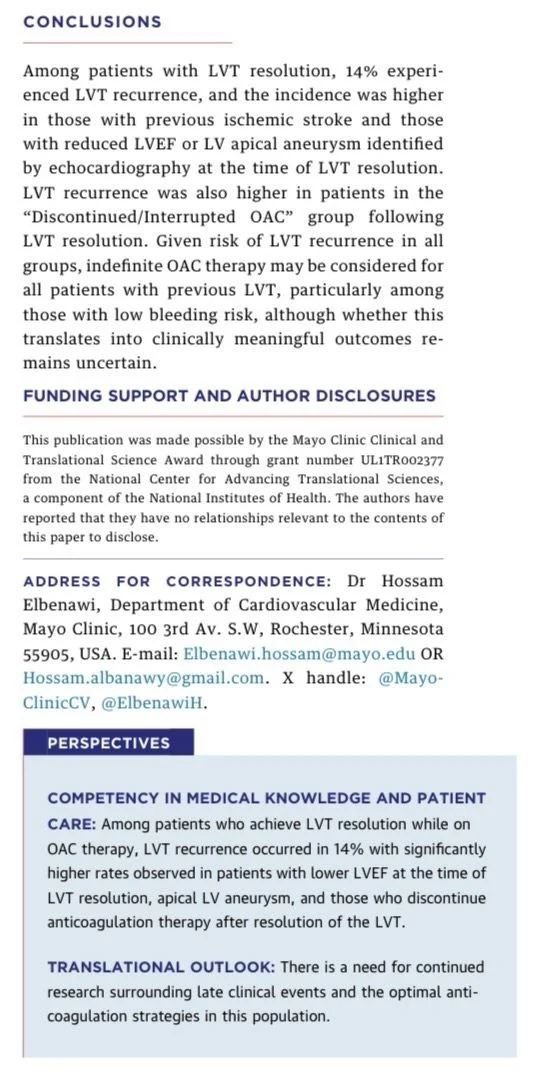
Patients with LV apical aneurysm, prior ischemic stroke, or persistently reduced LVEF benefit from prolonged AC.
The remaining question is:
Who can safely STOP AC after LVT resolution?
Stay tuned for Part 3 of Mayo Clinic multi-site LVT studies, exploring novel bed side score that help to define who can safely STOP AC post resolution?”
Title: Clinical and Echocardiographic Factors Associated With Left Ventricular Thrombus Recurrence
Authors: Kirsten M. Lipps, Hossam Elbenawi, Samuel Heller Jr., Robert D. McBane, Waldemar E. Wysokinski, Ana I. Casanegra, Stanislav Henkin, Thom W. Rooke, Paul W. Wennberg, David A. Liedl, Raymond C. Shields, Damon E. Houghton
Stay updated on all scientific advances with Hemostasis Today.
-
Sep 23, 2026, 16:04Monia Ezzalfani: Advancing Patient-Centered Care in Hemophilia A and B
-
Sep 23, 2026, 15:49Bilge Başak: How Activated PRP Modulates Osteoarthritic Chondrocyte Function
-
Sep 23, 2026, 14:50Mbonjo Bitsie Dora: Strengthening Sickle Cell Care Through Education, Awareness and Innovation
-
Sep 23, 2026, 13:58The New B12 Diagnostic Algorithm: From Serum Cobalamin to Functional Deficiency
-
Sep 23, 2026, 13:56Noha Soror: Preparing for Hematology and Medical Oncology Board Certification
-
Sep 23, 2026, 13:46Ugochi Ogu: What Can Platelet Proteomics Reveal about Pain and Neurocognitive Vulnerability in Sickle Cell Disease?
-
Sep 23, 2026, 13:42Melissa Hollo: Connecting Obesity and Anemia for Earlier Maternal Risk Intervention
-
Sep 23, 2026, 13:16Beverley Hunt: Advances in Haemostatic Management of Postpartum Haemorrhage
-
Sep 23, 2026, 13:13Ioanna Mela: Recruiting a Research Associate on DNA nanotechnology